A Poor Girl Finds a Millionaire Dumped Like Trash — And the Choice She Makes Changes Both Their Lives Forever
The first thing that crossed Ivy Carter’s mind was that someone had made a mistake.
People threw away broken furniture, rusted appliances, spoiled food. They didn’t throw away human beings. At least, not on purpose.
Yet there he was.
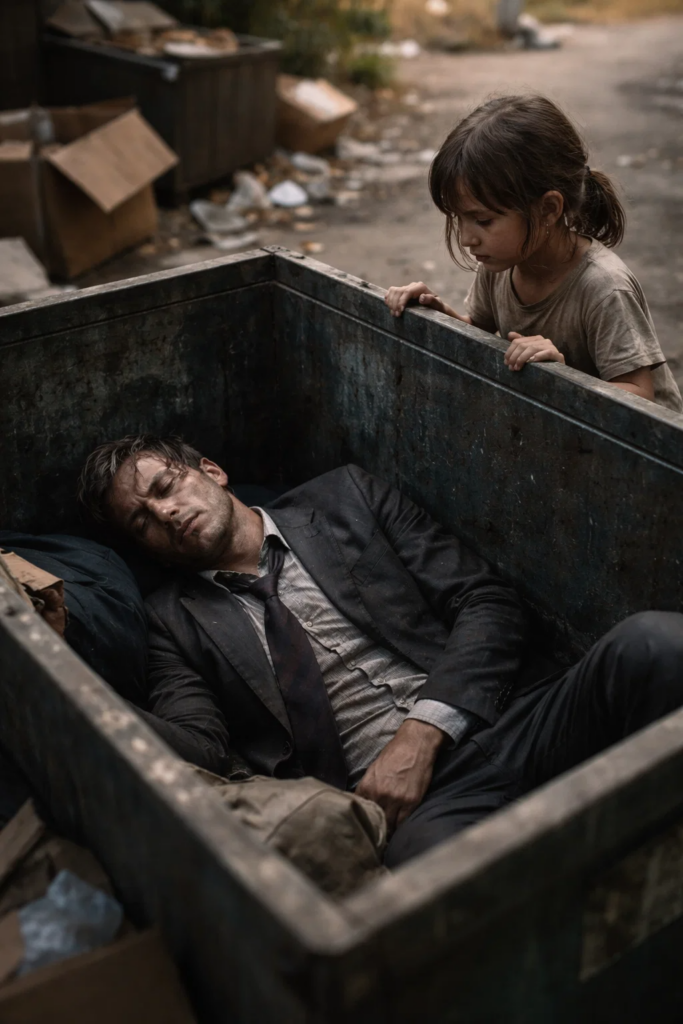
Half-buried between soaked cardboard boxes and twisted metal, a grown man lay motionless inside a rusted dumpster at the edge of West Ridge, the forgotten stretch of land where the city pretended nothing lived. The afternoon sun pressed down hard, making the air shimmer and the stench of rot cling to Ivy’s throat like glue.
“Why would anyone leave you here?” she whispered, the words slipping out before she could stop them.
Ivy was nine years old, thin as a reed, barefoot despite the sharp gravel and shards of glass scattered everywhere. Her soles were tough from years of walking places shoes never survived. She moved carefully, eyes trained to spot anything worth a few cents—aluminum cans, copper wire, bottles with intact labels. Every small find mattered. Her grandmother, Evelyn, had been coughing again last night, the kind of deep, rattling cough that stole sleep and made mornings come with fear.
Medicine cost money. Sympathy didn’t.
The man didn’t belong here. Even through the dirt and grime, Ivy could tell. His suit, torn and stained, had once been expensive. The fabric was too fine, the cut too clean. His shoes were ruined, but they weren’t cheap shoes. A dark smear of dried blood streaked his temple, matting his hair.
Ivy froze. If he was gone, there would be trouble. Police questions. People assuming things. If he was alive… then whoever put him here might come back.
She should run.
But then she remembered Evelyn’s voice, low and steady, repeating the same sentence whenever Ivy asked why they helped strangers when they barely survived themselves.
“If we stop caring,” her grandmother always said, “we won’t survive anyway. We’ll just exist.”
Ivy swallowed hard and knelt beside the dumpster. Her fingers trembled as she reached for the man’s neck, searching for a pulse the way Evelyn had taught her with a gentle patience that felt endless.
Nothing.
Her chest tightened.
Then the man groaned.

It was a raw, broken sound, like pain dragged from somewhere deep inside him. His chest shuddered, and under her fingers, life flickered—weak but real.
Relief flooded Ivy so fast it made her dizzy.
That was when she noticed the watch.
Gold, heavy, absurdly clean against the filth around it. It gleamed like it didn’t belong to this world at all, like it was mocking the landfill and everyone who survived inside it. Ivy had seen watches like that in store windows downtown, behind glass she could never touch.
If anyone else saw him, they wouldn’t help. They’d take the watch first. Maybe more.
“Hey,” Ivy whispered urgently, nudging his shoulder. “You can’t stay here. Please wake up.”
She poured the last of her water over his cracked lips. It was meant for later, for the walk home, but she didn’t hesitate.
His eyelids fluttered.
“What… where am I?” he rasped.
He tried to sit up and failed, pain forcing him back into the trash. Ivy grabbed his arm instinctively, surprised by how heavy he was.
“You’re in the landfill,” she said quickly. “And you need to get out. Now.”
Confusion clouded his eyes. “I don’t remember anything. I don’t know who I am.”
Night was coming. Ivy could already feel it in the way shadows stretched longer, in the way the air cooled too fast.
“That’s okay,” she said, with a confidence she didn’t feel. “You just need to walk.”
She hooked her small shoulder under his arm and pulled.
Somehow, he helped. Survival made him find strength he didn’t know he had. Step by step, they moved through paths Ivy knew by heart, avoiding the open areas where danger waited.
“What’s your name?” he asked softly.
“Ivy.”
“Thank you, Ivy.”
She didn’t answer. She was already thinking about how she would explain this to her grandmother.
Their house sat at the end of a dirt alley, patched together from wood and metal, light leaking through the cracks like something fragile but stubborn. Ivy pushed the door open.
“Grandma,” she called. “I need help.”
Evelyn looked up from her chair and froze.
“What on earth—”
The man collapsed onto the sofa, breath ragged. Evelyn didn’t ask another question. She moved on instinct, grabbing a clean cloth, lighting the stove, examining the wound with practiced hands that had cared for Ivy through fevers and hunger alike.
“He was in the landfill,” Ivy said quickly. “He doesn’t remember anything.”
Evelyn sighed, long and tired, but she cleaned the wound anyway.
“We don’t have much,” she said, not unkindly. “But you can stay tonight.”
That night, the man lay awake, staring at the ceiling, his mind empty and loud at the same time. His hand brushed the watch. A button pressed beneath his thumb.
A woman’s recorded voice filled the silence.
“For Andrew, always. — Claire.”
The name Andrew echoed inside him.
Morning came with pain and clarity in equal measure. He couldn’t leave. He was too weak. Evelyn allowed him to stay in exchange for work. Ivy taught him how to draw water, how to tend the tiny garden behind the house.
Days turned into weeks.
Andrew learned what hunger really felt like. What kindness without conditions looked like. He learned how fiercely a small girl could protect the only family she had.
Memories returned slowly. A company. A partner. A wife. Smiling faces that felt sharp around the edges.
One afternoon, Ivy ran in holding a newspaper.
“That’s you,” she said quietly.
Andrew stared at the photo. His wife. His business partner. The headline spoke of his disappearance with carefully chosen words.
“They did this,” he said, finally understanding. “They wanted me gone.”
That same night, Evelyn collapsed.
Andrew carried her to the street, flagged down a cab, demanded help with a voice that made people listen. At the hospital, Ivy clung to him, shaking.
Andrew left once, returned without the watch.
“I sold it,” he said simply. “She’s more important.”
The surgery succeeded.
Recovery took time.
But truth has a way of surfacing.
Months later, with proof, witnesses, and the help of people who owed Andrew favors he’d forgotten but not lost, the truth came out. His wife and partner faced consequences they never thought would touch them. Their wealth couldn’t buy silence forever.
Andrew didn’t go back to the man he was.
He rebuilt differently.
Evelyn received the care she needed. Ivy went to school, her hands trading scrap metal for books. Andrew stayed close, not as a savior, but as family.
One evening, Ivy asked him, “Why did you come back for us?”
Andrew smiled.
“Because when I was nothing,” he said, “you saw me as someone worth saving.”
And in the quiet of their small home, surrounded by warmth hard-earned, that was enough.



Leave a Reply