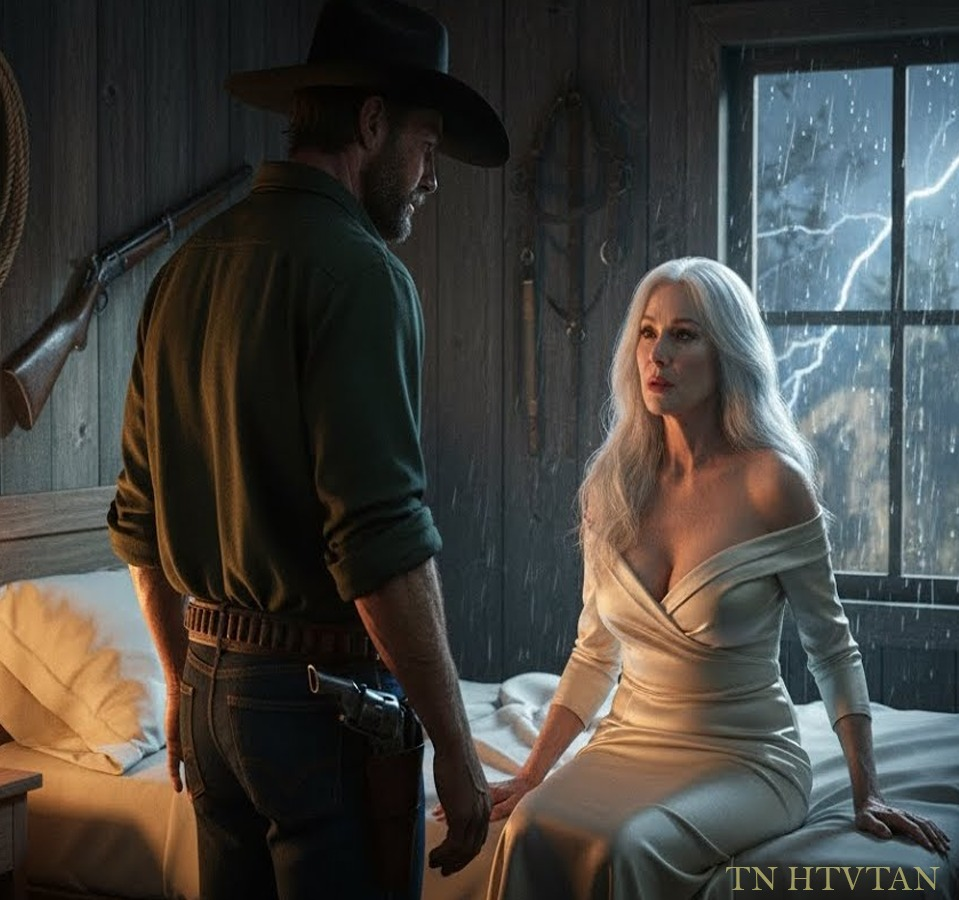
On the scorching plains of Sonora, where the sun burns the skin and the night freezes the bones, stood Rancho La Esperanza Perdida (Ranch of Lost Hope). It was 1887, and the wind carried dust, stray bullets, and rumors of bandits. Don Anselmo, the old landowner, had died of a fever three months earlier, leaving the ranch in the hands of his only daughter, Doña Catalina de la Vega.
She was 35 years old, with hair as silver as the moon over the desert and a beauty that silenced the coyotes. Catalina wore mourning clothes, but not out of habit. Her husband, Captain Ignacio Ruiz, had fallen in an ambush by the Rurales six years before. Since then, the lady had managed the ranch with a firm hand and a steely gaze.
The ranch hands respected her, the outlaws feared her, but deep in her heart, an ancient loneliness whispered to her every night. One stormy afternoon, when the sky crackled with lightning and the earth trembled, an unknown rider appeared on the horizon. He rode a black horse, wearing a wide-brimmed hat, with a rifle slung across his saddle.
He stopped in front of the ranch gate, soaked to the bone, dust clinging to his stubble. “Who lives here?” the foreman shouted from the tower. “A man seeking shelter,” the stranger replied hoarsely. “And work, yes, there is work.” Catalina came out onto the porch wrapped in a black shawl. She observed the tall rider, broad-shouldered, with scars that told stories of bullets and knives.
His eyes were gray, like the smoke from a dying fire. “Name,” she asked. “Mateo. Mateo Vargas. I come from Chihuahua. I have letters of recommendation and I’m hungry.” The woman scrutinized him. There was something about his posture, the way he held the reins, that reminded her of the men who never returned.
But the ranch needed strong hands. The bandits of the Crow were lurking nearby, and the ranch hands were deserting out of fear. “Give him a cot in the barracks,” he ordered the foreman. “We’ll see if it’s any good tomorrow.” Mateo tipped his hat. His eyes lingered for a second too long on the black lace neckline peeking out from under his shawl. Catalina noticed. She said nothing.
The following days were a test. Mateo tamed wild colts with a calmness that seemed like magic. He shot better than any of the rural police. And when the bandits tried to steal the cattle, he alone, with a revolver in each hand, made them flee, leaving three dead in the dust. The fame of the lone cowboy grew.
The ranch hands admired him. The girls in town sighed, but Catalina watched him silently from her bedroom window. She saw him sit alone by the fire, sharpening his knife, gazing at the stars like someone searching for a lost path. One night, the storm returned with a fury.
The wind howled like a lost soul. Catalina couldn’t sleep. She went down to the kitchen to heat milk. There was Mateo, shirtless, washing himself in a tub. The flash of lightning illuminated his torso. Old scars, muscles tanned by the sun. “Aren’t you sleeping, ma’am?” he asked without turning around. “No, the thunder awakens memories.” Mateo dried himself with an old shirt.
She approached. He smelled of damp earth and tobacco. “Memories are like stray bullets,” he said. “Sometimes they graze you, sometimes they kill you.” Catalina looked him in the eyes. For the first time, she saw more than just a cowboy. She saw a man carrying his own personal hell. “What are you running from, Mateo Vargas?” He smiled bitterly. From myself, I suppose, and from a woman who left me with a bullet in my heart, but not the one that kills.
The lady felt a lump in her throat and took a step back. “I’m not that woman.” “No, you’re worse,” he replied. “Because I could be.” The silence was filled with flashes of lightning. Catalina turned around and went upstairs, but she didn’t close her bedroom door. The next morning, the foreman found three ranch hands with their throats slashed in the corral.
The crow had left its mark, a black feather stuck in the door. Fear gripped the ranch. The men talked about leaving. Catalina gathered them all in the yard. “Whoever leaves, leave in shame,” she said. “But whoever stays will get double pay and my gratitude.” Mateo stepped forward. “I’ll stay, but not for the pay.”
That night, Catalina summoned him to her office. He came in with his hat in his hand. She was standing by the fireplace in a white dress that contrasted sharply with her usual mourning attire. “I need you to lead the men,” she said. “You’re the only one who isn’t trembling.” Mateo nodded. “In return, what do you ask?” She moved closer.
Her fingers brushed against his arm. “That he doesn’t leave me alone.” The cowboy swallowed hard. His hands, rough as old leather, took hers gently. “I’ve never known how to love without breaking,” he confessed. “And I’ve never known how to love without fear,” Catalina replied. They looked at each other. The fire crackled. Outside, the storm had subsided, but inside them, another was beginning.
The following days were spent preparing. Mateo trained the laborers like soldiers. They built traps, dug trenches. Catalina, for the first time in years, smiled as she watched him teach a boy how to…

Leave a Reply