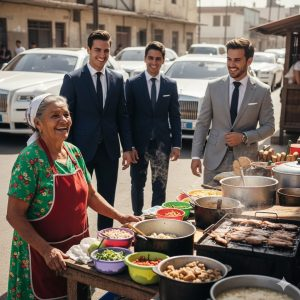
The sound of the three engines arrived before the cars. First a low, soft purr, as if the entire street held its breath. Then, the impossible sequence. A white Rolls-Royce, a black one, another white one, lined up one behind the other on the cobblestone sidewalk, too polished for that neighborhood of old red-brick buildings and bare trees. Shiomara Reyes, her brown apron stained with saffron and oil, stopped, ladle in the air. Steam from the yellow rice rose and touched her face like a warm memory.
She blinked, thinking it was some kind of recording, a wedding, something involving people who didn’t belong there. But the cars died away, the doors opened calmly, and three people stepped out, dressed as if the whole city had been made just for them to walk on at that moment. Two men and a woman, upright posture, impeccable shoes, their gazes not lingering on shop windows or other displays. They first glanced at the metal cart laden with large bowls, roasted chicken, vegetables, rice, wrapped tortillas, and then at the rest of the food.
There was no hurry in their stride. There was a weight to it, as if every step were a deliberate decision. Siomara unconsciously brought her hands to her mouth. For a second, the street became a tunnel. The distant honking of horns, the chill seeping through the collar of her flowered blouse, the forgotten knife beside the trays. She felt her heart pound in her throat, and with it, an old question she buried every day so she could work.
What did I do wrong? The three of them stopped a few steps away. The man on the left, in a dark brown suit with a short beard, offered a smile that seemed to want to be firm but couldn’t quite manage it. The man in the middle, in deep blue with a discreet tie, swallowed hard. The woman, gray-haired with loose hair, her expression that of someone who had learned not to cry in front of others, placed her hand on her chest. Siomara tried to say, “Good morning!” but only air came out. The man in the brown suit spoke first, and his voice, as it traveled across the distance, made something inside her break.
“You still make rice the same way.” She felt her legs go weak. That sentence wasn’t from a stranger. That sentence had a direction, a smell, the texture of an old winter. The cold of the street disappeared, and in its place came another sidewalk, dirtier, noisier, harder, where the footsteps of the world always seemed too hurried to see who was on the ground. Years before, Siomara had arrived in New York with a suitcase that seemed large only because it was all she had.
Her English was short, broken, full of fear. She knew two things perfectly: working and cooking. In Mexico, she learned early on that food wasn’t just sustenance; it was language, it was warmth, it was a way of saying “I see you” without words. She started washing dishes in a cafe near the subway, her hands cracked, the smell of detergent clinging to her skin. At night, she shared a room with two other women in a cramped apartment in Sunset Park. The building owner raised the rent whenever he wanted, and no one complained out loud.
Complaining in Speaking aloud was a luxury. After a year, when she’d saved enough to buy a used food cart and pay for an inexpensive food hygiene course, she thought life was finally taking shape. She got a license, not without humiliation, lines, and paperwork she didn’t fully understand. The first day with the cart was like opening a door to breathe. She assembled the bowls, adjusted the lids, and turned on the grill. The smell of chicken seasoned with lemon and chili wafted out like a promise of hope.
It was on that first day that she saw the three of them. They were near the wall of a building, huddled together as if they were a single body trying to survive. Three children, identical in their gaze, yet different in how they suppressed their hunger. One of them, the tallest, had a thin scar above his eyebrow. The middle one held his chin high, as if he didn’t want the world to see his weakness. The youngest, wearing an old hat, trembled more than the others, but tried hard not to. To prove it.
Siomara sensed the hunger before she sensed the torn clothes. She sensed the way their eyes followed the ladle, how their throats seemed to swallow just at the smell. She hesitated. In that neighborhood, people said you shouldn’t get involved. They said it was dangerous. They said if you gave them something once, they’d come back. They said many things to justify their own comfort. Siomara looked at the bowls, looked at the children, and for a moment saw herself as a 12-year-old waiting in her backyard for a plate that she didn’t know would ever arrive.
She remembered her younger brother, how he pretended to be full so she would eat more. Without thinking too much, she filled three bowls and walked toward them. “Hello,” she said in the English she knew. “I’d like to eat hot food.” The children remained motionless. It wasn’t immediate gratitude, it was distrust. It was the unspoken question.

Leave a Reply