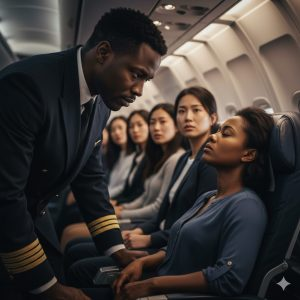
“Excuse me,” she said in a low but sharp voice.
“Colonel Helena Costa, Air Force. 550 combat hours in F-18 fighters. Specialist in tactical flight in extreme conditions.”
The silence that followed was brutal.
Mateus’s eyes widened.
“You must be joking,” he muttered.
But there was something in Helena’s composure that commanded respect: it wasn’t arrogance, it was the confidence of someone who had already survived real storms.
Mateus laughed nervously.
“Colonel? You? Look, I respect the military, but I’m not going to entrust my life to a fantasy. My wife and I paid dearly for this flight to be away from those kinds of… adventures.”
Helena ignored the mockery.
The copilot reappeared in the cockpit door, pale.
“Anyone with military experience, please. Captain Duarte is having seizures.”
Helena stepped forward, like someone who knows the moment of truth has arrived. She asked about altitude, speed, and wind direction.
“Thirty-eight thousand feet, crosswinds of 130 km/h, gusts up to 160,” Marcos replied.
She nodded and began dictating emergency procedures: pressurization, descent, communication protocols. Precise numbers, exact steps. The passengers were captivated by the sound of her voice.
Mateus snorted.
“Technical details? Anyone can read a manual.”
But the voices fell silent when Helena recited protocols that only a military pilot trained for extreme storms could know by heart.
The copilot, now visibly shaken, said in a trembling voice:
“The cockpit is yours, Colonel.”
And in that instant, something invisible changed: fear gave way to a fragile hope.
Mateus shouted furiously:
“I want to see credentials! Prove who you are!”
Helena offered a slight smile, serene and resolute.
“Mr. Rodrigues, there are three types of pilots: those who fly when everything is calm, those who fly when it’s difficult, and those who fly when it’s impossible. I’ve saved aircraft that the manuals declared lost. Today, I’m not judged by medals, but by the courage to act when no one else can.”
The plane shook violently. Thunder, lightning, flashing lights.
Before entering the cockpit, Helena stopped in front of Mateus:
“When we land—and we will land—perhaps you’ll understand that clothes, seat, or skin color don’t define competence.”
Inside the cockpit, chaos reigned. The captain was convulsing, the monitors were flashing red, the copilot was paralyzed. Helena knelt down, checked vital signs, and administered first aid with steady hands, tense only from the intensity of the moment.
In the seats, many passengers began to recognize what they had previously ignored beneath their simple clothing.
Then, Dr. Elisa Mendes, a neurosurgeon traveling in first class, approached.
“Colonel Costa, I’m Dr. Mendes. I’ve worked on combat rescues. I can help the captain.”
Helena nodded, grateful.
Mateus protested again:
“Are you going to trust her without any proof?”
The doctor looked at him intently:
“I’ve wept with entire families for lack of someone with courage. This woman has what money can’t buy.”
Mateus remained completely silent.
Helena adjusted instruments, recalibrated the route, and requested to tune into an emergency military frequency.
A voice answered:
“Colonel Costa, call sign Spectre. We confirm your identity. You were off radar for twenty minutes.”
The flight became top priority.
“Spectre, you have maximum priority. Clear airspace.”
Focused, Helena executed a maneuver many considered impossible: a spiral descent through the eye of the storm, a fighter jet technique adapted for a commercial airliner.
Mateus stood speechless, pale, watching the plane shake but remain stable.
Finally, the plane touched down. There was a reverent silence, followed by applause, tears, and relief.
Six months later, Helena Costa was promoted to brigadier general, becoming the youngest Black woman to achieve that rank. Her storm-flying technique was incorporated into official manuals.
Mateus Rodrigues, whose arrogance was immortalized in viral videos, saw his company and his reputation crumble. His wife divorced him. Her children learned that their father had failed to see beyond appearances.
Helena, on the other hand, became an inspiration to thousands.
Her motto is etched in the collective memory:
“When they underestimate you, let them see what only your courage can reveal.”
Leave a Reply