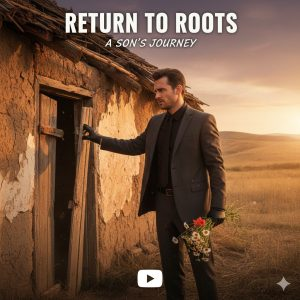
Alejandro Ibarra pulled his German pickup truck over to the side of the dirt road. Dust clung to his suit like an old guilt. In front of him, at the end of a narrow path lined with bougainvillea, stood a small adobe house with a weathered tile roof. A couple of chickens pecked near the garden, and the air was thick with the scent of damp earth and woodsmoke.
In his hands, Alejandro clutched a bouquet of wildflowers wrapped in fine paper. He had bought it that very morning in Polanco, at a flower shop where everything cost more because it was “well arranged.” His fingers trembled. Twenty-five years ago, he had left behind a baby and a woman who had truly loved him. Twenty-five years without a visit, without a conversation, without a face-to-face apology.
On the drive from Mexico City to that community in the Sierra de Puebla—San Isidro de las Palmas—Alejandro replayed a scene a thousand times: he would arrive, say who he was, offer money, take care of the material things, and the girl would forgive him… perhaps out of gratitude, perhaps out of weariness. In his mind, forgiveness was a transaction.
But when he got out of the car and heard, behind the faded blue door, a woman’s voice humming something sweet, Alejandro felt his script crumble. He knocked three times, softly, as if afraid of knocking the house down with a harder blow.
Footsteps. A lock clicked. And the door opened.
The young woman looked about twenty-five, maybe twenty-six. Her brown hair was pulled back in a simple ponytail, and her eyes—unmistakably green—had a warm glow that Alejandro hadn’t seen in his mirror for decades. She wore a hand-sewn cotton dress with small flowers, and yet she looked effortlessly elegant. The worst part was her smile: pure, without resentment.
“Good afternoon,” she said, drying her hands on a cloth. “Can I help you with anything?”
Alejandro’s voice faltered. It was his daughter. And yet, she looked at him the way one looks at a stranger who arrives with dust on his shoes.
“I…” He swallowed, gasping for air. “I heard they make palm baskets around here. That a very good artisan lives here.”
He lied. And the lie tasted like iron.
The young woman’s face lit up.
“Oh, that’s wonderful! Please come in. I just took some cornbread out of the oven, and the coffee’s ready. My name is Ana Martínez… well, Ana Sofía Martínez.”
“Martínez,” Alejandro thought. His mother’s last name. Olivia’s.
He went inside. The house was small, but spotless. Baskets hung on the walls: large, small, round, oval, with the finest woven threads. In the center, a wooden table covered with a crocheted tablecloth, white as a cloud. Nothing there seemed “poor”; it was simple, yes, but full of dignity.
Ana Sofía returned with a tray: a clay coffee pot, two cups, and slices of steaming cornbread.
“Did you come from far away?” she asked.
“From the city,” Alejandro replied, taking in every detail as if he could somehow recover lost years.
“Wow, you’re tired. Here, have a little something. Coffee cures the journey here.”
While she served, Alejandro looked up… and felt his blood run cold.
A framed photograph hung on the main wall. A young man was holding a baby. Alejandro recognized himself instantly: the same look, the same way of holding the baby, the same gesture of feigning confidence. Below, in feminine handwriting, it read: “Ana and Dad. Our love forever. March 2000.”
The handwriting was Olivia’s.
Alejandro’s cup trembled in his hand.
“Did you see it?” Ana Sofía asked, following his gaze casually. “That’s my dad. Mom always said he was a hard worker and that he went far away… to give us a better life.”
Alejandro choked on his coffee.
“Did your mom… speak well of him?”
“Always,” she replied with a pained peace. “She said he was young when I was born, that he was afraid, but that he loved us. He never let me get angry. He taught me that resentment is a burden you carry… and that it keeps you from moving forward.”
Alejandro clutched the bouquet of flowers, useless. No amount of money could buy that.
“And your mom…?” he asked, already knowing the answer before he heard it.
Ana Sofía lowered her gaze for a second, but she didn’t break down.
“He passed away two years ago. Pneumonia. Until his last day, he said that if you ever… well, if my father ever came back, I should listen to him. That life sometimes takes time, but it’s not always late.”
That “you” pierced his chest. Alejandro felt a lump in his throat, not from nostalgia, but from pure shame.
Then he noticed. Ana Sofía was moving carefully. Her skin had a different glow. The slight curve of her belly.
“Forgive me if I’m being indiscreet…” he murmured. “Are you pregnant?”
Ana Sofía smiled, and that smile seemed to hold a future within.
“Yes. Three months. My husband, Diego, is working at the blacksmith shop. It’s our first baby.”
Alejandro felt the world turn. He hadn’t just lost his daughter; he was about to lose his grandson without even having met him.
“Have you thought of a name yet?” he asked, his voice tight with emotion.
—Ivan— I said
Leave a Reply