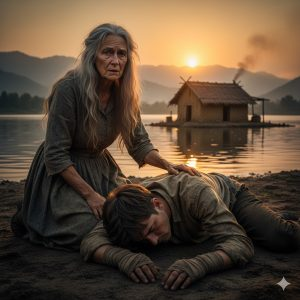
What happened next changed my destiny forever.
Dawn was slowly breaking over my small town, San Isidro, and the sun, still shy, barely touched the surface of the river that snaked behind the hills. At 76 years old, I woke before the first rooster crowed, as I had done every day for more than half a century. My hands, calloused and cracked, seemed made of the same earth I walked on.
Each wrinkle spoke of years of work, of silences, of hopes that were never fulfilled. I lived alone in an adobe hut with a rusty tin roof and walls that creaked in the wind. Poverty had become a silent companion, not as punishment, but as destiny. I never complained, never asked for anything, because I, Amalia Torres, had learned that in life one survives not with what one has, but with what one endures.
That morning the air smelled of dampness and old wood. The river murmured softly, as if talking to itself. I walked to the bank with My metal bucket, my bare feet sinking into the cold mud. I bent down slowly to scoop up water and sighed. “Not even the saints remember this place anymore,” I said softly.
I watched my distorted reflection in the water and thought that it had been years since I’d really looked at myself. The wrinkles were deep, my hair completely white, but my eyes were still alive, filled with a light that refused to fade. It was the gaze of a woman who had seen too many goodbyes and not a single promise kept.
As I filled the bucket, I heard the song of a distant bird and the metallic clang of a can being pushed by the wind. I stood up and looked around. The town was still asleep. Only the rustling of the trees and the steady flow of the river could be heard. Suddenly, a sharp sound broke the calm: a dull thud that echoed among the stones.
I frowned, stopped moving my hands, and listened intently. I thought that Perhaps it was a fallen branch or an animal that had come to drink, but the sound returned, this time accompanied by a faint, almost human moan. My heart, accustomed to the monotony of silence, pounded.
I took a few steps forward, watching the current. The water’s surface moved slowly, reflecting golden glimmers of dawn. Suddenly, something dark floated downstream. A large, irregular shape swayed among the waves. I felt a chill run down its spine. “The river never gives back what it swallows,” I muttered to myself.
Yet my feet began to move forward without my conscious control. I approached, until the mud almost made me lose my balance. The shape was slowly nearing the bank, and in a moment of clarity, I made out a human form. The body of a man, motionless, bound with thick ropes. I felt my throat close up.
“That can’t be real,” I said, “perhaps my old eyes are deceiving me.” But the river wasn’t lying. The body moved with the current, crashing against the rocks. I set the bucket down and, without thinking, started walking toward the water. The cold bit my feet, the air grew thick.
I remembered my late husband’s voice, telling me the river could be treacherous, but at that moment nothing else mattered. “Hold on!” I shouted desperately, though the man couldn’t hear me. The water reached my knees, then my waist, and the weight of years made itself felt, but fear didn’t stop me. My hands, hardened by work, clung to the lifeless body.
I pulled with all my strength, slipping again and again on the wet stones. The current pushed me, but I resisted, groaning with effort. When I finally managed to drag him to the bank, I fell to my knees, gasping. The body was cold, the skin pale, the hair plastered to his face. He looked dead.
I touched his neck, searching for a pulse, and to my surprise, I felt a faint heartbeat. “God hasn’t claimed him yet,” I said softly. With trembling hands, I began to cut the ropes with an old knife I carried on my belt. The ropes were so tight they had left deep cuts in his skin. The man had wounds on his arms, and his breathing was barely a whisper.
My heart pounding in my chest, I slowly turned him over so he would vomit the water he had swallowed. When I saw a trickle of water and blood coming from his mouth, I said with relief, “He’s alive.” I took off my headscarf and placed it on his chest to try to dry him. The wind was blowing hard, and the river mist enveloped me like a veil.
The sun was just beginning to rise, painting the sky orange. I thought that it had been years since I had felt anything like this. Fear and compassion, at the same time. I looked at the man and realized that he was neither a peasant nor a vagrant. His hands were His clothes were fine, expensive, though torn.
“I don’t understand what someone like him is doing in a place like this,” I said to myself. I dragged him as best I could to the entrance of my cabin. Every step was

Leave a Reply