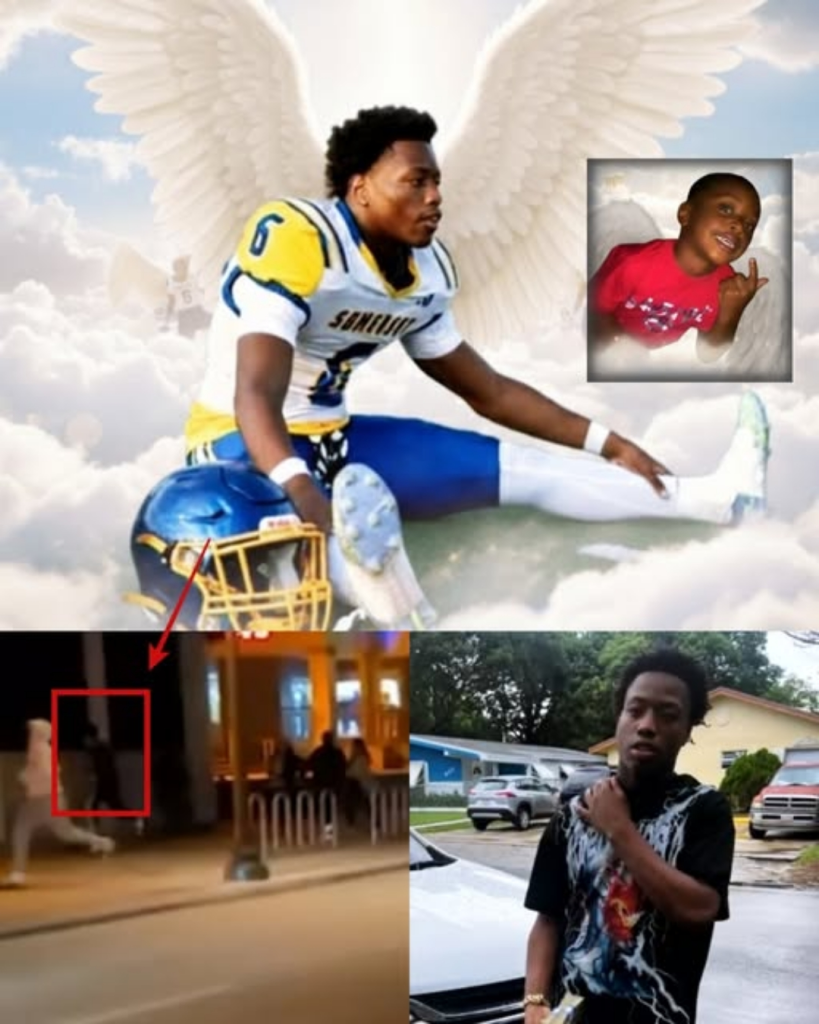
The last night of the year in Fort Lauderdale always seems to breathe differently.
The air is softer, salted and warm, and the ocean carries a steady hush that makes even loud crowds feel strangely held.
On New Year’s Eve, the shoreline becomes a promise people share without speaking: one more night to laugh, one more night to believe nothing bad can find you under fireworks.
Joshua Gipson, Jr. was seventeen, old enough to crave independence and young enough to still be protected by his family’s prayers.
That Wednesday night, December 31, he went to the beach with friends the way teenagers do when they want to feel the world opening up.

They weren’t looking for trouble, only for the glow of midnight, the countdown, the photos, the moment everyone posts and remembers.
The stretch of North Fort Lauderdale Beach Boulevard near the sand was busy, crowded with small groups moving like schools of fish—close together, then splitting apart, then joining again.
Cars crawled past with windows down.
Music spilled from speakers.
Someone laughed too loudly, as if they could laugh the year into being better.
Joshua walked with his friends, shoulders loose, face lit by phone screens and streetlights and the reflection of the water.
He was the kind of teen people described with warmth even when they weren’t trying to be poetic.
A family friend would later call him “a warm ball of sunshine,” the sort of person whose presence made others relax.
He had plans—real ones, not just vague wishes.
According to someone close to the family, Joshua hoped to attend Virginia Tech the following year.

College, a new city, a new identity: the same dream so many families carry like a carefully folded letter, tucked close to the heart.
That night was supposed to be ordinary in the way good nights are ordinary.
Teenagers wandering, friends teasing each other, someone checking the time too often.
The year was almost over, and the future still felt like a wide road.
Then the sound came.
At first, the mind tries to translate it into something else.
Firework.
Car backfiring.
A prank.
But the body recognizes danger before the brain can soften it.
People flinched.
Faces changed.
A few heads snapped toward the street.
Witnesses later told WPLG that it appeared to be a gunfight between two people—an exchange of shots that had nothing to do with Joshua and everything to do with anger moving faster than thought.
On nights like this, when crowds are dense and adrenaline runs high, violence can travel farther than the people who started it ever intended.

The beach that had been full of celebration fractured into motion.
Some ran toward the sand, some toward the sidewalk, some froze in place, unsure where safety lived.
Phones dropped.
Voices rose and broke.
The air, seconds earlier filled with music and the promise of midnight, filled with fear.
Joshua went down.
Not in a dramatic way that movies teach us to expect, not with time slowing and everyone understanding at once.
In real life, tragedy often arrives like a door slamming—sudden, senseless, and immediately permanent in its force.
One moment he was there.
The next, his friends were screaming his name into a world that did not answer.
Someone called 911.
Someone else tried to keep him awake.
Hands reached for him—hands that had held soda cans and phones and each other’s shoulders only minutes earlier.
Now those hands shook as they pressed down, as they begged, as they tried to do anything that might keep a seventeen-year-old from slipping away in front of them.
Police and emergency responders arrived near midnight, lights cutting across the boulevard.
Sirens tore through the humid air, slicing into the night’s soundtrack with a violence of their own.
Officers pushed through the crowd, trying to secure the area, trying to locate what had caused the shots, trying to stop the panic from multiplying.
Joshua was rushed to the hospital.

There is a particular kind of hope that appears in crisis: sharp, desperate, irrationally strong.
Families cling to it because the alternative is unthinkable.
According to the reporting shared by the family and those close to them, they believed Joshua would survive.
They believed the doctors would do what doctors do, that youth would matter, that prayers would land somewhere and be answered.
In hospital waiting rooms, time becomes a cruel trick.
Minutes stretch into hours.
Every door opening feels like judgment.
Every sound—the squeak of shoes, the murmur of staff, the distant beep of a monitor—feels like it might be the moment life changes forever.

Someone called the family.
Someone drove too fast.
Someone held a phone with shaking fingers, hoping for the right words and getting only fragments.
In families, roles appear instinctively in emergencies: one person becomes the communicator, one person becomes the quiet one, one becomes the one who keeps saying, “He’s going to be okay,” as if repetition can force reality into shape.
But reality does not always bend.
Joshua Gipson, Jr. died after being taken to the hospital, his family said.
Seventeen years collapsed into a single headline.
A future that had been detailed with hopes—Virginia Tech, graduation, adulthood—was suddenly reduced to grief.
And the year turned.

Midnight arrived anyway.
It arrived for strangers raising plastic cups and cheering under fireworks, for couples kissing, for friends shouting “Happy New Year!” into the salt air.
It arrived in bright colors over the ocean and exploded across the sky, indifferent to the boy who would never see it.
Somewhere close by, a family stepped into a new year without their child.
A mother stepped into January with a wound that would never close.
A community stepped into 2026 carrying a name it should not have had to learn this way.
He was only seventeen.
He was only there to celebrate.
And then he was gone.
A family friend, speaking to WPLG, tried to give words to what cannot be properly spoken.
“I feel like I just lost a child, and he wasn’t even my child,” she said.
Grief does that—it spills over boundaries, makes unrelated hearts ache, turns strangers into mourners because the loss feels too unfair to stay contained.

She described Joshua as warm, bright, good.
Not perfect—teenagers never are—but good in the way people mean when they say it with tears.
The kind of kid you trust around younger children.
The kind of kid who remembers to text back.
The kind of kid who makes adults believe the next generation might be kinder than the last.
She also spoke of his mother’s pain, saying the woman was “incredibly distraught” and “speechless.”
That word—speechless—may be the most accurate in tragedies like this.
Because language was built for ordinary days.
It was built for schedules and jokes and arguments and apologies.
It was not built to hold the moment a parent learns the world has taken their child.
In the hours after a shooting, people always search for logic like it might be hiding in the sand.
Why there.
Why then.
Why him.
Sometimes the answers are procedural—investigations, suspects, evidence, charges.
And those things matter, because accountability matters, because communities need to know the truth.
But for the family, for the friends who watched, for the people who loved Joshua, the question that remains is simpler and heavier:
How can someone die for nothing?
A witness told WPLG that Joshua appeared to be hit by a stray bullet in an exchange of gunfire between two people.
The phrase “stray bullet” sounds almost accidental, almost like an unfortunate detail of physics.
https://www.youtube.com/embed/yvhRy6t5u1w?t=1s
But there is nothing accidental about choosing to fire a gun in a crowd.
There is nothing accidental about letting anger become a weapon and then being surprised when an innocent person pays the price.
That is the quiet horror of public violence: it does not only harm the intended target.
It poisons the air around it.
It turns an entire street into a place people will always remember with a flinch.
It transforms the most ordinary acts—walking, laughing, standing near friends—into risks no one agreed to take.
On January 1, as the news moved through the city, people who had been on that beach began replaying their own choices.
If I had left earlier.
If I had walked on the other side of the street.
If we had gone somewhere else.
If I had told him not to go.
Survivors carry guilt even when there is no rational reason for it.
Friends who were with Joshua may spend years trying to understand how they walked away and he did not.
Teenagers, especially, can feel the weight of tragedy in ways adults underestimate—quiet nightmares, sudden anxiety in crowds, the way fireworks might never sound the same again.
And then there is the family’s grief, which has its own geography.
It spreads through bedrooms and closets and school hallways and the small places where reminders hide.
A hoodie on a chair.
A half-used bottle of cologne.
A text thread that will never update.

People will say, “He’s in a better place,” because people say that when they are helpless.
People will say, “Everything happens for a reason,” because people want the world to be orderly.
But sometimes grief refuses those comforts, because what happened has no reason that can justify it.
Joshua’s life mattered because he existed, because he was loved, because he made others feel the world was warmer.
He mattered because he was a son and a brother and a friend and a teenager with plans.
And that is enough.
In the days that follow tragedies like this, memorials appear as if summoned by a shared instinct.
Candles in glass jars.
Bouquets wrapped in plastic.
Stuffed animals that look too small to carry such sorrow.
Handwritten notes with shaky letters, promising never to forget.
People gather and speak softly.
They tell stories that begin with laughter—because the best stories about someone you loved usually do.
They talk about the time he helped someone without asking.
They talk about his smile, his jokes, his way of showing up.
And beneath every story is the same raw truth: all of it should have continued.
Joshua should have graduated.
He should have stepped onto a college campus.
He should have had his first apartment, his first job, his first big mistakes and the chance to learn from them.
He should have grown older in the ordinary way, the way we all assume we will.
Instead, the community is left holding the outline of a young man where a future should be.
The investigation will follow its necessary path—witness interviews, evidence collection, the difficult work of piecing together exactly what happened just before midnight along North Fort Lauderdale Beach Boulevard.
People will wait for updates, for names, for charges, for some kind of conclusion that feels like it matches the size of the loss.
But even when the legal part ends, the emotional part will not.
A mother will still wake up and reach for a phone she will never receive a text on again.
A friend will still pass a familiar spot and feel their throat close.
A family will still set an extra plate in their minds before remembering there is no one left to fill it.
This is what a “stray bullet” does.
It doesn’t just strike a body.
It strikes an entire network of love.

It reaches into the future and erases scenes that should have existed: graduation photos, dorm move-in day, late-night calls home, a mother cheering at some distant milestone.
It turns all of that into absence.
And yet, even in the bleakest stories, communities often try to salvage meaning where they can.
They hold vigils not only to mourn, but to insist that Joshua’s life is more than the way it ended.
They speak his name out loud because silence feels like surrender.
They say he was good, because goodness deserves to be recorded.
A family friend described him as “a good kid, a good person, a good brother—loving, caring, just overall great.”
Those words are simple, but they are heavy with truth.
In a world that can be harsh, being remembered as loving and caring is not small.
It is a legacy many people never earn.

On the beach, the ocean continues, as it always does.
It pulls and releases.
It smooths the sand.
It reflects the sky as if nothing has changed.
But everything has changed.
Somewhere in Fort Lauderdale, a family is moving through days that feel unreal, days that begin and end without the person they love most.

Somewhere, a mother is learning how to breathe around grief that sits in her chest like stone.
Somewhere, friends are learning that childhood can end in an instant.
And in the middle of it all is the name Joshua Gipson, Jr.—seventeen years old, full of plans, described by those who loved him as sunshine.
A boy who went to the beach on New Year’s Eve with friends.
A boy who should have come home.
A boy who didn’t.
Remembering Robert Grant Norton: The Oldest Victim of September 11

On September 11, 2001, tragedy struck America in a way that changed the nation forever. Nearly 3,000 lives were lost in the attacks, each story carrying its own weight of love, sacrifice, and heartbreak. Among them was Robert Grant Norton of Lubec, Maine, who at 85 years old was the oldest victim of that dark day.
Robert was a World War II veteran, part of the generation that answered the call to defend freedom during humanity’s darkest hours. His life had already borne witness to sacrifice, resilience, and service. He knew what it meant to endure hardship, and he carried the quiet strength of those who had lived through war and loss. On that September morning, he was simply a husband, a father, a grandfather, and a man traveling with his wife to celebrate a joyous


Leave a Reply