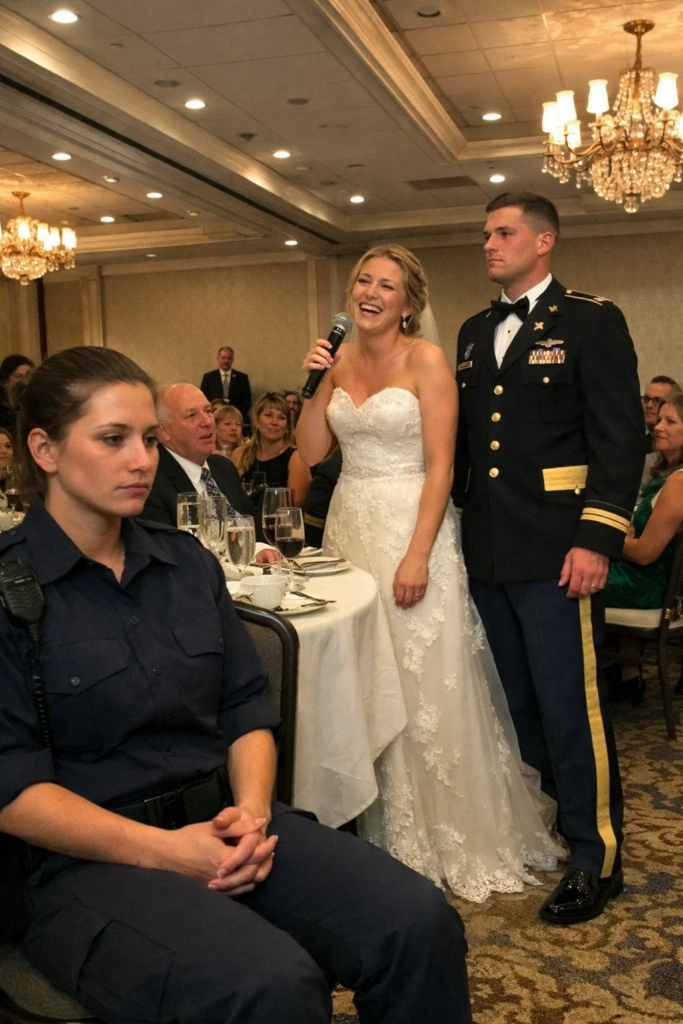
I Paid for My Sister’s Luxury Wedding and Sat Quietly in the Back — ‘She’s Just a Gate Guard, Who Would Ever Want Her?’ My Sister Joked Into the Microphone, But the Moment the Groom Stood Up, the Entire Ballroom Went Silent
I agreed to pay for my sister’s wedding because I believed, for a long time, that family was something you proved with sacrifice, even when the proof hurt, even when the cost was measured in overtime shifts, sleepless nights, and the quiet erosion of your own dignity. I told myself that loyalty was supposed to be uncomfortable, that love wasn’t meant to be convenient, and that if I just kept giving, eventually the balance would tip and I would finally be seen as more than the practical sister, the useful one, the background figure who existed to make other people’s lives smoother.
The venue alone cost more than I made in a year, a grand riverfront hotel with glass walls that reflected the city lights like a promise, crystal chandeliers hanging low enough to make the entire ballroom glow, and white roses shipped overnight because my sister insisted local flowers “didn’t photograph well.” Three hundred guests filled the space, their conversations blending into a polished hum of importance, every table packed with people who wore titles like badges and spoke about deals and connections as if that was what gave their lives weight. Everyone looked proud. Everyone looked certain of their place.
Everyone except me.
I arrived straight from work, still in my navy-blue uniform, freshly pressed but unmistakable, the kind of uniform people only notice when they want to remind you where you stand. I worked security at the front gate of a military base, a job that wasn’t glamorous but was honest, steady, and required a level of attention most people never thought about until something went wrong. I’d planned to change, but a delayed shift and a last-minute staffing issue erased that plan, and by the time I arrived, the ceremony was already over.
My mother, Linda, saw me the moment I stepped inside and her face tightened like I’d tracked mud across a white carpet.
“Couldn’t you at least change?” she hissed under her breath, pulling me aside before anyone important noticed me too closely. “People will think we’re desperate.”
I looked past her at the room I’d paid for, the band I’d booked, the open bar I’d covered without complaint, and I said nothing. I reminded myself that tonight wasn’t about me. It was about my younger sister, the one everyone said was delicate, special, destined for better things. I told myself that if she was happy, it was worth it.
During the reception, my sister took the microphone, her dress immaculate, her smile perfectly practiced, and for a moment I thought maybe I’d been wrong, that maybe this would be the part of the night where gratitude made a brief appearance. She thanked the guests, her new husband’s colleagues, the city officials, the friends who’d “supported them,” and then her gaze found me.
“And of course,” she said lightly, “I should thank my sister for helping with… some things.”
The pause was intentional. The laughter that followed was immediate.
She tilted her head, eyes bright with satisfaction. “My sister is just a gate guard,” she added, her voice carrying easily through the room. “Who would ever want her?”
The laughter swelled, people glancing at me with open curiosity, amusement, judgment layered together in a way that burned worse than anger. I stayed seated, my hands folded neatly in my lap, because reacting would have given them something else to mock.
My mother stood, wine glass raised. “She’s always been the family’s embarrassment,” she said, as if delivering a harmless punchline. “But at least she’s useful.”
The room laughed again, louder this time, and something inside me shifted—not a snap, not a surge of fury, but a cold clarity that settled deep in my chest. I understood, finally, that love wasn’t missing here by accident. It had been replaced, deliberately, by convenience.
Then the groom stood up.
Major Andrew Collins didn’t rush. He didn’t smile. He simply rose from his seat, straightened his jacket, and took the microphone from the stand with a calm that immediately drained the room of its noise.
“Actually,” he said evenly, “she’s—”

My sister swayed, her hand flying to her chest, and collapsed to the floor in a dramatic spill of silk and lace that sent reminders of panic ricocheting across the ballroom.
For a split second, everything froze.
My mother screamed and rushed to her side, glaring at me like I’d pushed her. “Do something!” she shouted. “This is your fault! You always ruin everything!”
I started to stand, instinct and training kicking in automatically, but Andrew lifted one hand, stopping me without even looking in my direction.
“She’s fine,” he said, his voice slicing through the noise. “She’s just realized the floor is the only place left for her once the truth comes out.”
My sister’s eyes fluttered open, confusion flickering across her face when she realized she wasn’t the center of attention anymore.
Andrew turned back to the microphone, and the chandeliers I had paid for caught the sharp edge in his expression.
“You laughed,” he said, scanning the room. “You laughed because you think a gate guard is beneath you. You laughed because it was easier to believe that than to question why someone like her was paying for everything you’re enjoying tonight.”
Several officers seated near the front stood without being told, a quiet, instinctive movement that shifted the atmosphere instantly.
“Three years ago,” Andrew continued, “my unit was hit in a place most of you wouldn’t recognize if you heard the name. Our convoy burned. We were pinned down. The person who pulled me out, who kept me alive while everything around us fell apart, wasn’t a nobody.”
His eyes met mine, steady and unflinching.
“She was Sergeant First Class Sarah Miller. A combat medic who dragged me through open fire with a shattered shoulder and didn’t let go until I was breathing in a helicopter.”
A hush fell over the room, the kind that presses against your ears.
“She didn’t take a gate security job because she failed,” he went on. “She took it because the VA hospital was close, and because she’s been paying for treatments her own mother needed, quietly, without asking for thanks. She paid for this wedding, every last detail, because she believed family mattered.”
My mother’s face drained of color as understanding caught up with her.
“I didn’t know,” Andrew said, his voice colder now, “that the inheritance I was told about was actually her life savings.”
He removed the boutonniere from his lapel and dropped it beside my sister.
“The license isn’t signed,” he said flatly. “And it won’t be.”
The fallout was immediate and messy. My mother sobbed, my sister screamed, guests whispered and fled, and within minutes the room was half-empty, the illusion of importance dissolving as fast as it had formed.
Andrew walked toward me, stopping a few feet away.
“You okay?” he asked quietly.
“I will be,” I said, and meant it.
I crossed out charges on the invoice that had been waiting for my signature, paid only for what had already been used, and walked out of that ballroom without looking back.
Months later, I stood at the gate again, the sun just beginning to rise, my uniform still the same but my life entirely different. The house I’d bought stood waiting for me at the end of the day, the silence inside it peaceful instead of lonely, my phone full of numbers that belonged to people who saw me clearly.
I hadn’t lost my family that night.
I’d finally stopped losing myself.
And that turned out to be worth far more than any wedding ever could.

Leave a Reply