“She Said If I Told You, You’d Leave Again.” — I Came Home From a Business Trip and Realized My Daughter Had Been Carrying a Secret Alone
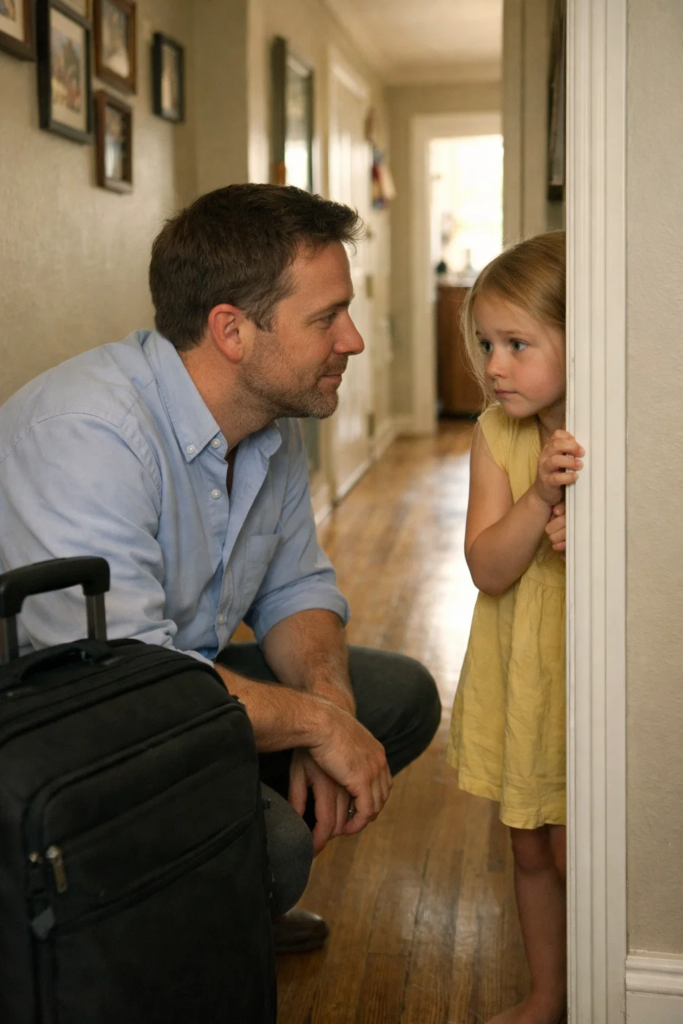
The house was too quiet for a Tuesday night, the kind of quiet that doesn’t feel peaceful so much as unfinished, as if a conversation had been interrupted and never resumed, and Adrian Bell noticed it the moment he stepped inside, his suitcase still rolling behind him, wheels clicking softly across hardwood floors that had been polished that morning by a service he barely remembered scheduling.
He had been gone for nine days, a last-minute trip that had stretched longer than planned, stitched together by meetings that ran late and dinners that blurred into obligation, and all the way home he had pictured the usual scene—his daughter racing down the hallway in mismatched socks, his wife calling out a warning about shoes on the floor, laughter filling the space before he could even put his bag down.
Instead, there was only the hum of the refrigerator and the faint tick of the wall clock.
“Lena?” he called, keeping his voice light, rehearsed.
No answer.
He took another step forward, then stopped when he heard it, not a sound that demanded attention, not a cry or a sob, but something smaller and more fragile, drifting from the direction of the guest room that had slowly become their daughter’s refuge.
“Papa…”
The word barely reached him, thin as breath on glass.
“I’m here,” Adrian said immediately, the suitcase forgotten. “I’m home.”
There was a pause, long enough to make his chest tighten, and then her voice came again, shaking, wrapped around fear she was trying desperately to keep quiet.
“My back hurts so much I can’t sleep,” she whispered.
“Mommy said I’m not allowed to tell you.”

The hallway seemed to tilt.
Adrian moved toward the doorway slowly, every instinct screaming at him to run while some deeper part of him warned that sudden movement might break something already cracked.
Mila stood just inside the room, half-hidden behind the doorframe, her small fingers gripping the wood as if it might anchor her in place, her shoulders hunched forward in a way that made her look smaller than her nine years, eyes lowered, not meeting his gaze.
“I’m not mad,” he said softly, though she hadn’t accused him of being so.
“I promise. You can tell me anything.”
She swallowed, her throat working visibly.
“She said if I told you, things would get worse,” Mila murmured.
“She said I’d make you leave again.”
The sentence landed harder than any accusation ever could.
Adrian knelt, lowering himself to her level, careful to keep his hands visible and still.
“I’m not going anywhere,” he said, slow and deliberate, each word placed like a stone meant to hold weight.
“What happened to your back, sweetheart?”
Mila hesitated, then shook her head, tears spilling despite her effort to hold them back.
“She got really angry,” she said finally, the words tumbling out now that they had begun.
“I knocked over the lamp. It was an accident. She pushed me, and I fell against the dresser, and it hurt so bad I couldn’t breathe, and she told me to stop crying because the neighbors would hear.”
Adrian felt his pulse pounding behind his eyes.
“Did she take you to see a doctor?” he asked, though the answer was already echoing inside him.
Mila shook her head again.
“She wrapped it and said it would heal,” she whispered.
“She said doctors ask questions.”
When he reached out instinctively to pull her into his arms, Mila flinched, a sharp intake of breath escaping her.
“Please don’t touch,” she said quickly.
“It really hurts.”
Adrian withdrew his hand as if burned, forcing his breathing to slow, to steady.
“Can you show me?” he asked gently.
Mila turned around with visible effort and lifted the back of her pajama top. The bandage beneath was uneven, stained, far too old to be covering something that was supposedly “fine,” and the skin around it was darkened and swollen in a way that made his stomach drop.
“We’re going to the hospital,” he said immediately, his voice calm even as something inside him splintered.
“Right now.”
“Am I in trouble?” Mila asked, fear sharpening her tone.
“No,” Adrian said, pressing his forehead briefly to the doorframe to steady himself before meeting her eyes again.
“You did exactly what you were supposed to do.”
The drive felt endless, every bump in the road pulling a quiet sound from Mila that made him grip the steering wheel harder, one hand reaching back to rest near her knee as if proximity alone could help.
At the children’s hospital, they moved fast, the kind of practiced urgency that didn’t rely on panic. Mila was guided onto a bed, given pain relief, her breathing easing slightly as machines hummed softly around her.
Dr. Elaine Porter introduced herself with a voice that balanced warmth and authority, explaining each step before she took it, giving Mila a sense of control she clearly hadn’t been allowed lately.
“This injury didn’t happen today,” Dr. Porter said after the exam, her eyes meeting Adrian’s with quiet gravity.
“There’s infection. She needs treatment and observation.”
“She’ll be okay?” Adrian asked, the question tearing its way out of him.
“She will,” the doctor replied.
“Because she was brought here.”
Later, a social worker joined them, her questions gentle but precise, and when Mila spoke about being told to stay quiet, about being warned that honesty would make things worse, something shifted in the room, the air thickening with shared understanding.
“I have to make a report,” the social worker said to Adrian afterward.
“This isn’t optional.”
“Please,” Adrian said without hesitation.
“Do whatever you need to do.”
When Lena arrived, hours later, she looked composed, irritated more than concerned, her first words sharp.
“This is unnecessary,” she said, arms crossed.
“You’re blowing this out of proportion.”
Officer Ben Ortega set a folder on the table between them.
“Your daughter’s injuries suggest otherwise,” he said calmly.
Lena scoffed.
“She’s dramatic,” she replied.
“She always has been.”
Adrian said nothing, watching as Officer Ortega opened the folder and slid photographs and documents forward, the evidence speaking more clearly than any argument ever could.
The turning point came not in the hospital room, but later that night, when Adrian returned home to pack clothes for Mila and found a small suitcase tucked behind winter coats in the hall closet, already filled, passports and cash arranged with careful intent, a note folded neatly on top in Lena’s handwriting.
“If you say anything, we leave,” it read.
“He’ll never find us.”
The weight of it pressed down on him as he handed everything to the officer the next morning.
Emergency custody was granted before the sun fully rose.
Weeks passed in increments so small they were barely noticeable, measured in therapy appointments and slow healing, in nights when Mila slept through without waking from pain or fear, in mornings when she laughed again, tentative at first, then freer.
One afternoon, as they sat together on a park bench watching leaves drift across the playground, Mila leaned against him, careful but unafraid.
“Papa,” she said quietly,
“you believed me.”
Adrian wrapped an arm around her, holding her the way he’d wanted to from the start.
“Always,” he said.
And for the first time, she rested fully against him, certain that telling the truth had not made things worse, but better, and that the secret she’d carried alone had finally been laid down where it belonged.

Leave a Reply