I Came Home from My Father’s Funeral and Found My Daughter Sleeping Under the Stairs — What My Mother-in-Law Did Changed Everything
I came home later than expected, exhausted in the particular way that only grief mixed with obligation can create, the kind that makes your bones ache and your mind move slower than your body, and as I unlocked the front door of the house that had never felt so unfamiliar before, the first thing that struck me was not the silence, but the wrongness of it, as though the air itself had been disturbed while I was gone and never quite settled back into place.
We had been away for four days to attend my father’s funeral in another state, days that blurred together in airport lounges, hotel rooms that smelled faintly of cleaning solution, and conversations that kept circling the same memories until they felt worn thin, and by the time we pulled into the driveway that night, all I wanted was to see my children in their beds, safe and asleep, so I could finally let myself fall apart in private.
The house lights were dim, just a single lamp glowing faintly in the living room, and Grant, my husband, wheeled our suitcases inside while I moved instinctively toward the hallway, already calling out softly, not wanting to wake anyone, but needing reassurance that everything was where it should be.
That was when I saw her.
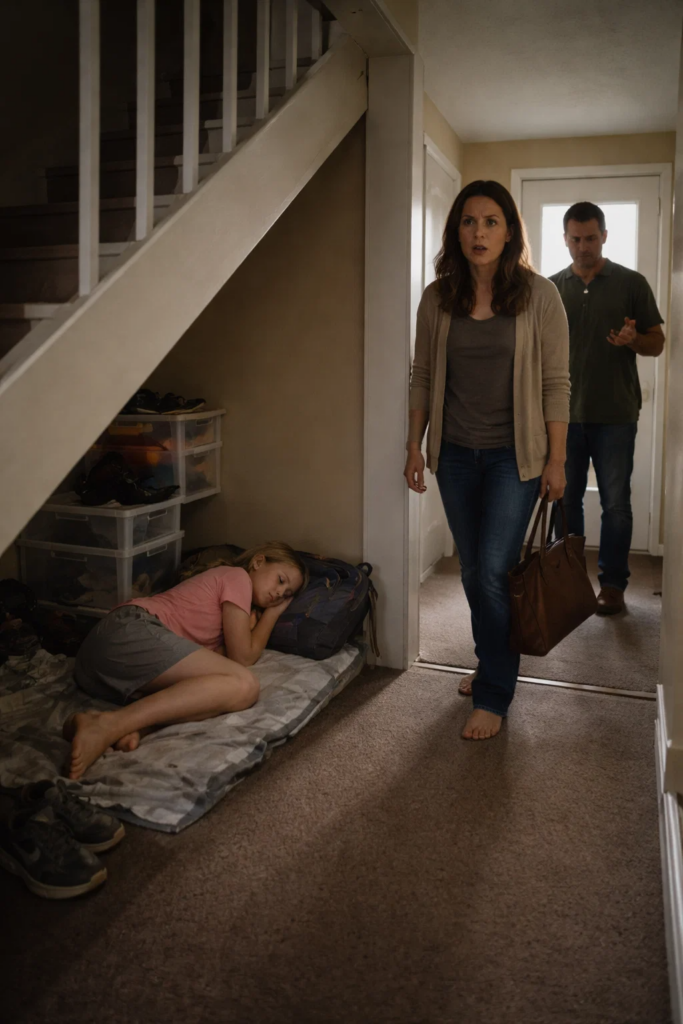
Maribel, my eldest daughter, was curled tightly beneath the staircase that led to the basement, her thin blanket tucked around her shoulders with the careful precision of a child who had learned not to take up too much space, her knees drawn to her chest, her face half-hidden in shadow except for the faint glow of a nightlight plugged awkwardly into a wall socket nearby, and for a moment my brain refused to understand what my eyes were telling it.
Maribel was eleven years old, still young enough to need a soft light through the night because darkness pressed in too heavily when she was alone, still sensitive to cold floors and unfamiliar sounds, still someone who flinched at raised voices even when they weren’t meant for her, and seeing her sleeping on concrete beneath the stairs, in a place meant for boxes and forgotten things, felt so violently wrong that my breath left my body before I realized I had stopped breathing.

“Grant,” I said quietly, my voice trembling despite my effort to keep it steady, “why is Maribel sleeping here?”
He looked down, confusion flickering across his face before settling into something uneasy.
“What do you mean?” he asked, though his eyes had already followed mine.
I dropped my bag and knelt beside her, brushing hair gently away from her face, careful not to wake her, because even asleep she looked tense, as if rest was something she had borrowed rather than been given, and when she stirred slightly, her eyes fluttered open, immediately searching the darkness with practiced caution.
“Mom?” she whispered.
“I’m here,” I said, forcing calm into my voice as I wrapped my arms around her, feeling how cold her hands were, how stiff her body felt from sleeping on a hard surface. “Why are you down here, sweetheart?”
She hesitated, her gaze flicking past me toward the living room, and then back again, the way children do when they’re weighing truth against consequences.
“Grandma said it was better,” she murmured finally, her voice so small it barely carried. “She said Sadie needed her room because she’s family, and I could sleep here since I don’t mind.”
Something inside me went very still.
“Did she say why?” I asked gently, though every muscle in my body felt like it was bracing for impact.
Maribel swallowed.
“She said I should understand my place,” she said, choosing her words carefully, as though she had practiced them in her head. “She said I wasn’t really part of this family the same way Sadie is, and that I shouldn’t make things harder.”
I stood slowly, my hands shaking now despite myself, and looked directly at Grant, whose face had gone pale in a way I had never seen before.
“She said what?” he asked, his voice barely above a whisper.
I didn’t answer him immediately, because my priority was lifting Maribel gently into my arms, carrying her to her bedroom, tucking her into her own bed where she belonged, pulling blankets around her and kissing her forehead until her breathing evened out again, until I could see her shoulders relax in a way they clearly hadn’t downstairs.
Only then did I step back into the hallway and close the door behind me.
“What the hell happened while we were gone?” I asked, my voice low and sharp, the kind of calm that exists only because screaming would wake children.
Grant ran a hand through his hair.
“My mom offered to help,” he said, avoiding my eyes. “She said she’d handle bedtime, meals, everything. I thought—”
“You thought what?” I interrupted. “That she suddenly stopped making comments about Maribel not being your ‘real’ child?”
He flinched.
“She’s never done anything like this before,” he said weakly.
“She’s always done this,” I replied, my voice shaking now despite my effort. “She’s just never had the opportunity to do it without me here.”
We didn’t argue that night, not properly, because grief and exhaustion pressed too heavily on both of us, but something fundamental shifted between us in that moment, a line crossed that could not be uncrossed simply by apologies.
Linda returned the next afternoon, cheerful and oblivious, bringing Sadie back from the park with ice cream on her hands and stories spilling out of her mouth, and when she saw me, she smiled warmly, the practiced smile of someone who believed herself untouchable.
“Everything went just fine,” she said brightly. “The girls were angels.”
I looked at her, really looked at her, and wondered how someone could smile so easily while carrying cruelty so lightly.
“Thank you for watching them,” I said evenly. “It must have been a lot.”
“Oh, you know me,” she laughed. “Family always comes first.”
I smiled back.
That was when I decided not to confront her directly, not yet, because anger would only give her the opportunity to deflect, to minimize, to rewrite what had happened, and what Maribel needed was not a shouting match, but certainty, safety, and proof that she would never be quietly pushed into corners again.
Linda’s annual family gathering was approaching, an event she treated like a personal legacy, something she curated meticulously, from the matching tablecloths to the carefully chosen guest list, and when I offered to help with planning, her delight was immediate.
“I’d love that,” she said. “You always have such good ideas.”
I did not correct her.
In the weeks leading up to the event, I spoke gently but honestly with relatives, not with accusations or dramatics, but with quiet truths slipped into conversations where they could not be ignored, mentioning how Maribel had struggled lately, how she had slept under the stairs while we were away, how children sometimes internalize words adults think don’t matter.
Reactions ranged from shock to discomfort to outright anger, and by the time the day arrived, the atmosphere carried an undercurrent Linda could sense but not control.
The slideshow played after dinner, beginning with familiar images of birthdays and holidays, smiles and shared moments, until the image shifted, subtly at first, to a photo of Maribel asleep beneath the staircase, her small body curled inward, a nightlight glowing beside her like a fragile shield, and the silence that followed was absolute.
Linda stood abruptly, her face drained of color.
“That’s not—” she began.
But she didn’t finish, because no explanation could erase what everyone had seen.
Later, when people left, when the house finally quieted, Linda approached me, her voice shaking with something that sounded suspiciously like fear.
“You embarrassed me,” she said.
“No,” I replied calmly. “You revealed yourself.”
She didn’t return after that, not for a long time, and when she eventually did, it was with an apology that was cautious and incomplete, but real enough to begin a boundary rather than erase one.
Grant attended counseling with me, learned to listen without defending, learned that neutrality in the face of harm is not kindness, and Maribel, slowly, began to take up space again, her laughter returning in small, precious increments.
One night, months later, I found her asleep in her bed, nightlight glowing softly, blankets kicked halfway off, sprawled comfortably across the mattress like a child who finally believed she belonged exactly where she was.
And as I turned off the hallway light, I knew with absolute certainty that some lines, once crossed, are not meant to be repaired the way they were before, but rebuilt stronger, clearer, and far less forgiving of cruelty disguised as tradition.



Leave a Reply