“Please, She Can’t Breathe,” the Stranger Whispered at 3 A.M. — Minutes Later, Men in Suits Arrived, and the Doctor Realized the Child Wasn’t Just a Patient.
The automatic doors of Harborline Children’s Hospital were not designed to be forced open at three in the morning, not in a coastal town where the loudest sound after midnight was usually the surf colliding with rock or a fishing boat coughing to life before dawn, yet that night the doors burst inward so violently that the glass rattled in its frame, and for one suspended, impossible second, the emergency room stopped breathing.
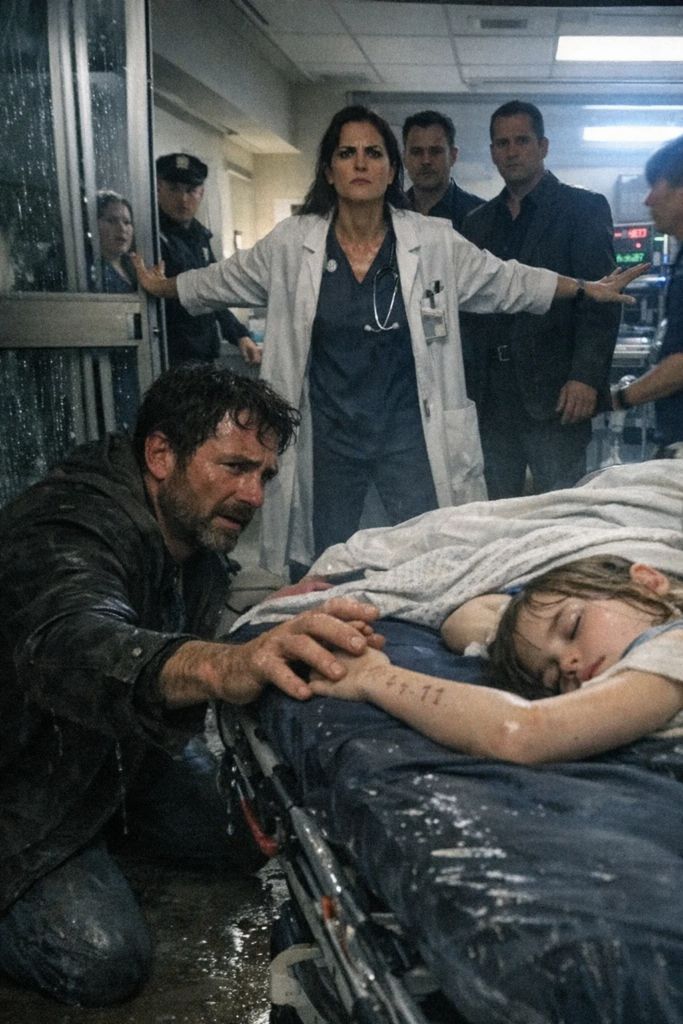
A man stood in the doorway, rain cascading from his shoulders, his leather jacket darkened with seawater and road grime, his boots leaving wet footprints across the polished floor, his silhouette framed by stormlight like something torn from a nightmare. He looked like the kind of figure parents warned children about, the kind people crossed the street to avoid, tall and broad, hair tied back, face lined by years of wind and regret.
In his arms, he carried a little girl.
She couldn’t have been more than seven. Her head lolled against his chest, curls plastered to her pale cheeks, her lips tinged blue, her small body frighteningly light in his grip. One of her shoes was missing. The other dangled from her toes as if she’d tried to kick it off while running.
“Please,” the man said, and the word cracked in half as it left him. “She can’t breathe. She’s burning up. I don’t know what’s wrong.”
For a heartbeat, no one moved.
Then Dr. Mara Lin, the attending physician on duty, stepped forward, her training overriding the primal instinct to retreat.
“Gurney, now,” she called.
Nurses rushed forward, wheels squealing. Mara moved directly into the man’s space, close enough to smell salt and gasoline and blood that wasn’t his.
“Sir, I need you to put her down so we can help her,” she said calmly.
His arms tightened.
“She’s all I’ve got,” he whispered. “They told me to leave her.”
Mara met his eyes. She saw no threat there, only terror, the kind that comes when you know time is running out.
“You brought her here,” she said gently. “That means you haven’t left her.”

Something in him broke. He lowered the girl onto the gurney with reverence, his hands lingering as if afraid she would vanish the moment he let go. As the nurses rushed her through the swinging doors, he staggered backward, collapsing into a chair, his head falling into his hands.
“What’s her name?” the intake clerk asked.
The man stared at his palms. “Lila.”
“Last name?”
He swallowed. “She doesn’t have one.”
That was when the police arrived.
Two officers stepped inside, summoned by a nervous security guard who had used the word intruder. Their hands hovered near their belts as their eyes locked onto the man.
“Rowan Hale,” one officer said. “You’re a long way from the docks. What’s going on?”
Rowan didn’t look up. “Saving a kid.”
Inside the trauma bay, monitors screamed as Lila’s temperature spiked. Mara’s hands moved with practiced urgency, IV lines sliding into place, oxygen flowing.
As she rolled up Lila’s sleeve, Mara froze.
On the inside of the girl’s arm, just below the elbow, were numbers.
09-14-18.
They weren’t decorative. They weren’t part of a bracelet or bandage.
They were inked into her skin.
“Run her through the system,” Mara said quietly.
At the nurses’ station, Jenna typed rapidly. “Nothing. No birth certificate. No school record. No pediatric visits. It’s like she doesn’t exist.”
Every computer in the ER went dark.
Then rebooted.
Then locked.
An unfamiliar emblem flashed across every screen.
Outside, Rowan lifted his head as the lights flickered.
“They found her,” he murmured.
The radios crackled.
“All units,” the dispatcher said, her voice suddenly stripped of warmth, “this facility is under federal hold. Detain Rowan Hale immediately. This is not a criminal investigation.”
One officer frowned. “Then what is it?”
A pause.
“An administrative recovery,” came the reply. “Do not interfere.”
Three men in dark suits entered through a side corridor, moving with effortless authority. The one in front smiled politely.
“We’ll take the child now,” he said.
Mara stepped forward. “She’s unstable.”
“She is property,” the man replied softly.
Through the glass, Lila’s eyes fluttered open.
“Don’t let them take me,” she whispered.
Rowan surged to his feet. “You promised,” he said hoarsely. “You said I could keep her.”
The man’s smile vanished. “That was before we realized she could still talk.”
One of the officers hesitated.
Rowan looked at him. “My sister vanished five years ago,” he said quietly. “No body. No answers. Then this girl crawled out of the woods near an old research site and called me Uncle like she’d known me forever. You think that’s coincidence?”
The officer’s jaw tightened.
Rowan continued, his voice shaking. “She knows things no kid should know. She recites procedures in her sleep. She thought being locked in glass rooms was normal.”
The officer reached down.
Cut the cuffs.
Alarms screamed.
Mara didn’t wait for instructions. She lifted Lila into her arms and ran.
They moved through service corridors as the hospital descended into chaos. Rowan cleared doors, overturned carts, blocked agents long enough for Mara to reach the ambulance bay.
Bullets shattered mirrors.
The engine roared.
They disappeared into the night.
Harborline Children’s Hospital erased every trace of Lila by morning.
But far from the coast, in a town where no one asked questions, a girl learned to draw stars instead of numbers.
And every night, a man sat beside her bed, reminding her that she was not an experiment.
She was a child.
And she was free.
Leave a Reply