My Stepmother Ruined My Graduation in Front of Everyone — What She Did After Forced Us All to Face the Truth
Graduation was supposed to be the clean dividing line between everything I had survived and everything I was finally allowed to hope for, the kind of day people tell you to remember forever because it proves that effort eventually turns into something solid, something no one can take away from you, and yet when I woke up that morning, standing in front of my mirror adjusting a borrowed gown that felt heavier than it looked, I already had a strange knot in my stomach that had nothing to do with nerves and everything to do with my family.
My name is Rachel Monroe, and until that day, I truly believed that if I tried hard enough, if I stayed polite enough, if I kept being the reasonable one, then maybe the adults in my life would eventually meet me halfway.
That belief didn’t survive my graduation.
My biological mother arrived first, just like she always did, ten minutes early, carrying a bouquet of sunflowers so bright they looked almost defiant against the gray morning sky, and when she saw me she smiled with the kind of pride that made my chest tighten.
“You did it,” she said softly, pressing the flowers into my arms as if they were fragile. “I knew you would, but seeing you like this still doesn’t feel real.”
“Mom,” I laughed, hugging her carefully so I wouldn’t wrinkle the gown, “you’re going to make me cry before the ceremony even starts.”
She pulled back just enough to cup my face. “Crying is allowed today. You earned it.”
I was still smiling when I saw my father walking toward us, his tie crooked the way it always was when he was nervous, and beside him was my stepmother, Marianne, dressed impeccably in a pale blue dress that looked chosen specifically to photograph well.
My smile tightened, but I stepped forward anyway.
“Hey, kiddo,” my dad said, hugging me a little too tightly. “You ready to be done with high school forever?”
“More than ready,” I replied, glancing briefly at Marianne. “I’m glad you both could make it.”
Marianne’s lips curved into a smile that didn’t quite reach her eyes. “Of course we came,” she said. “A graduation like this is a family milestone.”
My mother nodded politely. “It’s nice to see you, Marianne.”
Marianne’s gaze flickered to my mother and then away, so fast I almost missed it, and something cold settled just under my ribs.
My parents had divorced when I was eight, not explosively, not with screaming or court battles, but with a quiet sadness that lingered for years, and my father remarried less than eighteen months later, bringing Marianne into my life with the expectation that we would simply adjust, that blended families were like puzzles that snapped together if you pressed hard enough.

I tried.
I really did.
But Marianne had always carried a sharp edge when it came to my mother, a subtle competitiveness that surfaced in small ways—standing too close to my father, correcting him unnecessarily, reminding people loudly that she was “the wife now,” as if the title itself needed defending.
Still, this was my graduation, and I told myself that surely, surely, no one would choose today to make things about themselves.
The ceremony passed in a blur of applause and nerves and names mispronounced over a crackling microphone, and when I walked across the stage, my heart felt like it might burst out of my chest, because for one moment, one perfect moment, all the complicated parts of my life faded behind the simple fact that I had done this.
When it was over, families spilled out onto the lawn in clusters of laughter and cameras, and my friends pulled me into hugs that smelled like sunscreen and cheap perfume, signing my graduation cap with inside jokes and promises to stay in touch, each signature feeling like a tiny anchor to a chapter that was already slipping away.
It was when the crowd thinned just enough that I turned to my parents and said, as casually as I could, “Hey, can we get a picture? Just me with Mom and Dad?”
The air shifted instantly.
Marianne’s smile vanished as if it had never been there.
“What do you mean, just the three of you?” she asked, her voice sharp enough that my shoulders stiffened.
“I mean,” I said carefully, already wishing I’d phrased it differently, “just one photo, with my biological parents. It’s kind of important to me.”
My mother opened her mouth, probably to smooth things over, but Marianne spoke first.
“That’s inappropriate,” she said flatly. “You’re asking my husband to pose like we’re not married.”
I felt heat rush to my face. “That’s not what I’m saying. It’s not about you at all. It’s about me.”
My father frowned. “Marianne, it’s just a picture.”
“No,” she snapped, her voice rising. “It’s disrespectful. I won’t be erased so she can play happy family with your ex.”
My mother stepped back slightly, hands raised in a gesture of peace. “No one is erasing you. Rachel just wants a memory from her graduation day.”
Marianne’s eyes flashed. “And what about my feelings? Do they matter to anyone here?”
I could feel people starting to look over, curiosity pulling their attention toward us, and panic clawed at my throat.
“Please,” I said quietly, my voice breaking despite my effort to stay calm. “It’s one photo. I promise.”
For a moment, I thought she might relent, that she would take a breath and remember where she was, but instead she did something so sudden and violent that it stunned me into stillness.
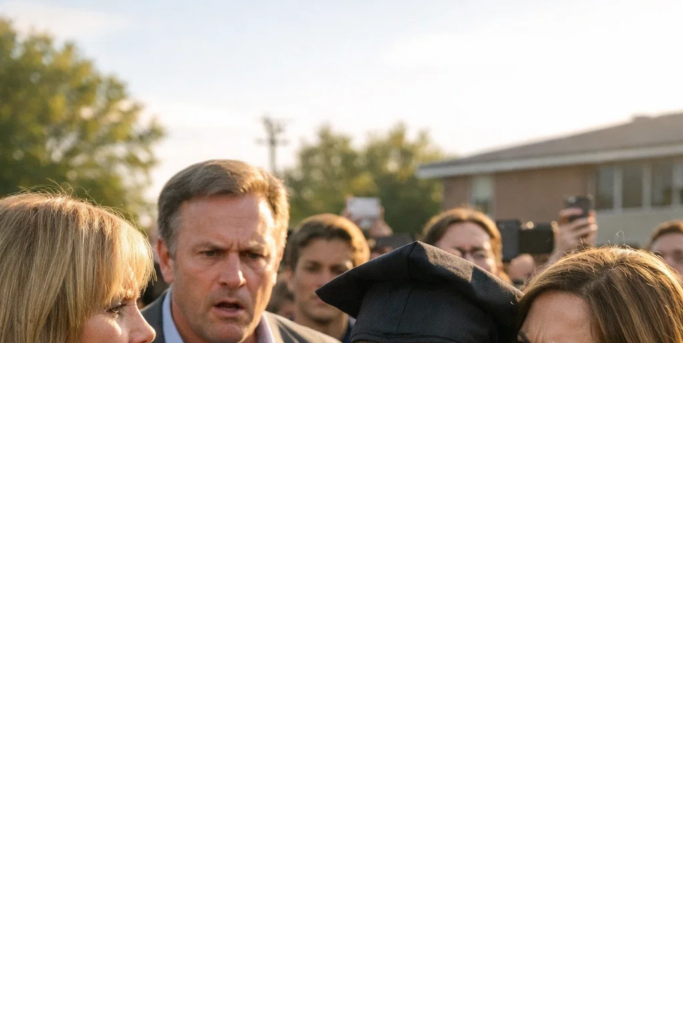
She reached up, grabbed the edge of my graduation cap, and yanked it off my head.
“Marianne, stop,” my father shouted, but it was too late.
She ripped the tassel free, then tore straight through the fabric, the sound loud and awful, like paper being shredded, and I watched in disbelief as the cap I had carried all day, the one covered in messages from friends and teachers and memories I could never recreate, collapsed into her hands.
Gasps rippled through the crowd.
I couldn’t breathe.
For a split second, the world narrowed to the scraps of black fabric in her fists and the echo of something precious being destroyed for no reason that made sense.
“What is wrong with you?” my father yelled, his face red with shock and anger. “That was her graduation cap. How could you do that?”
Marianne looked at him as if she had only just realized what she’d done, but instead of apologizing, she straightened her spine.
“I was pushed,” she said. “I won’t be disrespected in public.”
My mother stepped forward, wrapping an arm around me as tears spilled down my cheeks despite my efforts to hold them back.
“This day wasn’t about you,” she said quietly, her voice trembling with fury she rarely showed. “It was about her.”
Marianne said nothing more. She turned and walked away, heels clicking sharply against the pavement, leaving behind a silence so thick it felt physical.
“I’m so sorry,” my dad said, his voice hollow as he looked at the ruined cap. “I had no idea she would react like that. I swear to you, Rachel, I’ll fix this.”
I nodded because I didn’t know what else to do, but inside, something had cracked.
That night, we gathered at my father’s house for a small celebration, though “celebration” felt like the wrong word for a room filled with forced smiles and unspoken tension.
To my shock, Marianne showed up.
She sat stiffly beside my father, barely speaking, while my mother busied herself in the kitchen, determined not to let the day end in bitterness.
I stayed quiet, picking at a slice of cake I couldn’t taste, watching them from across the room, my chest tight with anger and exhaustion.
Eventually, my father stood and motioned for Marianne to follow him outside.
I waited a few seconds, then slipped toward the patio door, stopping just close enough to hear.
“Do you have any idea what you did to her?” my father asked, his voice low but furious. “That was cruel, Marianne. Completely unacceptable.”
“I lost control,” she said, her voice small now. “Seeing you with her, with your ex… it made me feel invisible.”
“That doesn’t justify destroying something she can never replace,” he replied. “I love you, but if this continues, I can’t keep asking my daughter to pay for your insecurities.”
There was a long pause.
“I know,” Marianne whispered. “I messed up. I hate who I was in that moment.”
“You need to make it right,” he said. “And not for me.”
I stepped back before they noticed me, my heart pounding.
Later that evening, as I stood by the window, staring out at the quiet street and wondering how something so important could feel so broken, Marianne approached me slowly.
“Rachel,” she said softly, holding something behind her back, “can we talk?”
I turned to face her, arms crossed, every instinct telling me to walk away.
She took a breath and held out a brand-new graduation cap.
“I contacted your school,” she said, her voice shaking. “And your friends. They helped me recreate it. It’s not the same, but… I wanted to try.”
Attached to the cap was a small envelope.
Inside, a handwritten note read:
I was wrong. I let my fear hurt you, and I will regret that for a long time. You deserved better from me. I hope one day I can earn your forgiveness.
I looked up at her. “Why did you really do this?” I asked. “Because you’re sorry, or because you’re afraid Dad will leave?”
She didn’t look away. “Both,” she admitted. “But mostly because I saw the look on your face today, and I realized I became the kind of person I never wanted to be.”
I studied her for a long moment, then said quietly, “If you’re serious, you’ll respect my relationship with my mom, not compete with it.”
She nodded immediately. “I promise.”
I handed her my phone. “Then take the picture.”
Her hands trembled as she raised the camera and took a photo of me standing between my parents, holding my new cap.
Then I gestured for her to join us.
“Now one with everyone,” I said.
She hesitated, then stepped in, tears sliding down her cheeks as the shutter clicked.
Forgiveness didn’t come instantly, and it didn’t erase what happened, but it opened the door to something better than resentment.
Sometimes, healing doesn’t mean forgetting the damage.
It means choosing to move forward anyway, with clearer boundaries, braver honesty, and the understanding that even deeply flawed people can change when they’re finally forced to face themselves.
Leave a Reply