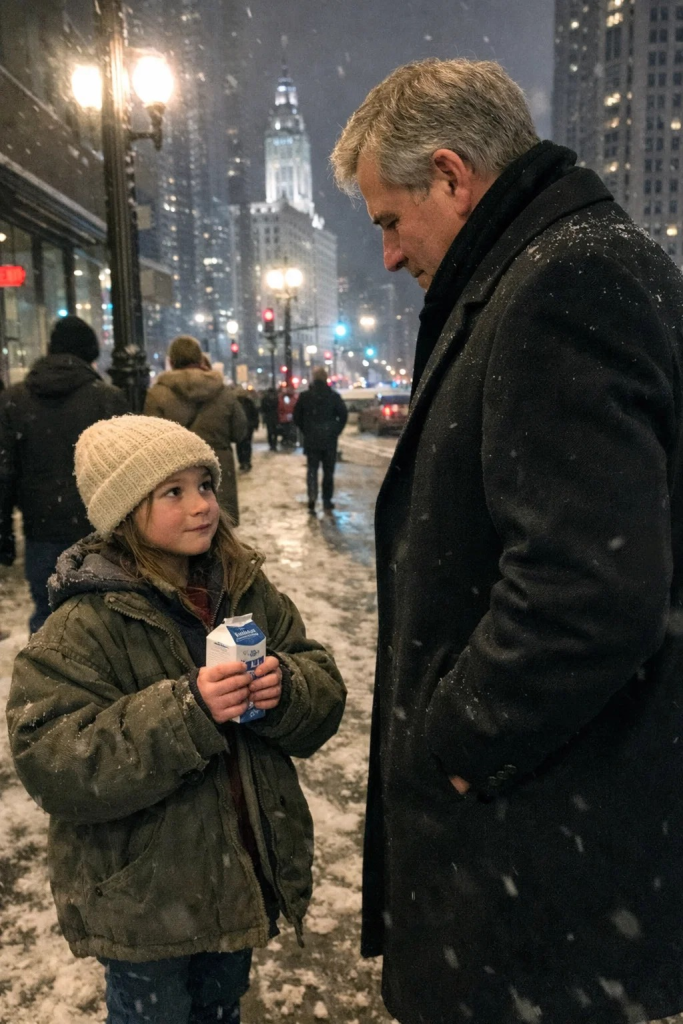
“Could you help me buy some milk? Just one box. I’ll pay you back someday. I swear.” – A Homeless Girl Asked a Ruthless Billionaire for Milk on a Freezing Night — Seventeen Years Later, She Returned to Repay Him in a Way He Never Expected
It was a late February evening in Chicago, the kind of cold that didn’t announce itself loudly but crept in slowly, biting through fabric and settling deep into the bones. The sidewalks were slick with half-melted snow, streetlights reflecting off puddles like tired stars, and the city moved with its usual indifference—people hunched into themselves, collars raised, eyes fixed forward, as if looking too closely at anyone else might slow them down.
That was when a voice stopped him.
“Sir… excuse me, sir.”
The man turned, more out of reflex than intention. His name was Richard Vaughn, and most people in the city recognized it—not because they knew his face, but because they knew what it stood for. Vaughn Capital. Commercial real estate. Aggressive acquisitions. Ruthless negotiations. A man who built an empire brick by brick and never apologized for the weight of it.
The girl standing in front of him couldn’t have been more than nine or ten. Her hair was tucked unevenly under a faded knit hat, her coat clearly too big, sleeves swallowing her hands. Her lips were cracked from the cold, and she was holding a cardboard sign that had been folded and unfolded so many times the words were barely legible.
“My little brother hasn’t eaten today,” she said, her voice trembling but steady. “Could you help me buy some milk? Just one box. I’ll pay you back someday. I swear.”
People passed them without slowing, some pretending not to hear, others glancing just long enough to reassure themselves it wasn’t their responsibility.
Richard looked at her longer than he meant to.
“What’s your name?” he asked.
She hesitated, as if unsure whether answering correctly mattered. “Mara. My brother’s name is Owen. He’s sick.”
He had heard a thousand pitches in his life—startup founders promising returns, lawyers offering guarantees, politicians selling certainty. But this wasn’t a pitch. This was a child staking her dignity on a promise she had no way of keeping.
“You’re going to repay me,” Richard repeated, not unkindly.
“Yes,” she said immediately. “When I grow up.”

Something shifted. It wasn’t sentimentality. It wasn’t pity. It was recognition—of responsibility, of resolve, of a kind of courage that couldn’t be taught in any boardroom.
“Come on,” he said after a moment, gesturing toward the convenience store across the street.
Inside, the fluorescent lights hummed softly. Richard filled a basket—milk, bread, soup, fruit, a small pack of medicine the clerk recommended. Mara watched silently, her eyes darting between the items and his face, as if afraid the moment might evaporate if she blinked too hard.
When he handed her the bag, she clutched it like it was made of glass.
“Take care of your brother,” Richard said. “That’s payment enough.”
She nodded so hard her hat nearly slipped off. “Thank you,” she whispered, then paused. “I won’t forget this.”
“I know,” he replied, surprising himself with how certain he felt.
She ran back into the night, small boots splashing through slush, disappearing into the maze of alleys and side streets. Richard stood there longer than necessary, the warmth of the store fading from his coat, feeling unsettled in a way he couldn’t quite explain.
He told himself it was nothing. Just another face in a city full of them.
But it wasn’t.
Years passed, as they tend to do, quietly and relentlessly. Chicago grew upward and outward. Richard’s company expanded into new markets, new cities. He grew wealthier, more influential—and lonelier. His marriage dissolved not with drama, but with exhaustion. His penthouse echoed at night. His success tasted increasingly hollow.
He donated, of course. Galas. Foundations. His name etched into plaques. But none of it filled the space that had opened somewhere inside him—a quiet, persistent awareness that something essential was missing.
Then, nearly seventeen years later, his assistant knocked on his office door.
“There’s a woman here to see you,” she said. “She doesn’t have an appointment, but she says you’ll want to talk to her.”
Richard sighed. “Everyone says that.”
“She mentioned… milk.”
That stopped him.
When the woman entered, he saw confidence first. She stood straight, professionally dressed, her eyes alert and calm. But beneath that was something familiar—a steadiness forged under pressure.
“My name is Dr. Mara Collins,” she said. “I don’t know if you remember me.”
He did.
The memory hit him all at once: snow, a cardboard sign, a promise spoken through chattering teeth.
“You were a child,” he said slowly.
“Yes,” she replied. “And you bought my brother milk.”
Owen had survived. Not easily, not without struggle, but he lived. Social workers eventually intervened. A shelter took them in. Teachers noticed Mara’s intelligence. Scholarships followed. Long nights of study, second jobs, exhaustion—but she kept going.
“I promised I’d repay you,” she said. “Not with money. With something better.”
Her proposal was ambitious: a mobile health initiative for homeless families, starting in Chicago but designed to expand nationwide. Not charity for show, but systems that lasted. Accountability. Dignity.
Richard listened, really listened, for the first time in years.
But not everyone welcomed the idea.
A competing developer, Franklin Moore, showed up in city meetings, arguing against zoning permits, claiming the clinics would “lower property values.” Behind closed doors, he pushed harder—leveraging connections, burying applications, delaying approvals.
Mara noticed the resistance. She gathered evidence. She documented emails. She refused to be intimidated.
“This isn’t about me,” she told Richard one night over coffee. “It’s about children who never get a chance.”
Richard made a choice then—not as a businessman, but as a man finally ready to stand on the right side of something that mattered.
When the investigation into Moore’s dealings went public, it unraveled quickly. Corruption charges followed. Projects froze. Reputations collapsed.
The clinic opened six months later.
Children filled the waiting room. Murals brightened the walls. Nurses laughed. Parents cried—not from despair, but relief.
Richard stood at the opening ceremony, watching Mara speak with quiet authority, her brother beside her, healthy and smiling.
“You kept your promise,” he said.
“So did you,” she replied. “You just didn’t know it yet.”
Richard didn’t live forever, but he lived well after that. His legacy wasn’t a skyline—it was a generation of children who grew up healthier, safer, seen.
Mara continued the work, expanding the program, mentoring others like her. She built a life grounded not in what she’d survived, but in what she chose to give back.
And Franklin Moore? He faded into footnotes and court records, a reminder that power without integrity always collapses under its own weight.
Sometimes the smallest kindness becomes the longest echo.
And sometimes, a single box of milk is enough to change the future.


Leave a Reply