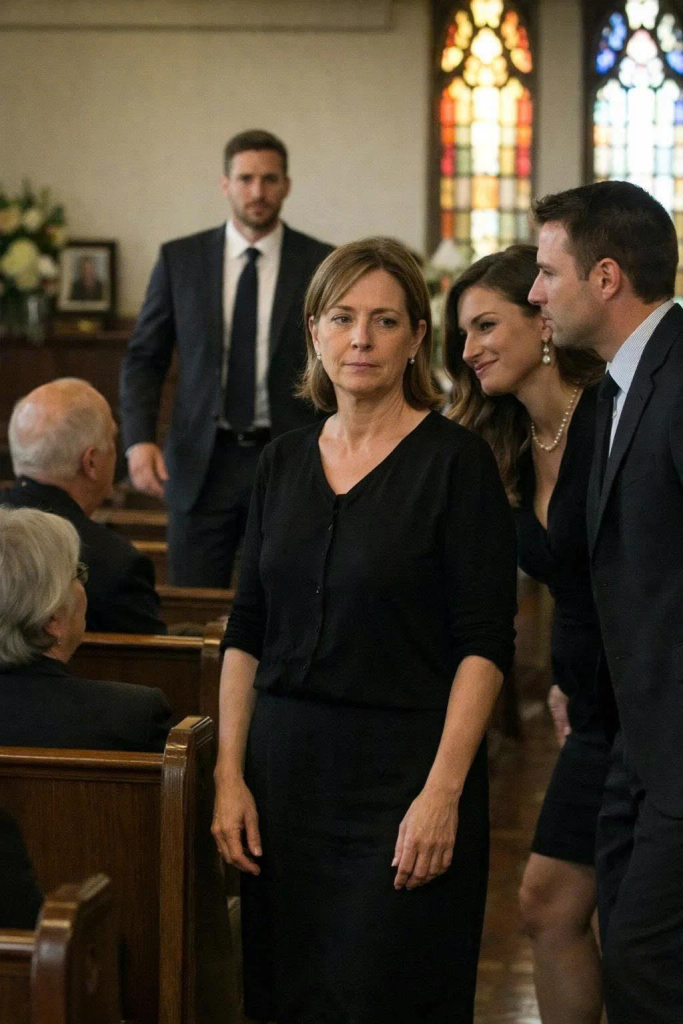
“Still alone?” “Thirty-eight now, right? I almost didn’t recognize you without a ring.” — My Sister Stole My Fiancé, Mocked Me at Our Mother’s Funeral, and Didn’t Realize the Man Walking Toward Me Was About to End Everything She Thought She’d Won
Six years ago, Hannah Moore learned a lesson she never thought she would need to survive: betrayal doesn’t always arrive wearing the face of an enemy, sometimes it walks into your life smiling, calling you sister, and asking to borrow your future.
At thirty-two, Hannah had been engaged, hopeful, and foolishly certain that loyalty was something blood guaranteed. Her younger sister, Claire, had always lived a step behind her, copying her clothes, her friends, her ambitions, and finally, the man Hannah was supposed to marry. Andrew Keller was charming in the way men with money often are, confident without substance, generous only when being watched, and deeply uncomfortable with women who expected more than admiration, yet Hannah had believed love would soften his sharper edges because that was what she had been taught to believe.
The night she discovered the truth, there had been no dramatic confrontation, no screaming, no shattered glass, only a quiet email accidentally forwarded, a hotel receipt that didn’t lie, and a sister who refused to answer her phone. Within weeks, Andrew and Claire had made their betrayal official, framed it as fate, and told anyone willing to listen that feelings “just happened,” while Hannah packed a suitcase, swallowed her humiliation, and left Boston without looking back.
She moved to Chicago, rebuilt herself brick by brick, poured her grief into long hours and ambition, and became a name in her field not because she wanted revenge, but because survival demanded excellence. She learned how to be alone without being lonely, how to succeed without needing applause, and how to forgive herself for loving people who did not deserve it. Their mother, Patricia, called often, always hopeful that time would repair what betrayal had destroyed, but Hannah understood that some fractures don’t heal, they simply stop bleeding.
Then Patricia died.
The funeral was held in their hometown, in a chapel that smelled of lilies and old wood, a place filled with memories Hannah hadn’t visited in years. She arrived early, dressed simply, composed, not bracing herself for pain anymore, but for disappointment, because disappointment was familiar and manageable. She stood near the front, listening to soft organ music, when the doors opened behind her.
Claire entered as if on cue.
She was draped in black silk, diamonds catching the light with deliberate precision, her arm looped through Andrew’s as though possession itself were an accessory. They walked slowly, ensuring every head turned, and Hannah felt the ripple of recognition move through the room like a whispered rumor finally confirmed.
Claire’s gaze found her immediately.
She smiled.
“Still alone?” Claire said softly as she approached, her voice sweet, sharpened by years of rehearsed superiority.
“Thirty-eight now, right? I almost didn’t recognize you without a ring.”
Hannah looked at her sister, really looked, and felt nothing but a distant curiosity, the way one might examine an old scar.
“I’m sorry for your loss,” Andrew added, though his eyes flicked past Hannah as if measuring the room, not the moment.
Claire’s smile widened.
“I suppose not everyone gets the fairytale,” she continued, lifting her hand just enough for the diamond to catch the overhead light.
“I got the man, the money, and the house on the hill. Some of us just win.”

The words landed, not with impact, but with emptiness, because Hannah realized something in that instant that surprised even her: Claire still thought this was a competition, and Hannah had stopped playing years ago.
She smiled.
It wasn’t sharp. It wasn’t forced. It was calm.
“Have you met my husband yet?” Hannah asked.
The air shifted. Claire blinked. Andrew stiffened.
“I didn’t know you were married,” Claire said, the first crack appearing in her voice.
“I am,” Hannah replied, turning slightly toward the aisle.
“He should be here by now.”
As if summoned by the quiet certainty in her tone, footsteps echoed across the stone floor, steady and unhurried. The man who approached did not rush, did not look around to assess the room, because he didn’t need to. His presence carried weight without effort, authority without arrogance, and when he reached Hannah, his attention belonged entirely to her.
“Everything alright?” he asked gently, his hand resting at the small of her back in a way that was protective without being possessive.
“Yes,” Hannah said. “Now it is.”
Claire’s face drained of color.
Andrew stared.
“You,” Andrew whispered, recognition colliding with fear.
“You’re… you’re Richard Lawson.”
Richard inclined his head politely.
“And you are?” he asked, though it was clear he already knew.
Andrew swallowed.
“I work for Lawson Capital,” he said, his voice unsteady. “Senior acquisitions.”
“Ah,” Richard replied evenly. “Then you already know my wife.”
Hannah felt the moment settle around them like a closing door. Richard Lawson wasn’t just wealthy; he was the man whose signature decided which companies survived recessions and which didn’t, a strategist known for rewarding integrity and dismantling arrogance with equal precision.
Claire laughed nervously.
“This isn’t funny,” she said, looking at Hannah.
“You didn’t tell me you were married.”
“You didn’t ask,” Hannah replied.
“And I stopped volunteering my life to people who enjoy twisting it.”
Richard looked at Claire then, not with hostility, but with an unsettling neutrality.
“You must be the sister,” he said.
“Hannah mentioned you once, a long time ago, when she was explaining why honesty mattered to her.”
Andrew shifted.
“Sir,” he began, “I can explain—”
“I’m sure you can,” Richard interrupted calmly.
“You’ve been explaining things for years, according to the internal reviews I’ve been reading.”
Andrew’s breath hitched.
Claire frowned.
“What reviews?”
Richard’s gaze returned to Hannah, his voice gentle again.
“The service is about to begin,” he said. “Do you want to stay?”
Hannah looked at her sister, who was gripping her purse too tightly now, at Andrew, whose confidence had begun to leak away under the weight of consequences.
“No,” she said. “I’ve already said goodbye.”
As they turned to leave, Claire spoke, desperation breaking through her practiced cruelty.
“You think you won,” she said. “You think this proves something?”
Hannah stopped, turned back once, and met her sister’s eyes without anger.
“No,” she said softly. “I think it proves that I stopped losing.”
They walked out into the afternoon light, the chapel doors closing behind them, sealing off a chapter that no longer had power over her. Weeks later, the fallout arrived quietly, as real consequences often do. Andrew’s career stalled, then unraveled, not because Richard intervened directly, but because integrity audits have a way of exposing men who mistake charm for competence. Claire’s carefully curated life shrank under the weight of debt and disappointment, and for the first time, she had no one else to blame.
Hannah never celebrated their downfall.
She didn’t need to. She had built something better.
That evening, as she and Richard sat on the balcony of their home overlooking the city she had chosen for herself, she rested her head against his shoulder, breathing in the peace she had earned.
“You okay?” he asked.
“Yes,” she said, watching the lights flicker on one by one.
“I finally am.”
And for the first time in six years, the past stayed where it belonged—behind her.


Leave a Reply