My Husband Broke My Nose in the Kitchen While His Parents Watched — “Stop Being Dramatic, It’s Just a Scratch,” His Mother Said, But That Night I Walked Out Bleeding, Filed a Police Report, and Ended the Marriage for Good
The night my life finally cracked open did not arrive with warning or ceremony; it came disguised as an ordinary argument, the kind I had learned to endure with a lowered voice and careful posture, and it carried the smell of bleach from the freshly wiped counters mixed with burned oil from a pan forgotten on the stove, a smell that would stay with me long after the bruises faded.
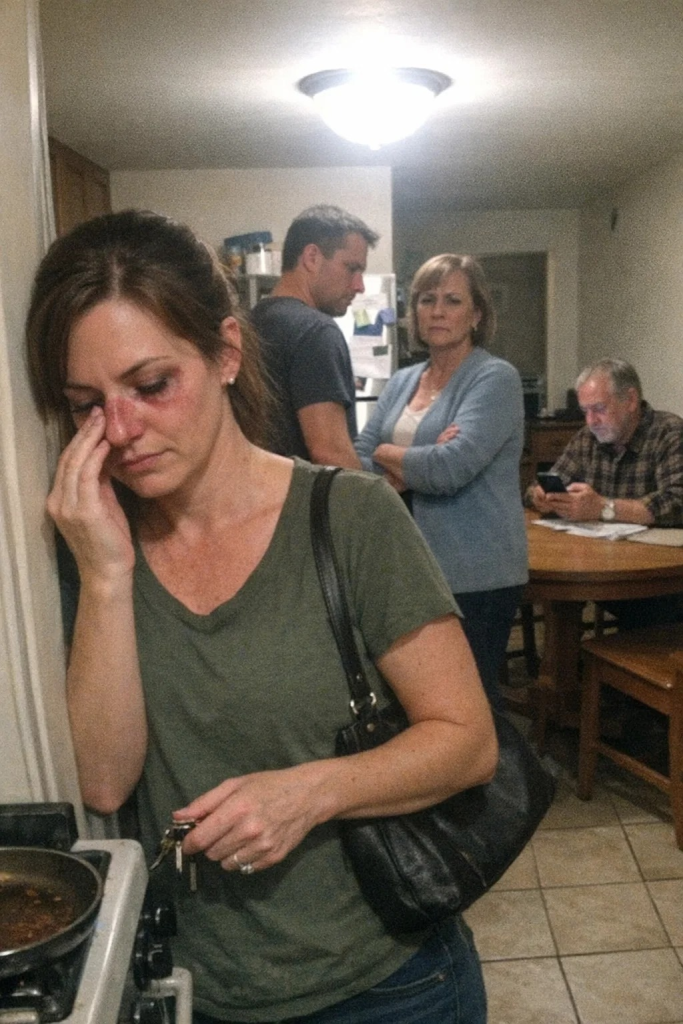
My husband, Thomas, was standing in the kitchen, jaw tight, eyes already hard with the kind of anger that didn’t need fuel anymore. He had been pacing, complaining about dinner cooling too fast, about money, about how I never paid attention the right way, and I stood near the refrigerator clutching a dish towel like it was something solid enough to hold me in place. I remember thinking, absurdly, that if I stayed calm enough, if I chose the right words, this version of him might pass.
“Why are you looking at me like that?” he snapped, stepping closer.
“I’m not,” I said quietly, and that was my mistake. The towel slipped from my hands. His palms hit my shoulders, and before I could take a step back, my spine slammed into the refrigerator door. The sound was sharp and metallic, magnets clattering, a grocery list fluttering down like it was embarrassed to be there. Then his knee came up, fast and deliberate.
I heard the crunch before I felt the pain.
Warmth flooded my face, thick and shocking, and my scream came from somewhere deep and animal, not fear yet, just disbelief. Blood spilled over my lips and chin, staining my shirt as my legs gave out and I slid down the cold metal, my nose burning like it had been set on fire.
I reached for my phone on the counter, instinct taking over while my hands trembled and slipped, but before I could even unlock the screen, it was gone.
“Don’t,” my mother-in-law, Brenda, hissed as she yanked it from my grasp. She stood in the doorway like she had been watching the whole thing unfold, arms crossed, face pinched with irritation rather than concern. “What are you doing? Are you trying to humiliate this family?”
“I need help,” I whispered, pressing my sleeve to my face, my voice barely recognizable.
She scoffed. “It’s nothing. Just a little scratch. You always exaggerate.”
Thomas turned away, already reaching into the fridge for a beer, his breathing heavy. “She loves making scenes,” he said flatly.
From the dining table, my father-in-law, Leonard, barely looked up from his phone. “Always has,” he muttered. “Such a drama queen.”

That was the moment something inside me went very still. Not numb—clear. I understood, with a certainty that felt almost calm, that this was not just my husband losing control. This was a system. A house built to protect him and erase me. No apology was coming. No one was going to step between us.
I wiped my mouth, smearing red across my sleeve, and forced myself to stand. I met Brenda’s eyes, then Leonard’s. They didn’t see a woman bleeding in their kitchen. They saw inconvenience.
They thought I was trapped.
Later that night, locked in the bathroom with a towel pressed against my face, staring at my reflection under harsh light, I finally let myself see what had been happening for years. My nose was swollen and crooked, my eyes bloodshot, my lips split, and yet beneath the fear, there was something steadier than I’d felt in a long time.
Resolve.
When the house fell quiet, I moved carefully, packing only what mattered. Documents. Clothes. Cash I’d hidden away without fully admitting why. I left behind furniture, framed photos, the illusion of a marriage. Before dawn, I walked out with a bag over my shoulder and a body that hurt but still worked.
At the urgent care clinic, the nurse didn’t rush me. She didn’t dismiss the way I flinched when she touched my face.
“Did someone do this to you?” she asked gently.
“Yes,” I said, my voice trembling but firm.
That single word changed everything.
The doctor documented every injury. X-rays confirmed the fracture. Photographs were taken. A social worker came in and spoke to me like I was a person whose life mattered. By noon, I was filing a police report, saying Thomas’s name out loud while my hands shook, my spine straightening with every sentence.
The calls came fast after that. Dozens from Thomas. Voicemails from Brenda accusing me of tearing the family apart. One message from Leonard: You’re making a huge mistake. I didn’t answer any of them.
A temporary protective order followed. Then court dates. Paperwork. Nights where sleep came in short, shallow pieces. But every step forward was solid. People listened. They believed me. The facts spoke even when my voice faltered.
I moved into a small apartment across town, the kind with thin walls and cheap carpet, but it was quiet. Safe. The first night, I slept with the lights on and still woke up without fear sitting on my chest.
Healing didn’t come all at once. It came in fragments—in therapy sessions where I learned that survival wasn’t weakness, in mornings where I met my own eyes in the mirror and didn’t flinch, in evenings where silence stopped feeling like a threat.
Six months later, the divorce was finalized. Thomas wouldn’t meet my gaze. Brenda didn’t attend. Leonard sat rigid and angry, but none of it touched me anymore. The judge granted the divorce, upheld the restraining order, and closed the file.
I walked out of that courthouse lighter than I’d been in years.
I changed my number. Changed my routines. Took my name back. Slowly, I rebuilt a life that didn’t require me to shrink.
Now, when people ask why I left, I tell them the truth. I don’t soften it. I don’t protect the feelings of people who never protected me. Because somewhere, someone is standing in a kitchen just like mine once was, bleeding and shaking, being told it’s “not that serious.”
It is.
And it can end.
Leaving didn’t destroy a family. It saved a life—mine.
And for the first time in a long time, that life finally feels like it belongs to me.


Leave a Reply