Doctors Said the Officer Was “No Longer There” and Asked His Wife to Let Go — Then His K-9 Stepped Between the Bed and the Machines, Reacted Seconds Before Every Alarm, and Exposed the Truth They Never Wanted Found.
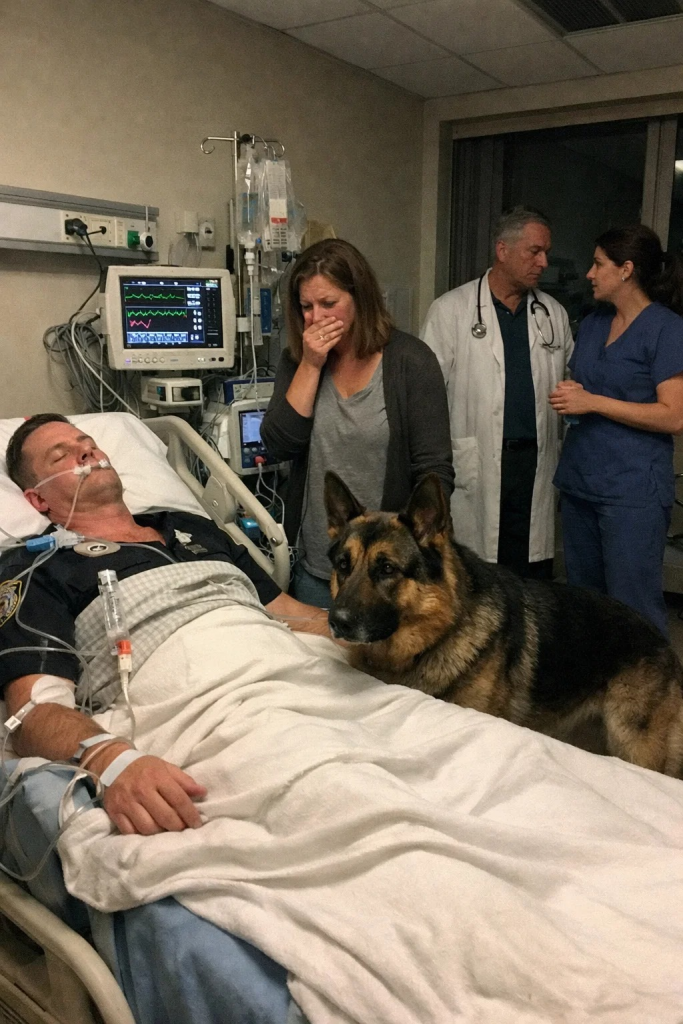
The emergency wing of St. Alder Medical Center carried a silence that felt practiced rather than peaceful, the kind that settles in places where hope has learned to speak softly so it doesn’t draw attention to itself, and beneath the muted glow of ceiling lights lay Officer Samuel Rowe, motionless except for the steady rise and fall of a chest guided by machinery, his body intact enough to confuse strangers yet damaged in ways that left no visible map for the people tasked with deciding whether his life had already reached its end.
At the foot of the bed sat Kairo, a German Shepherd trained for patrol and search, his coat still dusted with dried rain and asphalt, his harness unbuckled but not removed, as though no one had the heart to strip him of the last symbol of purpose he still understood, his gaze fixed on Samuel with a concentration so unbroken it seemed less like watching and more like guarding something sacred.
Samuel and Kairo had been paired for nearly five years, long enough that routine had evolved into instinct, long enough that silence between them meant more than commands ever had, because Samuel spoke little and listened deeply, and Kairo learned early that this particular human carried his intentions quietly, storing them behind careful eyes and measured movements, a trait that made him both respected and underestimated within the department.
The night everything unraveled began without urgency, a routine welfare check requested by a property manager in a newly rezoned neighborhood where abandoned buildings were being quietly reclassified and sold before questions could be asked, and Samuel had remarked over the radio that something felt staged, not dangerous exactly but rehearsed, a comment that earned him mild laughter and a reminder to file the report quickly.
They never finished the report.
Security footage would later show Samuel’s cruiser slowing near a warehouse entrance just as floodlights flared without warning, disorienting both man and dog, followed by a concussive blast that didn’t shatter windows but collapsed Samuel to the pavement as if gravity itself had suddenly doubled, and while Kairo lunged forward barking into empty darkness, a second shockwave rippled through the corridor, silent yet devastating, before everything dissolved into alarms and static.
By the time Samuel arrived at the hospital his body bore no external wounds severe enough to justify his condition, and that alone unsettled the trauma team, because injuries that cannot be easily explained tend to frighten people who rely on explanation for control, and when scans returned inconclusive yet his responsiveness failed to return, language shifted quickly from treatment to outcome.
“There’s no meaningful response,” one physician said gently to Elise Rowe, Samuel’s wife, who stood with her arms wrapped around herself as though holding something in place that threatened to fracture, “we’re seeing activity, but not coordination, not awareness in the way that suggests recovery.”

Elise nodded with the composure of someone who had spent years bracing for sudden change, her voice steady despite the weight pressing against it.
“So you’re saying he’s still there,” she said, not as a question but as a challenge.
The physician hesitated before answering, choosing his words with care.
“I’m saying we don’t know where ‘there’ is anymore.”
The recommendation came quietly hours later, framed as compassion, framed as dignity, framed as sparing Samuel further suffering, and Elise listened without interrupting, because arguing too early often closes doors you may need later, but as the final sentence settled into the room, Kairo rose to his feet with a low sound that was not a growl yet carried unmistakable warning.
He moved between the bed and the equipment with controlled precision, placing his body sideways as though shielding Samuel from something unseen, his ears pinned forward, his muscles rigid with certainty rather than fear, and when a nurse attempted to redirect him, Kairo did not snap or bark but simply refused to move, his eyes never leaving Samuel’s face.
“This isn’t appropriate,” the nurse said, tension creeping into her voice.
Elise raised a hand slowly, her attention fixed not on the staff but on the dog who had not stopped watching since they arrived.
“He’s trying to tell us something,” she said, unsure why she believed it yet unable to ignore the pull of it.
Kairo leaned forward then, pressing his nose gently against Samuel’s palm, and though nothing happened at first, the monitor shifted a fraction of a beat later, a change subtle enough to be dismissed yet real enough to register, and before anyone could rationalize it away, Samuel’s fingers curled slightly, not with strength but with intention.
The room went still.
“That’s reflexive,” the physician began, but Elise was already shaking her head.
“No,” she said, her voice sharpening, “that was an answer.”
Further testing followed, cautious and reluctant, because once hope is reintroduced it demands effort, and while the results did not promise recovery, they complicated finality enough to delay irreversible decisions, buying time that neither Elise nor Kairo wasted.
Over the next two days patterns emerged that could not be charted neatly, because every time Samuel’s condition destabilized, Kairo reacted seconds earlier, pacing, whining, pressing against the bed rails as if attempting to anchor Samuel to his body through proximity alone, and when Elise noticed she too began waking moments before alarms sounded, her thoughts scattered yet focused, as though fragments of Samuel’s awareness were brushing against her own.
Dr. Helena Ruiz, a neurologist known for questioning tidy conclusions, was brought in quietly, and after observing Kairo for less than an hour she stopped taking notes and simply watched, her expression shifting from curiosity to something closer to respect.
“Your husband isn’t absent,” she told Elise later, her tone measured but firm, “he’s displaced, and whatever happened to him disrupted not just function but communication, and somehow that dog is still receiving the signal.”
Elise swallowed.
“A signal from where?”
Ruiz hesitated before answering.
“From wherever Samuel is still thinking.”
The truth surfaced gradually, unearthed not by machines but by inconsistency, because the official incident report failed to align with sensor data recovered from Samuel’s cruiser, and the warehouse site showed signs of equipment removal far too precise for a simple vacancy, and when Elise pressed for access to the original call logs, she was denied on procedural grounds that sounded reasonable until they were repeated too often.
Kairo’s behavior shifted the night Deputy Chief Warren Hale visited unannounced, standing too close to the bed, asking too many questions about Elise’s understanding of the situation, and the moment he reached out toward Samuel, Kairo reacted violently, teeth bared, forcing security to intervene.
“That dog is unstable,” Hale said calmly, though his eyes betrayed unease.
“No,” Elise replied, meeting his gaze, “he’s alert.”
That night Elise dreamed not in images but in sensations, pressure, urgency, a ringing that felt intentional, and when she woke she understood with sudden clarity that Samuel had not been a casualty of chance but a witness silenced mid-warning, because the warehouse was part of a privately funded redevelopment initiative tied to city contracts that never appeared on public records, and Samuel had noticed discrepancies that suggested something dangerous was being tested quietly under the guise of infrastructure improvement.
The final confrontation came when Elise refused to authorize further reduction of care without a formal review, and Hale attempted to intervene directly, only to be stopped by Kairo at the doorway, his stance immovable, his warning unmistakable, and as security closed in, Samuel’s vitals surged violently, his heart rate spiking as if responding to the threat, and Elise felt it then, not as words but as certainty.
“He knows,” she said aloud, her voice cutting through the chaos, “and he’s scared because you’re here.”
Investigators were called, reluctantly at first, then urgently, and what they uncovered dismantled more than one career, because the equipment removed from the warehouse matched experimental crowd-control technology improperly deployed during off-record trials, technology that caused neurological collapse without leaving conventional trauma, and Samuel had stumbled into something that powerful people were desperate to keep quiet.
Samuel regained consciousness weeks later, not fully, not easily, but enough to speak his wife’s name, enough to rest his hand on Kairo’s head and breathe out as though finally reaching solid ground, and while recovery was slow and uneven, it was real, shaped by patience rather than expectation.
Kairo retired officially the following year, though he never truly stopped working, choosing instead to sleep beside Samuel’s chair as if standing watch had simply taken a quieter form, and when Samuel eventually returned to public service, it was not in uniform but as an advocate for transparency, a role that demanded the same quiet vigilance he had always carried.
What saved him was not defiance alone, nor loyalty alone, but the refusal of one living being to accept that silence meant absence, and in a system built to move forward efficiently, it was that refusal which forced the truth to slow down long enough to be heard.


Leave a Reply