“You’ll Never Be a Hero!” — The Elite Cadet Mocked Isabelle Drake During Training, Until a Senior Officer Stepped In and the Entire Camp Was Forced to Admit Who the Real Leader Was
The first thing Isabelle Drake learned after arriving at Camp Horizon was that silence could be louder than shouting.
The base sat on the edge of a frozen plain in the northern Midwest, a place designed to strip people down to what they were capable of under pressure, and Isabelle understood immediately that she was being measured long before she ever set foot on the training floor. She had transferred in from an intelligence-track program after requesting a broader operational role, a decision that already made her an anomaly, and the fact that she spoke softly, kept her posture relaxed, and never felt the need to prove herself only reinforced the unspoken verdict that spread among the other cadets.
She didn’t look like what they imagined a future field officer should look like.
She listened more than she spoke, took notes instead of boasting, and trained with an economy of movement that many mistook for hesitation. In the locker rooms and along the gravel paths between barracks, whispers followed her, not loud enough to be confronted but sharp enough to cut, speculating that she had been transferred as a favor, that she would wash out, that she didn’t have the edge required to survive a combat rotation.
At the center of those whispers was Avery Knox, a cadet whose reputation had been built on physical dominance and relentless confidence. Avery moved through Camp Horizon like she owned it, laughing loudly, finishing drills first, and collecting admiration from those who believed strength could only look one way. To her, Isabelle’s presence felt like an insult, a challenge to an order she believed she had earned, and that irritation quickly turned into something more pointed.
At first it was jokes, then comments disguised as concern, then remarks delivered just loudly enough for others to hear. Isabelle absorbed them without reaction, not because they didn’t hurt, but because she understood something Avery didn’t yet: emotional control was not the absence of feeling, but the decision not to surrender to it.
That fragile equilibrium shattered during a routine sparring session inside the main training hall, a space lined with padded walls and watched carefully by instructors who emphasized restraint above all else. When Isabelle saw her name paired with Avery’s on the board, she felt a brief tightening in her chest but said nothing, stepping onto the mat with the same steady focus she applied to every drill.
The signal to begin had barely sounded before Avery surged forward with a force that ignored every guideline of the exercise, her strikes fueled by something far less disciplined than training. Isabelle attempted to adjust, to create distance, to slow the exchange, but Avery wasn’t interested in control; she wanted dominance, and the crowd’s attention fed that desire. A blow landed where it shouldn’t have, then another, and before the instructors could intervene, Isabelle went down hard, the lights above her blurring into a white haze.
The room froze.
Some cadets looked away. Others stared, unsure whether they were witnessing an accident or something darker.
The doors opened sharply, and Lieutenant Rowan Mercer, recently reassigned to oversee advanced drills, crossed the floor with a speed that left no room for doubt about his authority. He placed himself between Avery and Isabelle without raising his voice, but the stillness that followed was immediate and absolute.
“This ends now,” he said, his tone cutting cleanly through the noise.

He knelt beside Isabelle, checked her breathing, and signaled for medics, then stood and turned to Avery, whose confidence had finally faltered under direct scrutiny.
“That was not training,” Rowan said evenly. “That was a choice.”
Isabelle regained consciousness hours later in the infirmary, her head aching but her mind clear enough to catalog every detail of the room. Rowan sat nearby, reviewing reports, and when she stirred, he met her gaze with a look that carried neither pity nor judgment.
“You stayed composed longer than most would have,” he said after a moment. “That matters.”
Isabelle swallowed. “I didn’t want to escalate it.”
Rowan nodded. “That’s not weakness. That’s discipline.”
Word traveled fast through Camp Horizon. Avery was removed from drills pending review, and conversations shifted from speculation to unease as others began to recognize patterns they had ignored. Rowan didn’t rush punishment; instead, he observed, listening carefully, watching how the group responded when the loudest voice was no longer leading them.
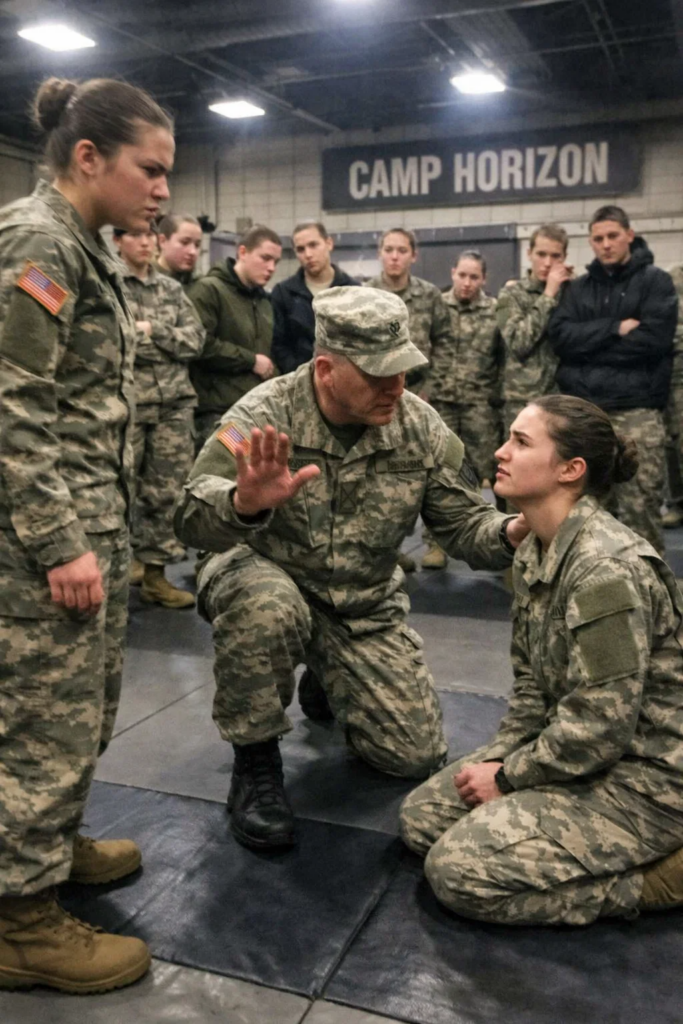
The following morning, he called the entire unit together on the training floor. The air was tense, filled with uncertainty, and when Rowan spoke, it was not to single anyone out, but to dismantle assumptions that had gone unchallenged for too long.
“Strength without control is liability,” he said. “And intimidation is not leadership, no matter how effective it looks in the moment.”
He then asked Isabelle to step forward.
A murmur rippled through the group, and Isabelle hesitated before complying, aware of every eye on her. Rowan explained that respect could not be mandated, only demonstrated, and proposed a controlled technical demonstration, not a contest, but a lesson in awareness and restraint. Isabelle agreed, her hands steady despite the weight of attention.
What followed shifted something fundamental in the room.
Rowan moved with precision, allowing Isabelle to respond rather than react, and as the exchange unfolded, it became impossible to deny her competence. She anticipated movement, adjusted angles, conserved energy, and executed transitions with a clarity that spoke of preparation rather than aggression. The room grew quiet, not out of fear, but recognition.
When it ended, Rowan addressed them again. “Heroism isn’t noise. It’s consistency under pressure. Remember that.”
Avery returned shortly after, accompanied by a senior instructor. She stood rigid, watching as the group dispersed with a new awareness, and when she approached Isabelle, her voice lacked its former edge.
“I was wrong,” she said quietly. “I let my pride get in the way.”
Isabelle nodded once, accepting the apology without spectacle, understanding that growth rarely arrived with grand gestures.
Weeks passed, and the atmosphere at Camp Horizon changed in subtle but meaningful ways. Isabelle became a steady presence in group drills, her insights gradually sought rather than dismissed, while Avery learned to recalibrate, to listen, to lead without overpowering. Rowan continued to observe, reinforcing accountability without humiliation, knowing that real change required space to take root.
The true test arrived during a full-day simulation designed to push the unit beyond controlled environments, forcing them to rely on one another under stress. Isabelle’s group included Avery and several cadets who had once doubted her, and as the exercise unfolded, hesitation gave way to trust through necessity. Isabelle identified patterns others missed, redirected plans before errors compounded, and when a malfunction nearly sent one cadet tumbling down a rocky slope, she reacted without hesitation, anchoring him before anyone else could move.
From that moment on, leadership flowed naturally.
Decisions were shared. Communication sharpened. When the simulation concluded ahead of schedule, the result spoke louder than any lecture.
That evening, Rowan addressed the unit one final time. “You learned something today that will follow you long after this base fades into memory,” he said. “Strength isn’t about being unbreakable. It’s about being accountable.”
Isabelle stood among them, no longer isolated, no longer underestimated, not because she had fought harder, but because she had endured with integrity.
Avery met her gaze and offered a nod, not as a rival, but as a peer.
Camp Horizon remained demanding, imperfect, and unforgiving in many ways, but it had taught them something essential: heroes are rarely the loudest in the room, and the strongest iron is forged not through force alone, but through restraint.
And Isabelle Drake, once dismissed as weak, walked forward with quiet confidence, knowing she had earned her place without becoming someone she wasn’t.


Leave a Reply