‘My Father Owns This City.’ — A Rich Kid Kicked a Police K9 on the Courthouse Steps, Until a Quiet Stranger Stopped Him and Exposed What They Were Really Hiding
The sound that stayed with Officer Ava Bennett wasn’t the kick.
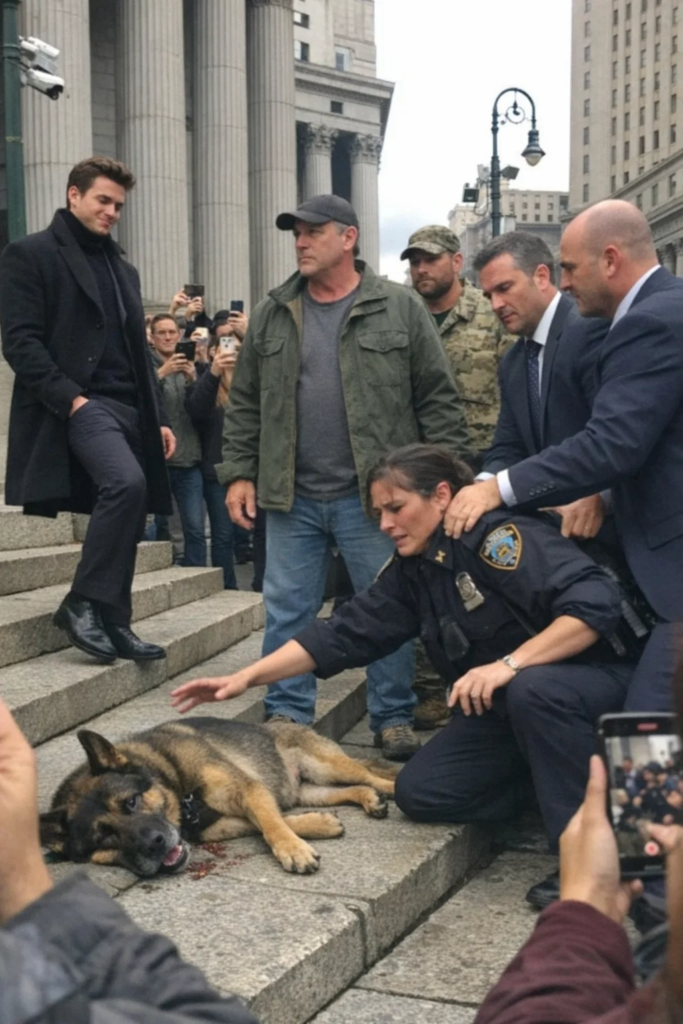
It was the silence that followed—the half-second where the street seemed to hold its breath, where the usual noise of Manhattan traffic faded into something distant and unreal, and all she could hear was her own pulse crashing in her ears as she hit the cobblestones on her knees.
“Stop—stop kicking him!” she screamed, her gloves scraping raw stone as she tried to crawl forward.
Echo lay curled on his side just inches away, his powerful body folded inward in a way it never should have been, ribs rising too fast, too shallow. He didn’t bark. He didn’t snarl. The sound that slipped out of his throat was a thin, broken whine that cut deeper than any shout.
Ava knew that sound.
It meant pain that training couldn’t override.
Above Echo stood a young man in a tailored wool coat, shoes polished to a mirror shine, hair perfectly styled despite the winter wind. He lifted his foot again—not rushed, not angry, but slow, deliberate, like someone savoring control. His expression held mild curiosity, as if he were testing how far the world would let him go.
Two other men in matching expensive suits restrained Ava by the arms. Not hard enough to bruise. Just enough to keep her helpless.
“Easy,” one murmured near her ear, breath warm with cologne. “You’re making this worse.”
“He’s a K9,” Ava sobbed, voice breaking. “He’s working. He didn’t do anything wrong. Please.”
The young man finally glanced at her, eyes cool and dismissive. Around them, a small crowd had gathered—pedestrians frozen in place, phones rising uncertainly, outrage battling fear. He noticed them and smiled faintly.
“My father funds half the campaigns in this city,” he said, almost bored. “Who’s going to stop me?”
Ava’s chest burned. Not for herself. For Echo—trained to obey, trained to trust, trained to put himself between danger and strangers without question, and now being punished like an object.
Then the air changed.
Heavy footsteps approached—not rushed, not aggressive. Just steady. Purposeful.
A man in worn jeans and a dark jacket moved through the crowd as if he belonged there, not pushing people aside, simply stepping forward and letting space open naturally. Beside him walked another man in camouflage, quiet, alert, eyes scanning angles and reflections.
The civilian’s voice wasn’t loud.
But it landed like a command.
“Step away from the dog.”
The rich kid laughed and lifted his foot again.
The civilian stepped between shoe and fur without hesitation. No speech. No posturing. Just a line drawn in real time. His eyes were calm in a way Ava had only seen in seasoned officers during active calls—the calm that didn’t come from confidence, but from certainty.
“You don’t want to do this,” he said softly.

For the first time, the rich kid hesitated.
Not because he cared about the dog.
But because he felt it: this man didn’t care about money.
One of the suited men tightened his grip on Ava. “You have no idea who you’re touching,” he warned, still smiling.
The civilian’s gaze flicked to Ava’s badge number, then to the rich kid’s watch—custom, heavy, absurdly expensive—and finally to the clear earpieces tucked behind the suits’ collars.
Something bigger clicked into place.
Echo tried to rise then, trembling, eyes locked past Ava’s shoulder at someone near the courthouse steps. A low growl rumbled from his chest, weak but unmistakable.
The rich kid swung his foot again.
The civilian moved.
Fast. Precise. He caught the ankle mid-motion, rotated just enough to steal balance, and the rich kid hit the cobblestones with a shocked grunt. Not broken. Not injured. Just stopped.
The crowd gasped. Phones tilted closer.
One of the suited men released Ava with one hand and stepped forward. “That’s enough,” he snapped, confidence cracking. “Back away.”
The man in camouflage shifted slightly, his hand hovering near his waistband—not drawing anything, just changing the equation. “Don’t,” he said calmly.
Ava was free.
She crawled to Echo immediately, fingers trembling as they found his ribs. “Hey, partner,” she whispered, pressing her forehead to his. “Look at me. Stay with me.”
Echo’s eyes locked onto hers—focused, loyal, still working.
The civilian knelt beside them, shrugging off his jacket and folding it carefully against Echo’s side the way someone with medical training would. “Breathing’s shallow,” he murmured. “Possible bruising. We need a vet unit now.”
Ava reached for her radio—and froze.
Her belt felt wrong. Too light.
“They took my radio,” she whispered, panic sharpening her voice.
The civilian’s eyes hardened. “They didn’t just restrain you,” he said quietly. “They disarmed you.”
The rich kid scrambled to his feet, face red with fury. “You’re finished,” he spat. “My father—”
“Your father can explain it to the cameras,” the civilian replied, nodding at the phones. Then he turned back to Ava. “What started this?”
Echo let out another low growl, deeper this time, eyes still fixed on the courthouse steps.
Ava swallowed. “Echo alerted on his car near the courthouse,” she said. “The kid bolted. These men showed up like they were waiting. They pinned me, grabbed Echo, and then—” Her voice cracked. “—then this.”
The civilian scanned the area. “Cameras?”
A woman in the crowd pointed. “Lamp post. Across the street. On the courthouse.”
The suited man followed her gaze—and his smile vanished.
Sirens wailed in the distance.
Real ones. Close.
“Get up,” one suit hissed to the rich kid. “Now.”
Echo growled again, sharper.
Ava finally understood.
“These aren’t bodyguards,” she whispered. “They’re handlers.”
The civilian stood. “Nobody moves,” he said evenly, “until local units arrive.”
“You’re interfering with a protected operation,” one suit snapped.
“Then protect it in court,” the civilian replied.
Two patrol cars screeched to a halt, followed by a third. Officers poured out, weapons ready. The rich kid shouted names, threats, promises—but the crowd’s recordings swallowed his voice.
Echo was lifted gently onto a stretcher. As the ambulance doors closed, he stretched his nose toward Ava’s palm, tail twitching weakly.
“You did good,” she whispered.
Then Echo barked once—sharp and directional—toward the courthouse.
Ava turned.
A third suited man stood near the steps, watching calmly.
In his hand was her radio.
He didn’t run.
He simply turned and walked into the crowd.
“That one,” the civilian said. “He took her radio.”
Two officers moved instantly, cutting angles. The man reached a black SUV parked too cleanly at the curb.
“Stop! Police!” Ava shouted.
He froze.
An officer grabbed his wrist. The radio clattered onto stone. Another officer opened the SUV’s rear door, and a small metal case slid out.
Later, bomb techs would call it “components.”
Everyone else called it what it was.
Inside were burner phones, fake credentials, and a list of license plates—police plates.
Ava’s name was on it.
Federal agents arrived within the hour. The rich kid’s family connections didn’t help. Too many cameras. Too much evidence. Too many people watching.
Echo survived surgery.
Bruised ribs. Internal trauma. Weeks of recovery.
The first time Ava visited him, he tried to stand anyway, tail thumping weakly like he was apologizing.
She pressed her forehead to his. “You saved people,” she whispered. “Again.”
The civilian stopped by once. His name was Reid Larson. Former Navy SEAL. He didn’t stay long.
“Good dog,” he said quietly.
Months later, Echo returned to duty.
When Ava walked him past the same cobblestones, people stepped aside—not out of fear, but respect.
Because money can buy silence.
Until a loyal dog refuses to ignore the truth.
Leave a Reply