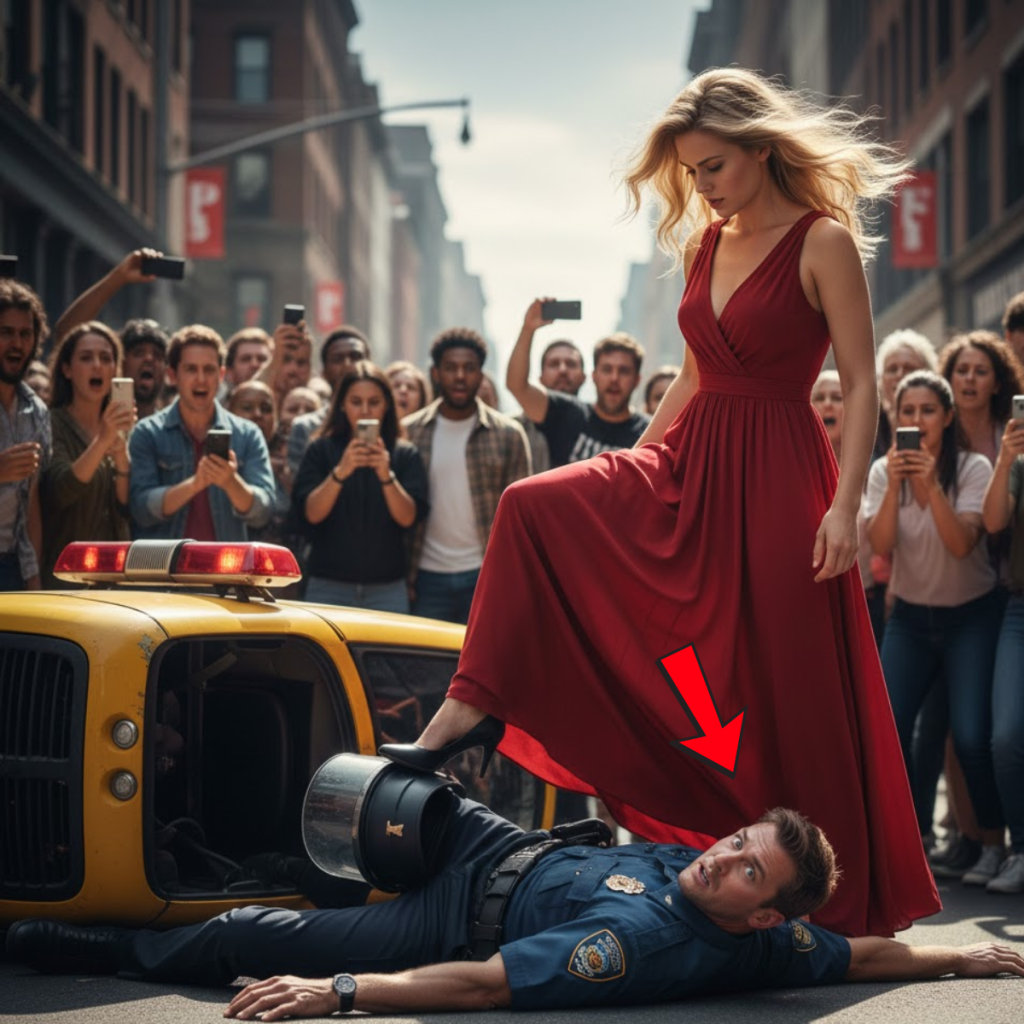
A Corrupt Sergeant Jails a Stranger… Until He Learns She’s the City’s Police Captain
Captain Sarah Johnson should’ve been thinking about flowers, family photos, and her brother’s wedding.
Instead, she was sitting in the back of a New York taxi, wearing a simple red dress, trying to disappear into normal life—just for one day. No uniform. No rank. No “Captain.” Just Sarah, the sister on leave, heading home to celebrate.
The driver, Mike, glanced in the mirror, uneasy.
“Ma’am,” he said, “I’m taking a different route. I don’t usually use this road.”
Sarah looked up. “Why? What’s wrong with it?”
Mike’s hands tightened on the wheel. “There are officers stationed there. The sergeant in that area… he gives tickets for no reason. Forces taxi drivers to pay. If anyone refuses, he beats them.”
Sarah’s expression stayed calm, but her mind sharpened. Corruption rumors were common in a city this big—most exaggerated, some real. But the way Mike said it sounded like fear, not gossip.
“God forbid we meet him today,” Mike muttered.
A minute later, they did.
Up ahead, several officers stood by the roadside. At the center was Sergeant Tom Davis, posture loud with authority. He lifted his hand and signaled sharply.
The taxi rolled to a stop.
Tom strode over like he owned the street. He didn’t even check the speedometer or ask a routine question.
“Hey, cabbie,” he snapped. “Get out. You think you own the road, driving that fast? Pay a $500 ticket—right now.”
Mike’s face drained. “Officer… I didn’t break any rules. Please don’t do this. I don’t have $500.”
Tom’s eyes narrowed, enjoying it. “Don’t argue with me. Take out your license and registration. Is this taxi stolen?”
Mike rushed to hand over the papers. Everything was valid. Perfectly in order.
Tom barely glanced at them.
“Papers are fine,” he said, like it didn’t matter. “But you still pay. $500. Or at least $300—or I impound the taxi right now.”
Sarah watched from the back seat, silent.
Anger rose in her throat, but she swallowed it. If she revealed herself too early, Tom would switch masks—play innocent, hide his pattern, destroy evidence. She needed to see how far he’d go, and she needed witnesses.
Mike’s voice shook. “Sir, I’ve only made $50 today. I have children. I’m just trying to feed my family.”
Tom’s patience snapped into violence. He grabbed Mike by the collar, shoved him, and barked, “If you don’t have money, why drive a taxi? You’re arguing with me too? I’ll show you fun at the precinct.”
That shove was the moment Sarah couldn’t ignore anymore.
She stepped out of the taxi, moved between them, and spoke clearly—civilian voice, but commander spine.
“Sergeant,” she said, “this driver hasn’t committed an offense. You can’t ticket him without cause, and you just assaulted him. That’s a violation of law and civil rights. Let him go.”
Tom stared at her like she’d insulted his bloodline.
“Oh?” he sneered. “Now you’re teaching me the law? Big mouth. Looks like you need a taste of a cell too. Come on—both of you. We’ll see how brave you are at the station.”
Sarah held his gaze. She didn’t flinch.
Tom didn’t recognize her. That was the best—and worst—part.
He barked at his officers. “Take them in.”
Two male and two female officers grabbed Sarah and Mike and marched them into the precinct like trophies.
Inside, Tom pointed at a bench like a king giving a command. “Sit them there. They need to be shown their place.”
Sarah sat. Mike sat beside her, trembling.
Tom dropped into his chair, smug, then answered a call on speaker without care.
“Yeah,” Tom said casually, “your work will be done. Your name won’t come up in that case. Just have my payment ready. I’ll handle everything.”
Sarah’s jaw tightened.
So it wasn’t just roadside extortion. It was internal bribery too—selling protection, erasing names, trading justice for cash. She forced herself to stay calm. Rage would feel good, but evidence would end him.
Mike leaned toward her, panicked. “Ma’am… what are we going to do? I have kids. They’ll take my taxi.”
Sarah spoke low and steady. “Don’t panic. He can’t touch you. I’ve seen everything.”
Mike looked at her, desperate and suspicious at the same time. “But… why didn’t you stop him earlier? Who are you?”
Sarah didn’t raise her voice. She didn’t dramatize it.
“I’m Captain Sarah Johnson,” she said. “I stayed quiet to expose him properly. Just wait. Watch what happens next.”
Mike blinked hard. Relief and disbelief fought on his face, but her calm was contagious. He nodded, barely.
Not long after, Tom disappeared into his office and ordered, “Bring the taxi driver in.”
An officer escorted Mike inside. Sarah watched him go, then stared straight ahead, listening.
Tom leaned back like a man enjoying his meal. “Want to save your taxi? Pay $300. If you don’t, I impound it—and you become my enemy. My rule runs this entire area.”
Mike’s voice cracked. “Sir… I don’t have it. Please. My children—”
Tom cut him off. “I don’t care. Pay or get ruined.”
Fear makes people do ugly math. Mike dug into his pocket and pulled out $200—everything he had.
“Please,” he begged, handing it over. “This is all I have.”
Tom took the money without shame. “Fine. Sit outside. Send that woman in.”
Mike stumbled out, looking like someone who’d just paid a ransom.
“Ma’am,” he whispered to Sarah, “he’s calling you now.”
Sarah rose, smooth and unafraid, and walked into Tom’s office.
Tom looked her up and down. “What’s your name?”
Sarah didn’t give him the satisfaction.
“What business do you have with my name?” she said. “Why did you bring me here?”
Tom’s eyebrows shot up. Most civilians folded in his presence. This one didn’t.
“Don’t get smart,” he warned, voice sharp. “We have the cure for smartness. If you want to go home, pay $200. Otherwise, you breathe jail air.”
Sarah’s reply landed like a slap he couldn’t return.
“I won’t give you a penny. I’ve done nothing wrong. Are you enforcing the law—or breaking it? Does that uniform mean anything to you besides fear and money?”
Tom’s face turned a dangerous shade of red.
He slammed his hand and shouted, “Lock her up. Holding cell—now!”
Sarah didn’t resist. She didn’t argue. She let them put her behind bars.
Because now she had what she needed:
the roadside extortion,
the assault,
the bribe,
the threats,
the illegal detention.
And Tom still had no idea who he’d just caged.
Minutes later, a black SUV rolled up outside the station.
A senior city official, James Wilson, stepped out, fury written on his face. He walked in fast and demanded, “I heard a woman has been locked in a cell here. I want to see her.”
An officer hesitated, confused—until Tom swaggered out.
“Yes,” Tom said proudly. “I put her in. Come, I’ll show you.”
He led James down the hall like he was presenting a solved problem.
Then James saw the woman behind the bars.
His expression detonated.
“What have you done?!” he shouted. “Do you know who this is? This is City Police Captain Sarah Johnson!”
Tom’s confidence collapsed in real time.
His mouth opened. No sound came out.
James snapped at the officers. “Open the cell. Now.”
The door unlocked.
Sarah stepped out—not angry, not loud—just cold and composed, like a judge walking to the bench.
Tom stammered, “I—I didn’t know—”
Sarah didn’t waste time on his excuses. She laid out the facts—cleanly, clearly:
how he stopped the taxi,
demanded a fake ticket,
threatened impoundment,
assaulted the driver,
dragged them to the station,
took cash,
demanded money from her,
then jailed her without cause.
“This isn’t just about me,” Sarah added. “This is happening to citizens and small business owners across the city.”
Then she moved fast—because the next 30 minutes mattered. Corrupt cops don’t just bully people. They erase traces.
Sarah filed an official report through proper channels and alerted Internal Affairs. She ensured everything was recorded in writing—no loose ends, no “misunderstanding” later.
The situation was serious enough that the chief of police and commissioner were informed through protocol. They arrived at the station themselves.
And when the commissioner walked in, he didn’t look at Sarah first.
He looked at Tom.
“By what authority,” he demanded, “did you detain a woman without cause and put her in a cell?”
Tom tried to speak, but the commissioner cut him off.
“Extorting money from citizens, threatening them, and abusing power is a crime. This is a violation of civil rights and will be treated accordingly.”
Sarah agreed to testify. Mike agreed to testify too, even though fear still lived in his hands. His statement was officially recorded: the fake ticket, the threats, the money taken, the intimidation.
Internal Affairs pulled station records and body cam footage. Patterns surfaced—more stops, more threats, more “tickets,” more cash.
Tom’s “rule” had a trail.
The next morning, just after dawn, a line of senior officers’ cars arrived like a storm forming on the street.
Tom saw the uniforms, the rank, the faces—and the color drained from his own.
No one listened to his excuses.
Handcuffs clicked around his wrists.
The commissioner’s final words were quiet, brutal, and unforgettable:
“This is the fate of those who violate the law.”
Tom Davis was taken away in the same building where he once played king.
And outside, in the corridor, Mike stood beside Sarah, still shaken—then finally able to breathe like a man who’d been drowning.
Because in a city where power often protects itself, one thing had just happened that almost never happens:
Someone higher up had seen it with their own eyes.
And this time, the uniform actually meant what it was supposed to mean.



Leave a Reply