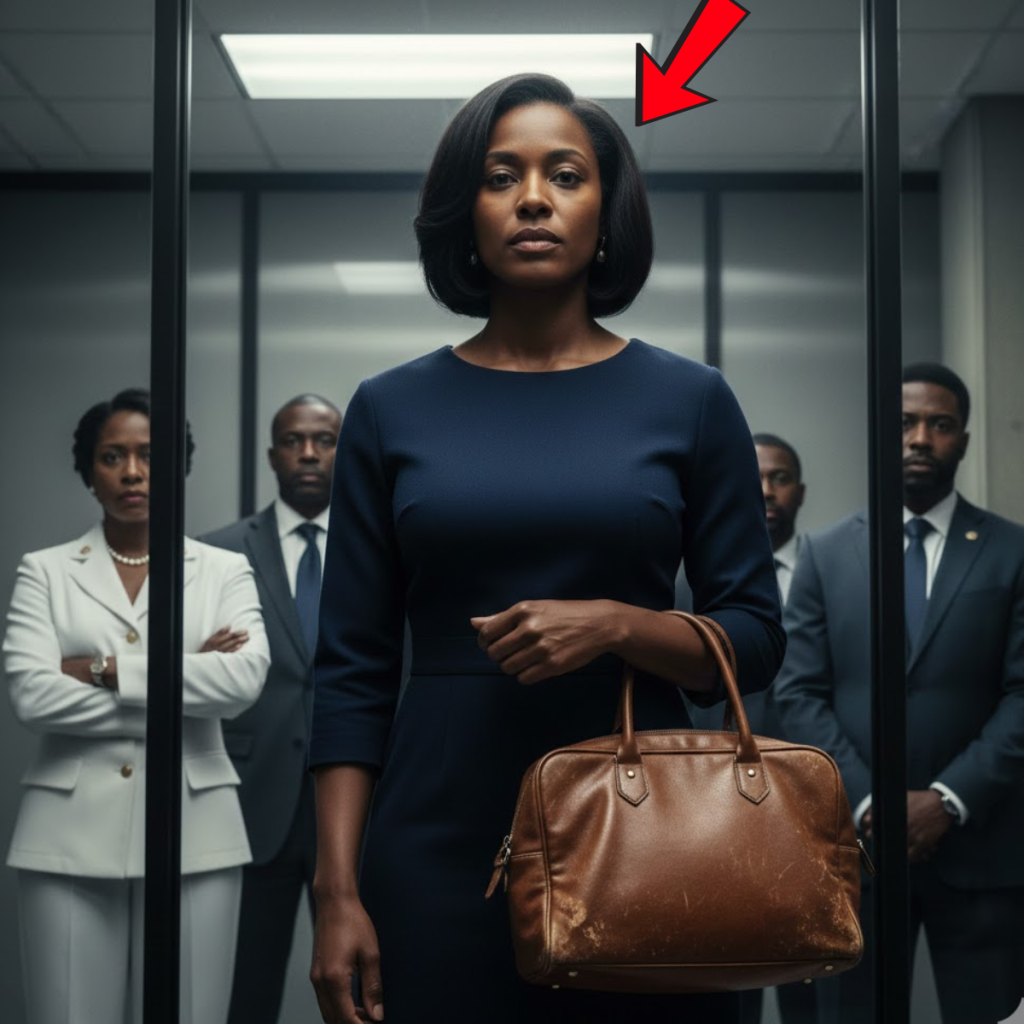
Rain pounded insistently against the tall windows of the imposing corporate building of Grupo Tabáres, as if the sky itself were weeping for the injustice that had just taken place on the ground floor. Marisol de Campos, her hands rough from work and her heart squeezed by disappointment, picked up her résumé from the mahogany table. The woman in front of her, impeccable in a pearl-gray tailored suit, did not even have the courtesy to look her in the eyes as she delivered the verdict.
—We’re sorry, Miss de Campos. Your profile does not fit the image we wish to project in this company.
The sentence lingered in the cold office air, heavy with a cruel subtext that Marisol understood perfectly. It wasn’t her university degree from UNAM, earned with honors and sleepless nights, that was lacking. It wasn’t her experience, her letters of recommendation, or her fluency in English and French. It was her white blouse, clean but simple, bought at a market three years earlier. It was her navy-blue skirt, whose frayed edges she had carefully mended the night before. It was her shoes, worn down from walking miles to save bus fare.
—I understand. Thank you for your time —Marisol replied with a dignity that painfully contrasted with the humiliation burning in her cheeks.
She stood up, straightened her back, and walked toward the exit with steady steps, refusing to let them see a single tear. What Marisol did not know—what she could not even imagine as she crossed the marble lobby feeling small and insignificant—was that the scene had not gone unnoticed.
Behind a one-way mirror overlooking the interview room, Antonio Tabáres, the owner of the entire empire, had observed every second. At thirty-five, Antonio was tired. Tired of falseness, rehearsed smiles, expensive suits hiding incompetence, and people who saw in him nothing but a bank account. He had come down to watch the interviews seeking distraction, but what he found was something he had not seen in years: authenticity.
He saw how Marisol clutched her worn handbag not with fear, but with determination. He saw how she lifted her chin in the face of the recruiter’s disdain. He saw a fire in her eyes that money could not buy.
—Who is she? —Antonio asked, his deep voice breaking the silence of the observation room.
His Human Resources director, Ramón, barely looked up from his tablet. —No one important, sir. A certain Marisol de Campos. Her résumé is… adequate, but her personal presentation is unfortunate. She doesn’t have the bearing for a company of this level. We have already selected Daniela Morales, the senator’s daughter, for the position.
Antonio felt a surge of irritation. He remembered his own origins, the story of his grandfather arriving in the city with a cardboard suitcase and a dream. At what point had his company become an exclusive club for the elite, blind to true talent?
—I want to see her file —he ordered, extending his hand.
Ramón blinked, confused. —Daniela’s?
—No. The young woman you just rejected for being poor.
As he read through the documents, a faint smile curved Antonio’s lips. Perfect grades. Brilliant recommendations. A life of struggle written between the lines: scholarships, part-time jobs, caring for a sick mother. This woman was not only capable; she was a warrior. And his company, full of soft executives who had never known real adversity, desperately needed someone like her.
—Call her —Antonio said, handing back the folder—. Have her come tomorrow.
—But sir, we already told her no. And besides, the analyst position is already…
—I don’t want her as an analyst —Antonio interrupted, turning to look out the window at a small figure walking away under the rain with a broken umbrella—. I want her in my personal office. As my Executive Assistant.
Ramón paled. —Mr. Tabáres, that position requires… tact, image, social polish…
—That position requires someone I can trust, Ramón. Someone who doesn’t bend at the first difficulty. Someone real. Call her right now.
Marisol was already on the bus, her forehead resting against the cold glass, watching the city blur beneath the downpour. She was thinking about her mother, Elena, waiting at home with hope shining in her eyes. How could she tell her she had failed again? How could she explain that the world valued appearance over effort? Her phone vibrated in her pocket. An unknown number.
She hesitated, but answered. The voice on the other end was tense, almost reluctant. —Miss de Campos? This is the Office of the General Director of Grupo Tabáres. There has been… a change of plans. Mr. Antonio Tabáres requests your presence tomorrow at nine sharp. Personally.
Marisol’s heart slammed violently against her ribs. Antonio Tabáres? The owner? The man featured in business magazines as the “Golden Bachelor” and the shark of finance? It had to be a mistake. Or a cruel joke.
—Mr. Tabáres? —she asked, her voice trembling—. For what?
—For an interview, miss. Don’t be late.
The call ended. Marisol stared at her phone, stunned. A mixture of fear and hope flooded her. She knew this was her last chance, the lifeline she needed before sinking. But she also knew she would be walking into the lion’s den, to the very top of that glass tower that had spit her out earlier that day.
When she arrived at her small apartment, the smell of hot soup and medicine welcomed her. Her mother coughed from the bedroom but smiled when she saw her enter. —How did it go, my girl?
Marisol took a deep breath, swallowing her fear. —I have another interview tomorrow, Mom. With the owner.
Elena’s eyes lit up. Despite the illness draining her strength, she rose with difficulty and walked to the old wooden wardrobe. —Then you need this —she said, pulling out a plastic garment cover—. It was your Aunt Carmen’s. I saved it for a special occasion. I think that occasion is today.
It was a navy-blue dress, classic cut, heavy fabric with a beautiful drape. Old, yes, but elegant and dignified. When Marisol tried it on in front of the spotted bathroom mirror, she did not see the poor girl counting coins for bread. She saw a strong woman. She saw Elena’s daughter.
That night, Marisol barely slept. She stared at the ceiling, rehearsing answers, imagining scenarios. She did not know that her life was about to take a one-hundred-and-eighty-degree turn, nor that the mysterious man pulling the strings was not only looking for an employee but, without realizing it, searching for someone who could restore his faith in humanity.
At dawn, Marisol smoothed her dress, lifted her chin, and stepped out to face her destiny. The sky was clear, but a storm of emotions brewed inside her, a storm about to collide with the unshakable calm of Antonio Tabáres.
A meeting was about to take place—one that would defy the odds and rewrite the rules of their two opposing worlds.
The private elevator shot upward at dizzying speed, making her ears pop, but the buzzing in Marisol’s head was not from the pressure—it was from her nerves. When the polished metal doors opened on the fortieth floor, she found herself in a silent lobby decorated with works of art that probably cost more than her entire neighborhood.
—Go in, Mr. Tabáres is expecting you —said a secretary with a much kinder smile than the one from the day before.
When she entered the office, the vastness of the space struck her. Floor-to-ceiling windows displayed Mexico City at her feet, a sea of concrete and light. And there, standing beside the desk, was him. Antonio Tabáres was taller than he appeared in photographs, with a magnetic presence that filled the room. He turned slowly, and his dark eyes locked onto hers with an intensity that made her shiver.
—Good morning, Miss de Campos —he said, his voice deep and calm—. Thank you for coming back.
—Good morning, Mr. Tabáres —Marisol replied, surprising herself with the steadiness of her voice—. Thank you for the opportunity. Though, if I’m honest, I don’t understand what I’m doing here after yesterday.
Antonio smiled, a small, enigmatic smile that softened his stern features. —Yesterday we made a mistake. My employees judged the book by its cover. I prefer to read the content.
He gestured to a chair, and the interview began. It was not a standard interrogation. He did not ask about her weaknesses or where she saw herself in five years. He asked how she handled the crisis in her previous job when the company went bankrupt. He asked about her mother. He asked what she would do if she had to negotiate with someone who despised her.
Marisol answered truthfully, without embellishment. She spoke of necessity, loyalty, and the ingenuity that is born when there are no resources. Antonio listened, fascinated. Every answer confirmed what he had sensed: he had a diamond in the rough before him.
—The position is yours —Antonio said suddenly, closing the folder—. Executive Assistant to the Presidency. The salary is triple what you requested. It includes full medical insurance for you and your immediate family.
Marisol felt the air leave her lungs. Medical insurance? That meant treatment for her mother. It meant life. Tears threatened to fall, but she held them back.
—Why? —she asked, her voice barely a whisper—. Why me?
Antonio leaned over the desk, looking at her intently. —Because in a world of sharks, I need someone who doesn’t bleed at the first bite. And because… —he paused, as if about to say something more personal, but stopped— because you have something money can’t buy: dignity.
Thus began a working relationship that soon became legendary within the company. Marisol learned quickly. Her organizational skills were impeccable, but what truly made her indispensable was her instinct. She knew when Antonio was overwhelmed and needed silence. She could distinguish flatterers from honest partners. She became his shadow, his filter, his right hand.
And Antonio, the man of ice, began to thaw.
It started with small details. A coffee brought exactly the way he liked it, without him asking. A shared joke after a tense meeting. Antonio found himself inventing excuses to call her into his office—not to work, but to hear her opinion, to watch her eyes light up when she spoke with passion.
He realized Marisol was not afraid of him. She respected him, yes, but she did not flatter him. If he was wrong, she told him—with respect but firmness. That honesty was like fresh water in the desert of his life.
The turning point came three months later: the Annual Industry Gala. The most important social event of the year, where million-dollar deals were sealed over glasses of champagne.
—I need you to come with me —Antonio said one Tuesday afternoon, without looking up from his documents.
—Of course, sir. I’ll prepare the reports and the agenda for—
—No —he interrupted, looking at her—. Not as my secretary. As my date.
Silence filled the office.
—Mr. Tabáres, that would not be appropriate. I am your employee. People—
—People will talk anyway. I need someone I trust by my side. There’s an investor, Mr. Mendoza, old school. He values family and principles. If I show up alone or with a hired model, he’ll distrust me. With you… it’s different. You’re real.
Marisol reluctantly accepted, driven by duty—and deep in her heart, by a secret desire she dared not name.
The night of the gala, Marisol was terrified. She had used part of her savings to buy a new dress, simple and wine-colored, elegant and discreet. When Antonio arrived in his sports car to pick her up, he was momentarily speechless. It wasn’t the dress. It was her. Marisol glowed with her own light.
—You look… stunning —Antonio murmured, opening the door for her.
—You don’t look bad yourself, boss —she replied, trying to ease the electric tension crackling between them.
The gala was a whirlwind of lights, music, and curious stares. Everyone wanted to know who the mysterious woman on Antonio Tabáres’s arm was. Far from shrinking, Marisol rose to the occasion. She conversed fluently, displaying her culture and intelligence. Mr. Mendoza was charmed, and the deal was closed before dessert.
But the climax came when the orchestra began to play a soft waltz.
—May I have this dance, Miss de Campos? —Antonio asked, extending his hand.
Marisol hesitated. They were crossing a dangerous line. But when she looked into Antonio’s eyes, she saw something that disarmed her: vulnerability.
She took his hand.
As their skin touched, the world around them disappeared. They danced at the center of the floor, moving as one. Antonio pulled her slightly closer than protocol allowed, his hand firm on her waist.
—Marisol —he whispered near her ear, sending shivers down her spine—. Tonight you shone brighter than anyone in this room. Not because of the dress or the deal. Because of you.
—I’m just doing my job, Antonio —she replied, using his name without “Mr.” for the first time.
—No. This isn’t work. I’ve spent months trying to convince myself it’s just professional admiration. But tonight, watching you here, laughing, being yourself… I can’t lie to myself anymore.
The music stopped, but they did not separate. They looked at each other in silence—two souls from different worlds recognizing one another in the middle of the crowd.
The ride home was quiet, heavy with unspoken words. When they arrived at Marisol’s modest apartment building, Antonio turned off the engine. The street was dark and calm.
—I don’t want this to end here —Antonio said, turning toward her—. I’m not talking about tonight. I’m talking about us.
—Antonio… we come from different worlds —Marisol said, her voice trembling with emotion—. You live in a penthouse; I live here. Your world won’t accept mine. Tomorrow, at the office, everything will go back to—
—To hell with the office —he burst out passionately—. To hell with the worlds. My world was empty until you walked in with your worn folder and intact dignity. You filled spaces I didn’t even know were empty. I don’t care what people say. I care about you.
Tears finally spilled down Marisol’s cheeks. It was the impossible dream come true, but fear still lingered.
—I’m afraid, Antonio. Afraid you’ll realize I don’t fit into your life.
—Then let me prove that you do. Let me into your life. Invite me to dinner. Here. Now. I want to know your world—the real one. I want to meet the woman who raised you to be so wonderful.
Marisol searched his face for doubt or mockery. She found only love and determination. She smiled through her tears and nodded.
—All right. But I warn you, Mom asks a lot of questions. And dinner is beans with tortillas.
—Sounds like the best banquet of my life —Antonio replied, smiling like a boy.
They climbed the stairs together, his hand tightly holding hers. When they entered the small apartment, Elena greeted them with surprise—but when she saw the way the millionaire looked at her daughter, she knew everything was all right.
Antonio removed his jacket, rolled up the sleeves of his thousand-dollar shirt, and sat at the wobbly Formica table. He ate gladly, listened to Elena’s stories, laughed wholeheartedly, and for the first time in years, felt at home. There were no waiters, no luxury, no pretenses. There was human warmth.
That night, at the apartment door before leaving, Antonio cupped Marisol’s face in his hands.
—Thank you —he said, looking at her with devotion—. For giving me back my life. For teaching me that a person’s worth is not in their clothes, but in their heart.
—Thank you —she replied— for seeing beyond the glass.
They kissed softly, a kiss that tasted of promises and future. It was not a fairy-tale ending where poverty magically disappears, but the beginning of a real story—two people willing to build a bridge between their worlds, brick by brick, based on respect, admiration, and a deep love born from a glance through glass.
Marisol watched Antonio’s car drive away, but this time she did not feel the distance. She knew that the next day, when she walked into the office, she would not be just the assistant. She would be the partner, the equal, the beloved woman.
And she knew, with absolute certainty, that she would never again let anyone make her feel less because of her clothes—because now she wore the most valuable garment of all: the confidence of being loved for who she truly was.
From the window, Elena watched with a smile as the rain had ceased and a bright moon illuminated the city, reminding them all that sometimes miracles happen in the most disastrous job interviews—and that true love understands neither postal codes nor designer labels.



Leave a Reply