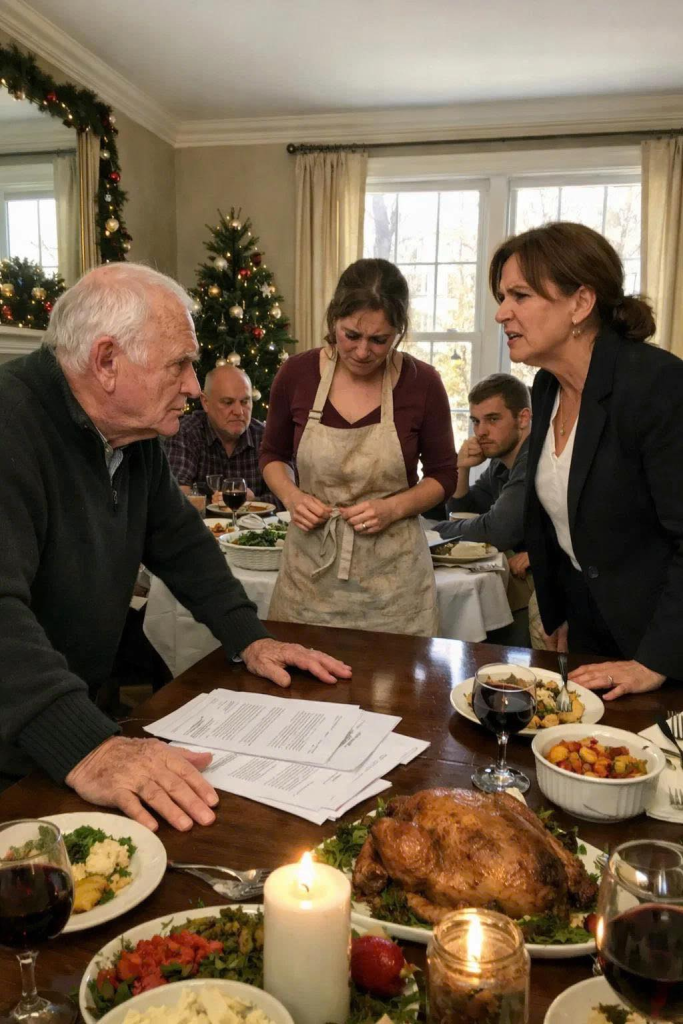
“Why Are You Still Wearing An Apron?” – My Grandfather Asked At Christmas Dinner — Seconds Later, He Discovered My Aunt Had Stolen $90,000 Meant For Me And Let Me Live Like A Servant
I didn’t grow up believing miracles happened at dining tables, especially not in our house, where the long mahogany surface had always been a place of quiet rules and unspoken hierarchies rather than warmth. By the time I was twenty-three, Christmas dinner had become less a celebration and more a performance, one where I knew my role so well I could play it half-asleep: smile politely, speak only when spoken to, clear plates before anyone asked, and never, under any circumstances, make things uncomfortable.
My name is Rowan Pierce, and for most of my life I had been the invisible grandchild, the one people referred to vaguely as “still figuring things out,” a phrase that somehow justified why I worked two jobs while living in a converted storage room at the back of my aunt’s house. I was told, often and loudly, that struggle built character, that not everyone was meant for comfort, and that gratitude was more important than ambition. Those lessons were delivered most enthusiastically by my aunt, Lorraine, who had married my father’s younger brother after my parents died in a highway accident when I was fifteen.
On paper, Lorraine had saved me. In reality, she had acquired me.
Christmas that year was supposed to be different. My grandfather, Harold Pierce, was flying in from Seattle for the first time in years. Harold was a distant figure in my life, not unkind but remote, the sort of man who believed responsibility could be fulfilled through systems and schedules rather than presence. He sent birthday cards with checks tucked inside, holiday emails written by assistants, and occasional phone calls where he asked if I was “doing all right” in a tone that suggested the answer was expected to be yes.
What I didn’t know, what would later shatter everything I thought I understood about my own life, was that for five years he had been sending me $1,500 every single month.
That Christmas afternoon, the house smelled like roasted meat and cinnamon, though beneath it lingered the sharper scent of cleaning chemicals that clung to my hands no matter how many times I washed them. I had been up since dawn, preparing food I knew I wouldn’t fully enjoy, moving quietly while Lorraine supervised from the living room, issuing corrections like a director who never stepped onto the stage herself.
“Rowan,” she called sharply, not bothering to look up from her phone, “make sure the glasses are spotless. Your cousin Nathan hates water marks.”
“Yes, Aunt Lorraine,” I replied automatically.
Nathan, her son, was sprawled on the couch scrolling through his phone, dressed in a cashmere sweater that probably cost more than my monthly rent contribution. He glanced up briefly as I passed and smirked.
“Try not to drop anything this year,” he said lightly. “We don’t want another scene.”
I didn’t respond. Silence had always been safer.
When the doorbell rang, the entire energy of the house shifted. Lorraine straightened her posture, Nathan put his phone away, and suddenly everyone was alert, polished, ready. I wiped my hands on my apron and went to open the door.
Harold stood there in a dark wool coat, his hair thinner than I remembered but his posture still rigid, eyes sharp behind wire-rim glasses. Beside him was a man in a tailored suit holding a slim leather briefcase, his expression neutral but attentive.
“Grandpa,” I said softly.
He looked past me at first, scanning the foyer, then his gaze dropped back to me and paused. His eyes narrowed slightly, not in anger but in concentration, as if something didn’t align with his expectations.
“Rowan,” he said slowly. “You’re… working today?”
I glanced down at the apron, suddenly self-conscious. “Just helping out,” I replied.
Before he could say more, Lorraine swept forward with practiced enthusiasm, greeting him loudly, ushering him inside, praising the weather, the flight, the food. The man with the briefcase followed silently, taking everything in with the quiet awareness of someone used to rooms where important things happened.
Dinner was set precisely at six. Harold was placed at the head of the table, Lorraine to his right, Nathan to his left, and I was seated at the far end near the kitchen entrance, close enough to hear if I was needed. The man with the briefcase introduced himself as Martin Reeves and declined food, choosing instead to observe with a glass of water resting untouched in front of him.
The conversation flowed easily at first. Lorraine spoke at length about home renovations, charity events, and how challenging it had been to “keep everything together” after taking me in. Nathan chimed in occasionally with stories about his job prospects and future plans, all spoken with confidence that had never been tested by necessity.

I ate quietly, responding only when directly addressed, until Harold turned toward me, carving knife paused mid-air.
“So, Rowan,” he said, his voice calm but carrying easily across the table, “how are your studies coming along? You should be nearly finished by now, shouldn’t you?”
My fork slipped from my fingers, clattering against the plate. The sound felt unnaturally loud.
“Studies?” I repeated, confused.
“Yes,” Harold continued, frowning slightly. “Your program. The one we discussed when you turned eighteen.”
Lorraine laughed quickly, a brittle sound. “Oh, you know Rowan,” she said, waving a hand dismissively. “Always changing plans. Never quite sticking to anything.”
I felt my pulse begin to race. “Grandpa,” I said carefully, “I’m not in school. I had to stop going. I couldn’t afford it.”
The table went silent.
Harold set his knife down slowly. “Couldn’t afford it,” he repeated, each word measured. “Rowan, I arranged for an education fund. Monthly transfers. Fifteen hundred dollars, deposited on the first of every month.”
I stared at him, my thoughts scrambling. “I’ve never received anything like that,” I said, my voice barely steady. “I thought… I thought you changed your mind.”
Lorraine’s chair scraped loudly as she stood. “This is ridiculous,” she said sharply. “You must be mistaken, Harold. Rowan has always had trouble managing money. She probably doesn’t even remember.”
“I remember very well,” Harold replied, his voice cold now. “Because I review the statements personally.”
He turned his head slightly. “Martin.”
Without a word, Martin stood and opened his briefcase, removing a neat stack of papers that he laid out across the table, directly over the decorative centerpiece Lorraine had insisted on buying last year. He began to slide documents forward, one by one.
“These,” Martin said evenly, “are bank statements showing consistent transfers from Mr. Pierce’s account to an account labeled ‘Rowan Pierce Trust.’ Five years. Sixty transfers. Ninety thousand dollars total.”
My hands began to shake.
“And this,” he continued, lifting another sheet, “is the authorization document. The secondary signatory with withdrawal access is listed as Lorraine Pierce.”
Lorraine’s face drained of color. “I was managing it,” she said quickly. “For the household. For her benefit. She lived under my roof.”
“For her benefit?” Harold asked quietly.
Martin flipped another page. “Here is a withdrawal matching the exact amount of the monthly deposit, followed by a payment to a luxury car dealership. Another covering renovation costs. Another for international travel.”
Nathan looked at his mother, eyes wide. “Mom?”
“I did what I had to do,” Lorraine snapped, her composure cracking. “This house doesn’t run itself. Rowan ate our food, used our utilities. That money helped all of us.”
Harold stood, placing both hands on the table, his voice low but shaking with restrained fury. “You stole from a child entrusted to you,” he said. “You let her struggle while you lived comfortably on funds meant to secure her future.”
“This is a misunderstanding,” Lorraine insisted, though her voice trembled. “We can talk about this privately.”
“No,” Harold replied. “We cannot.”
He nodded to Martin. “Proceed.”
Martin’s tone remained clinical. “Mr. Pierce has chosen not to pursue criminal charges at this time, contingent upon full restitution and immediate vacating of the property, which, for the record, is owned by Mr. Pierce through a family trust.”
Nathan stood abruptly. “You can’t just throw us out!”
“You’ve had five years you didn’t deserve,” Harold said calmly. “You have forty-eight hours.”
Lorraine turned toward me then, her expression twisted with anger and fear. “You’re enjoying this,” she accused. “After everything I did for you.”
I stood slowly, removing the apron I had worn all day and setting it carefully on the back of my chair.
“I didn’t do anything,” I said quietly. “I just told the truth.”
That night, I left the house with nothing but a small bag and the weight of five lost years lifting from my chest. Harold insisted I stay with him while we sorted everything out. Over the following months, he helped me enroll in school again, this time without intermediaries, and taught me how to manage what remained of the trust with transparency and care.
Lorraine and Nathan moved out quietly, their lifestyle collapsing under the weight of reality they could no longer avoid. There was no public spectacle, no dramatic downfall, just consequences catching up at last.
A year later, I sat at another Christmas table, this one smaller, simpler, filled with genuine laughter. I had finished my first year back at school, working part-time by choice rather than desperation. Harold raised his glass toward me, pride softening his features.
“To Rowan,” he said. “And to never confusing control with care again.”
I smiled, feeling something unfamiliar but welcome settle into my chest.
Peace.
And for the first time in my life, it felt earned.



Leave a Reply