“There’s Something Under the Ice.” — I Felt the Ice Give Way as My K9 Leapt Into the Frozen River, and What He Dragged Up Exposed a Child the City Tried to Erase
The Hawthorne River never truly froze the way postcards promised, not in this part of northern Ohio where winter pretended to be merciful but always carried teeth beneath the surface, and Officer Elias Monroe had learned over the years that the most dangerous moments were not when the ice cracked loudly and dramatically, but when it whispered, when it made that thin, brittle clicking sound that most people dismissed as harmless shifting but which, to him, sounded like a warning drawn out slowly, as if the river itself were asking whether anyone was listening.
Atlas was listening.
The Belgian Malinois stopped so abruptly that the leash snapped taut, nearly tearing the glove from Elias’s hand, and the stillness that followed felt heavier than any bark or growl ever could, because Atlas was not a dramatic dog, not prone to false alarms or instinctual lunges, and when he froze like this—muscles locked, ears angled forward, body squared toward something unseen—it meant the world had tilted just slightly out of place.
“What is it, boy?” Elias murmured, though his chest had already tightened in response, instinct answering instinct as he followed the dog’s line of sight toward the riverbank where the reeds bent in a way that didn’t match the wind.
Atlas didn’t answer with sound.
He answered with motion.
The leash burned through Elias’s palm as the dog surged forward, boots slipping uselessly against frozen mud as Elias lost his footing, and then Atlas was gone, plunging into the black water without hesitation, as if the river had called his name directly. There was no pause for thought, no calculation of risk, because partnership like theirs did not allow for debate, and Elias followed, the cold hitting him with a violence that stole breath and replaced it with pain so sharp it nearly made him retch.
The current fought him immediately, tugging at his legs, twisting him sideways, but Atlas had clamped onto something submerged, something heavy and deliberate, and he pulled with a determination that went beyond training, hauling the object inch by inch toward the bank while Elias grabbed the harness and added his strength, teeth clenched so hard his jaw screamed.
They collapsed onto the shore together, soaked and shaking, and what lay between them made the world feel suddenly unreal.

A backpack.
Not old, not damaged, but sealed too carefully, weighted too deliberately, and Atlas whined in a sound Elias had only heard once before, years ago, on a night that ended with hospital lights and a grief he had never fully learned to live around. His hands shook as he cut the zipper open, fabric tearing unevenly, breath held against instinctive dread.
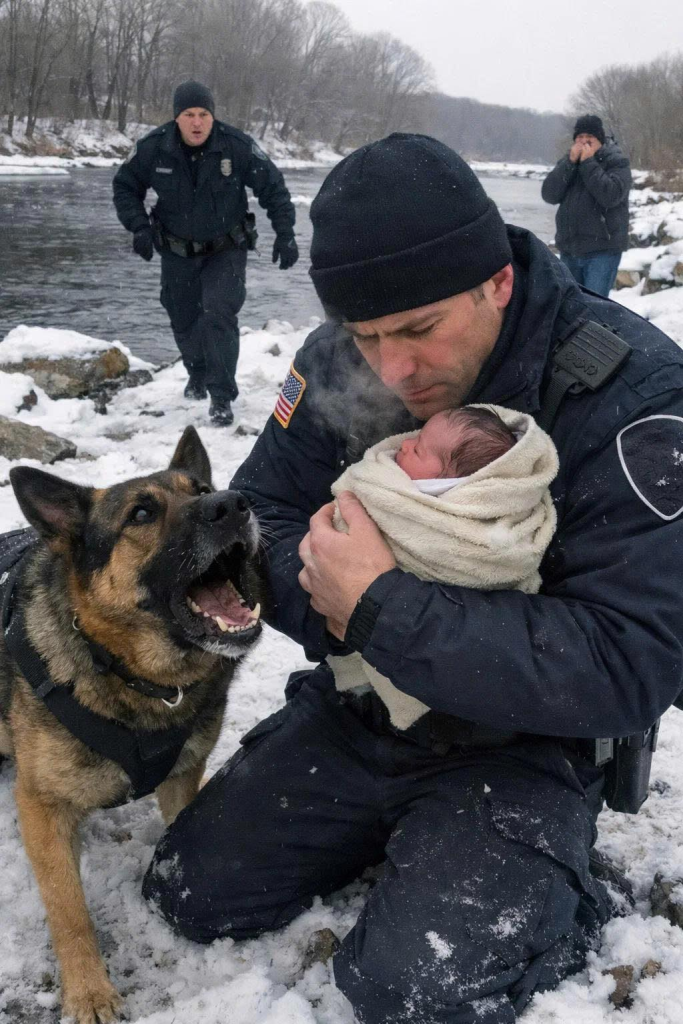
Inside, wrapped in a lavender fleece, was a baby.
For one unbearable second, time refused to move, the infant too still, too pale, the cold having painted her skin into something that didn’t look alive, and Elias felt a familiar fracture open in his chest, because seven years earlier he and his wife had buried a daughter who never cried, never breathed, never got the chance to prove the world wrong about its cruelty.
“No,” he whispered, not as refusal but as prayer.
Atlas barked once, sharp and commanding, snapping Elias back into himself, and training took over where fear threatened to win. Elias laid the baby on the blanket, fingers careful, movements precise despite the way his vision blurred, counting compressions, breathing for her, murmuring nonsense and promises he didn’t know if he could keep, until the smallest spasm rippled through her body, followed by a cough so fragile it barely registered as sound, and then a cry, thin but alive, cutting through the winter like a declaration.
Elias laughed and sobbed at the same time, pulling her against his chest, ignoring the cold biting into his skin because warmth mattered more than comfort, and he ran for his cruiser with Atlas close behind, paws slapping ice like a heartbeat refusing to stop.
The hospital swallowed them in motion and noise, and the baby vanished into capable hands while Elias stood dripping river water onto polished tile, staring at the space she had occupied as if focus alone could anchor her to the world. Atlas leaned against his leg, steady and present, reminding him that survival was not a solitary act.
It was nearly an hour later when Detective Samuel Brooks arrived, face tight with concern, and told Elias the baby would survive, but that something else had been found inside the backpack, sealed carefully beneath the lining as if someone had planned for time, water, and discovery.
A birth certificate.
The mother was listed as Mariah Cross, nineteen years old, reported missing four months earlier, a case that had quietly stalled despite unanswered questions and rumors no one wanted to touch. Alongside it lay a gold pendant engraved with a symbol every officer in Grayhaven recognized, because it belonged to Victor Calderón, a man whose money had a way of making inconvenient truths disappear.
Elias understood then that the river had not been an act of abandonment but of desperation, that Mariah had hidden her baby where no one would look, trusting cold and silence more than people, and that someone had found her too late to save her but not too late to try to erase what remained.
He stayed by the pediatric ward that night, suspicion settling into his bones, and it proved justified when Captain Roland Fitch arrived with officers whose loyalty was measured more in silence than integrity, accompanied by a social services agent with paperwork that felt rushed and wrong. Fitch spoke smoothly about protocol and transfer, about safety and procedure, but his eyes flicked too often toward the room where the baby slept.
“She needs stability,” Fitch said quietly, pulling Elias aside. “And you need to forget what you think you found. Fifty thousand reasons to do so.”
Elias looked at him, steady, and replied, “She has a name. It’s Mira. And that changes everything.”
Dr. Evelyn Hart refused the transfer, citing medical necessity, and together they discovered a flash drive sewn into the blanket, along with a note in Mariah’s handwriting, explaining that the drive contained records linking Calderón to a network of illegal activity, and begging whoever found it to keep her daughter alive long enough for the truth to matter.
What followed was chaos born of choice rather than chance, Atlas creating just enough distraction, Elias and Evelyn navigating forgotten service corridors beneath the hospital as footsteps thundered above, gunshots echoing where no one would admit to hearing them, until Detective Brooks revealed his own complicity but chose redemption in the end, delaying their pursuers long enough for them to reach federal ground.
The city cracked open in the days that followed.
Investigations reopened. Arrests followed. Calderón’s empire collapsed under the weight of its own secrets, and Captain Fitch stood before cameras with nothing left to say.
Elias woke in a hospital bed days later, battered but alive, Atlas resting his head against the mattress like a promise kept, and when Evelyn placed Mira into his arms and asked if he would foster her, something inside him finally loosened, because grief did not disappear, but it learned how to make room.
Spring came quietly to the Hawthorne River that year, ice melting without drama, water flowing as if nothing had ever been hidden beneath it, and Elias would walk there sometimes with Atlas and Mira bundled against his chest, knowing that some silences were meant to be broken, and some lives were saved not because the world was kind, but because someone chose to be.
Atlas stayed close, watching, because loyalty, once given, does not ask to be returned.
And somewhere beneath the thawing river, the lie the city had buried finally dissolved, carried away piece by piece, until only truth remained.

Leave a Reply