My Late Husband’s Last Gift Was a Dog. My Son-in-Law Said He Had It Put Down “For Safety.” Three Days Later, I Found the Dog Alive, Digging Desperately in the Garden He Built—And What Was Buried There Changed Everything
I never believed that love could be measured in something as simple as a dog until the day my husband died and left me one as his final, deliberate act of care. Arthur Bennett had always been a practical man, the kind who fixed broken hinges instead of buying new doors, who wrote notes instead of sending texts, who believed presence mattered more than grand gestures. When the doctors told us his time was short, he did not talk about fear or regret, but about logistics, about whether the furnace had been serviced, whether the insurance paperwork was organized, whether I would remember to eat when the house became quiet again.
A week before he passed, he came home with a golden retriever puppy tucked under his arm, all oversized paws and soft ears, blinking at the world as if unsure whether it was safe to exist yet.
“This,” Arthur said, setting the puppy down gently at my feet, “is Oliver. He’s not a replacement, and he’s not a distraction. He’s a companion. When you wake up and the house feels too big, he’ll remind you you’re still here.”
Arthur died three days later.
After the funeral, after the casseroles stopped arriving and the phone stopped ringing, Oliver became the reason I moved through my days at all. He slept curled against my calves at night, followed me from room to room with quiet devotion, and rested his head on my knee whenever grief threatened to fold me inward. In his eyes, I saw something achingly familiar: patience, loyalty, and a steady presence that did not demand anything except honesty.
The silence in the house softened, just enough to be survivable.
That fragile peace ended the afternoon my son-in-law arrived unannounced.
Mark Reynolds had always believed authority was the same thing as competence, and he wielded it accordingly. He spoke in certainties, made decisions before conversations had finished, and framed control as concern. My daughter, Hannah, had spent years smoothing over his sharper edges, explaining away his impatience as stress, his intrusions as good intentions. I had learned to keep my distance, not because I feared him, but because something about the way he evaluated people made my skin prickle.
That day, he walked into my kitchen, glanced around as if taking inventory, and sighed.
“We need to talk about the dog,” he said, his tone already rehearsed.

Oliver lifted his head from the rug, tail wagging once before settling again, utterly unaware that he had become a problem to be solved.
“What about him?” I asked, though my chest had already tightened.
Mark folded his arms. “He snapped at the delivery guy yesterday. Hannah was worried. I took care of it.”
I stared at him, not understanding the words individually, but sensing their collective weight pressing down on me.
“Took care of what?” I said.
“The dog,” he replied, as if clarifying a minor misunderstanding. “It wasn’t safe. I didn’t want to upset you, but this was the responsible thing to do.”
The room tilted. My ears rang, my vision narrowing as if the world had suddenly pulled away from me.
“You mean…?” I could not finish the sentence.
Mark nodded once. “It’s done.”
I do not remember sitting down, only the cold of the chair against my legs and the hollow ache spreading through my chest. Hannah stood in the doorway, her face pale, her hands twisting together as if she were trying to wring reassurance out of the air.
“I’m sorry, Mom,” she whispered. “He said it was necessary.”
Necessary.
Arthur’s last gift, erased by someone else’s convenience.
For two days, I barely left my bedroom. The house felt cruelly empty again, the silence sharper without the soft padding of paws behind me. I replayed every moment with Oliver, every wag of his tail, every quiet night he had slept beside me, wondering how I had failed to protect the one thing Arthur had trusted me with.
On the third morning, I went into the kitchen to make coffee out of habit more than hunger, my movements slow and automatic. As the machine gurgled to life, I glanced out the window toward the backyard, and something moved near the garden.
At first, I thought grief had finally pushed me into hallucination. Then I heard it: a familiar, urgent scratching sound, quick and insistent.
My heart stuttered.
I stepped closer to the glass.
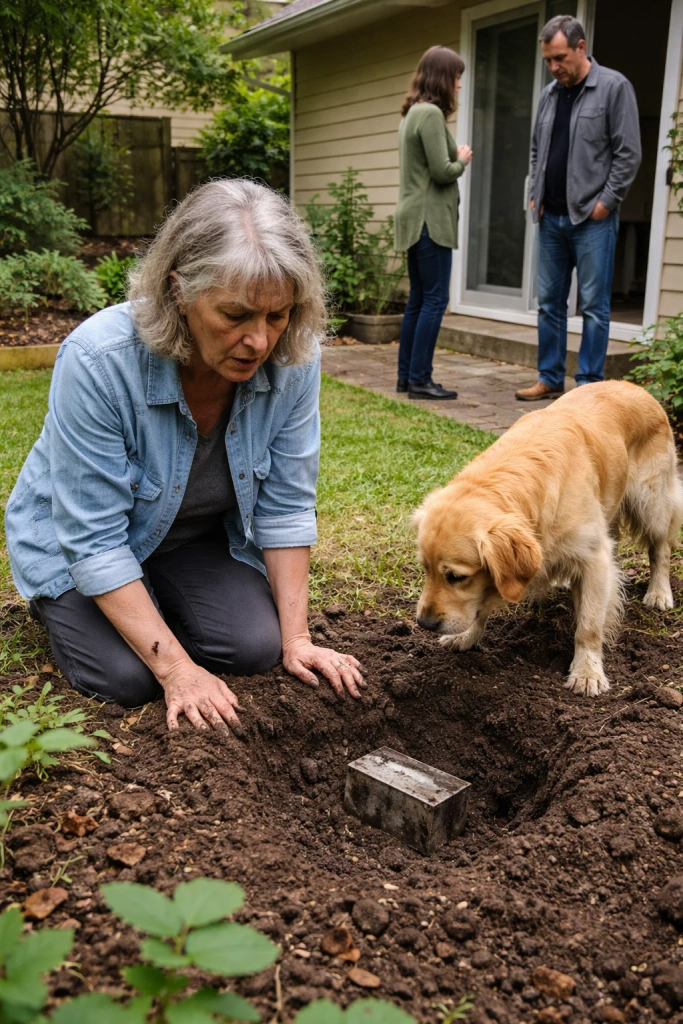
There, in the raised garden bed Mark had built just weeks earlier, was Oliver.
Alive.
He was digging furiously, dirt flying behind him as he worked, stopping every few seconds to glance toward the house, whining softly, as if trying to call me outside. Relief hit me so hard my knees nearly buckled, but it was quickly followed by confusion and then dread.
If Oliver was alive, then Mark had lied.
I rushed outside, calling Oliver’s name. He froze when he saw me, tail wagging wildly, then returned to the hole he’d been excavating with renewed urgency. Something glinted beneath the overturned soil, catching the sunlight at an unnatural angle.
I knelt beside him, brushing dirt away with trembling hands.
What I uncovered was not a bone, or a toy, or anything an animal might bury.
It was a small metal box, weathered and rusted, deliberately sealed.
My breath caught when I saw the name etched faintly into the lid.
Arthur Bennett.
Oliver had not been digging at random. He had been trying to show me something.
I carried the box inside, my hands shaking so badly I had to set it down twice to keep from dropping it. Oliver followed closely, pressing his body against my leg, as if grounding me. The lock had corroded just enough that I could pry it open with a kitchen knife. Inside were papers, neatly folded, protected in plastic sleeves, alongside a flash drive and several handwritten notes.
The first document was a letter in Arthur’s unmistakable handwriting.
If you are reading this, Claire, then something has gone wrong.
My vision blurred as I continued reading. Arthur wrote about money that had begun disappearing from our accounts during the months he was ill, small amounts at first, then larger, always coinciding with days Mark had offered to “help” with errands or finances. Arthur admitted he had not wanted to alarm me, nor confront Hannah without absolute proof, but he had trusted his instincts enough to hire a private investigator.
The evidence was meticulous.
Bank transfers, shell accounts, forged authorizations, all pointing to Mark siphoning funds under the guise of assistance. Arthur had hidden the documents after Mark began asking too many questions, sensing that discretion might be his last line of defense.
The realization settled heavily in my chest.
Mark hadn’t built the garden for me.
He had built it to bury evidence.
And when Oliver started digging near it, Mark panicked.
Hannah arrived later that afternoon, concern etched across her face the moment she saw me at the table, the papers spread before me, Oliver lying protectively at my feet.
“What’s going on?” she asked softly.
I handed her the letter.
She read in silence, her expression shifting from confusion to disbelief to devastation. When she reached the end, she pressed her hand to her mouth, tears spilling freely.
“He told me you were confused,” she whispered. “He said you were forgetting things.”
I closed my eyes. “I’m so sorry.”
When Mark returned that evening, he walked into a confrontation he had not prepared for. Hannah’s voice was steady but cold as she asked him to explain the documents. I watched him cycle through denial, deflection, and anger, his confidence eroding with every piece of evidence placed in front of him.
When he saw the lockbox, he went quiet.
That silence told us everything.
Hannah asked him to leave that night. There was no shouting, no dramatic ultimatums, just a firm boundary drawn at last. The next morning, we met with an attorney recommended by the investigator Arthur had mentioned. The case was clear, the evidence overwhelming.
Mark faced consequences swiftly.
Hannah filed for separation and began rebuilding her life, piece by careful piece. I recovered what Arthur had worked his entire life to provide, but more importantly, I recovered the truth, and with it, a sense of safety I had not realized I’d lost.
Oliver never left my side again.
Sometimes, I sit in the garden, watching him lie in the sun, and think about the quiet intelligence that guided him back to what mattered. Arthur had trusted that dog to look after me, and in doing so, he had protected far more than my heart.
He protected the truth.
And in the end, that made all the difference.

Leave a Reply