My Parents Chose My Sister’s Opening Night Over the White House — They Said, “We Can’t Be in Two Places at Once,” But When the Medal Was Placed Around My Neck, I Finally Understood Who My Real Family Was
My parents didn’t hesitate.
“We’re not coming,” my mother said, her tone brisk, practiced, as if she were rearranging errands instead of rewriting my memory of them. “Your sister’s show is more important.”
I stood in my kitchen, barefoot on cold tile, staring at the envelope that had been sitting on the table since dawn. Thick paper. Official weight. The return address alone felt unreal. THE WHITE HOUSE. My name printed beneath it, clean and unmistakable, as if it belonged to someone else who had lived a braver, louder life.
“It’s not just a ceremony,” I said, forcing my voice to stay even. “It’s… the White House. They don’t exactly send these out casually.”
“I know that,” my mother replied, already tired of the subject. I could hear movement on her end—fabric rustling, hangers clinking, the sound of a household preparing for something that mattered. “But your sister has opening night. This is her moment.”
In the background, my younger sister’s voice floated through the line, sharp with excitement. “Did Dad grab the tickets? They’re holding the house for us, right?”
They were already there, mentally. Already seated. Already applauding.
I swallowed and tried once more. “Dad?”
There was a pause, then his voice came on, warm and careful in the way that always meant the decision had already been made. “We’re proud of you,” he said gently. “You know that. But we can’t be in two places at once.”
I almost laughed at the simplicity of it. As if that had ever stopped them before.
“That’s okay,” I said. My throat tightened, but I didn’t let it show. “Tell her good luck.”
My mother exhaled, relief plain in the sound. “We’ll call you later. Maybe FaceTime after the show. Love you.”
The line went dead.

The silence that followed was dense, pressing in on my chest until it felt hard to breathe. I stood there for a long moment, phone still in my hand, as if waiting for it to ring again with a correction, an apology, a sudden realization that maybe this time was different.
It didn’t.
I finally sat down and opened the envelope.
The letter inside was precise and polished, the language refined until it felt almost bloodless. “For extraordinary heroism in combat,” it read, citing a province halfway across the world, a date that still woke me up at night. It described decisive action, leadership under fire, courage beyond expectation.
It did not mention the blast that turned the afternoon into white noise and heat. It did not mention the way the ground seemed to lift me and throw me back down, or the metallic taste in my mouth, or how my hands shook as I dragged Corporal Reyes behind the remains of a wall and kept calling for evacuation even when my voice cracked.
It didn’t mention how quiet it got afterward.
On the counter beside me, my dress uniform was laid out with military precision. Jacket pressed. Ribbons aligned. Shoes polished until I could see my own reflection in them. In the darkened window above the sink, my reflection stared back—jaw set, shoulders straight, the version of myself my parents preferred. The one who didn’t complain. The one who didn’t ask for anything.
For as long as I could remember, I had been trying to earn a different kind of love from them. I had called from time zones they couldn’t pronounce. I had sent money without being asked and gifts even when I was forgotten. I had swallowed disappointment whole and told myself that next time would be different, because there was always a next time.
Now, the White House wanted me to stand under chandeliers and history, and my parents were choosing a theater seat.
Something in me shifted—not loudly, not dramatically, but with the quiet finality of a door closing.
I picked up my phone again, scrolled past my mother’s name, and tapped another contact.
“Command Sergeant Major Evelyn Brooks,” came the voice on the other end, sharp and steady.
“It’s Captain Morgan,” I said. “Are you busy?”
There was a brief pause. “For you? Never. What’s going on?”
“My family isn’t coming,” I said, surprised at how calm the words sounded out loud. “And I don’t want empty seats. I want them filled with people who were actually there.”
Another pause, longer this time, then a low exhale. “Send me the names,” she said. “I’ll handle the rest.”
I looked down at the uniform again, at the medals already pinned, and felt something solid settle in my chest. “Thank you,” I said. “All of you deserve to be there.”
When the call ended, the silence in my kitchen felt different. Not empty. Clear.
I started typing.
Sergeant Luis Alvarez. Medic Thompson. Lieutenant Park. Staff Sergeant Reed. People who knew the smell of dust and smoke, who knew exactly what that letter left out.
Three days later, I stood backstage in the East Room of the White House, the air thick with polish and history. The chandeliers caught the light and scattered it across gold-trimmed walls. It felt unreal, like stepping into a photograph from a textbook.
My phone buzzed in my pocket.
Mom: Opening night was incredible. She was radiant. We’re heading to dinner with the cast. Hope your thing went well. Send pictures if you can.
I stared at the message for a moment, then turned the screen off without replying.
When my name was called, I walked forward without looking for the people who weren’t there.
Instead, I looked at the front row.
Alvarez was there, standing straighter than I’d ever seen him, his grin unmistakable even from a distance. Thompson had one hand pressed to her mouth, eyes bright. Sergeant Major Brooks stood with her hands clasped behind her back, pride radiating from every line of her posture.
These were my people.
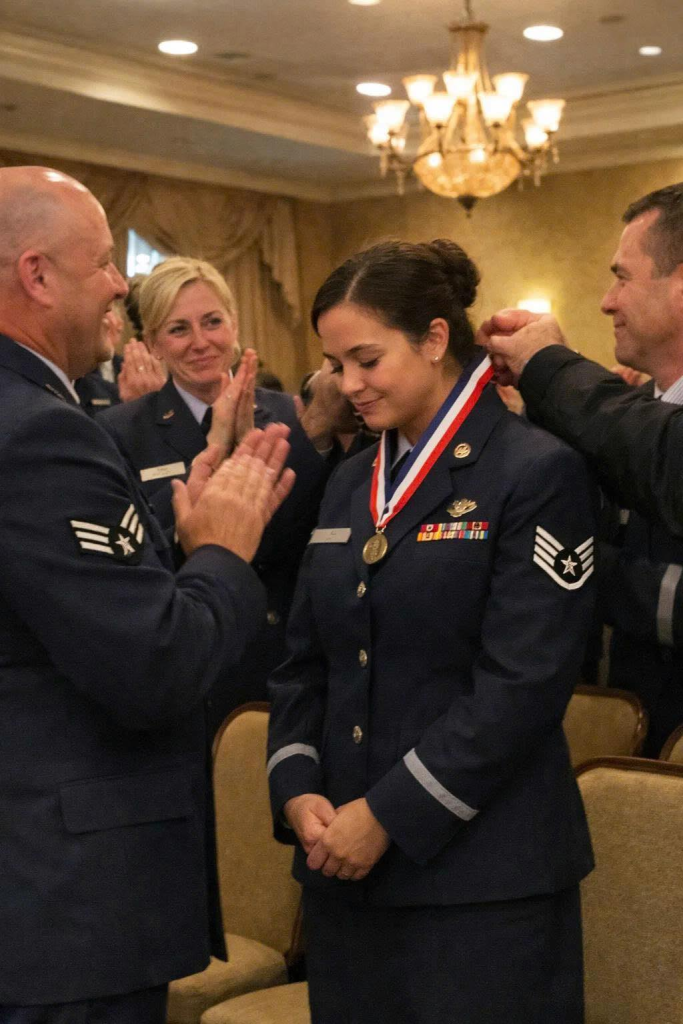
The citation was read aloud, words echoing off the walls, and when the medal was placed around my neck, its weight surprised me—solid, undeniable.
As the President shook my hand, he leaned in slightly. “Your family must be very proud,” he said quietly.
I looked past him, at the men and women who were already on their feet, applause rolling through the room like thunder.
“They are,” I replied, my voice steady. “They’re all here.”
Later, as the reception wound down, my phone buzzed again with photos I didn’t open. I tucked it away and turned toward the group gathering near the exit.
“Captain,” Alvarez called, jerking his thumb toward the doors. “We found a place that serves terrible food and strong drinks. You in?”
I smiled, feeling lighter than I had in years. “Lead the way.”
As we stepped out into the night, medals clinking softly, I didn’t feel the familiar pull of regret. My parents had made their choice, and so had I.
For the first time, I wasn’t asking to be seen.
I already was.


Leave a Reply