
When Doña Elvira opened the door, she recognized Santiago immediately. She said nothing, only bowed her head. “I found the metal box,” Santiago said.
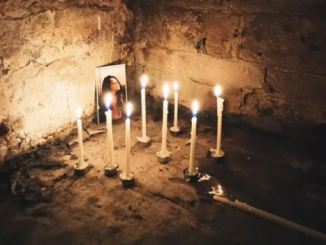
Santiago had started his job as a “grave attendant” at 25. The name sounded somber, but in reality, his work consisted of cleaning, tending to, and lighting candles at the graves of those who had been forgotten or whose relatives lived far away.
Five years earlier, a woman named Elvira, elegantly dressed and with her face almost hidden by a wide-brimmed hat and dark glasses, sought him out on the recommendation of the cemetery administrator. She hired him to look after a single grave, located in a secluded corner of the San Miguel town cemetery.
The agreement was extremely strange:
Santiago had to care for that grave as if it were the final resting place of a close relative. The site had to be immaculate at all times, without a single weed. And most peculiar of all: Doña Elvira demanded that the grave not have any name engraved on it.
“If anyone asks, just say it’s the Nameless Grave. For payment, I’ll give you ten times the market rate,” Doña Elvira said, her voice hoarse and worn.
And she kept her word. Every month, the payment arrived in Santiago’s account punctually, without missing a single peso.
For five years, Santiago transformed that arid patch of land into a small garden: he planted a bougainvillea bush behind the gravestone, placed a pot of fresh marigolds there every week, and covered the ground with small river stones.
But something always troubled him: no one, absolutely no one, came to visit.
Doña Elvira never appeared a second time. What man or woman lay beneath that earth, so isolated? A criminal? A forgotten soul? Or someone so lonely that they could only afford to pay a stranger to look after their final resting place?
Santiago often talked to the anonymous gravestone.
“Mangoes are very cheap this year, sir or madam. I suppose there aren’t any mangoes down there, are there?”
“The rainy season was long this year; I had to replace the soil around the marigolds. I hope the person down here isn’t cold.”
This was how Santiago filled the mysterious void and eased the guilt of receiving money from a spirit no one remembered.
At the end of the fifth year, while Santiago was watering the bougainvillea, Doña Elvira suddenly appeared. This time she wasn’t wearing glasses, but her hat still covered most of her face.
She handed Santiago a small, carved wooden box.
“Santiago. Today marks five years. You’ve done an excellent job. You’re a man of your word.”
Doña Elvira’s voice was still husky, but it trembled slightly. She gazed at the grave for a long time and then turned to him.
“I have one last request. Inside this box is an object. Tomorrow, very carefully, place it on the gravestone, at the highest point, where I’ve left a small mark.”
Santiago took the box. He wanted to ask about the deceased’s identity, but he only saw Doña Elvira’s tired eyes. Her eyes held a deep sadness, but also a terrifying determination.
“Just do as I ask. After that, you won’t need to look after this grave anymore. I’ll pay you the full sixth-year contract as a thank you.”
With that, Doña Elvira turned away, and her figure disappeared among the trees of the cemetery.
That night, Santiago couldn’t sleep. Ending this contract meant not only losing a significant source of income, but also the feeling of losing a silent friend of five years. He opened the wooden box.
Inside was an antique bronze picture frame, carefully polished. And the photo inside…
Santiago felt a chill run down his spine. It was a photo of a boy about five years old, grinning from ear to ear, revealing a gap where two front teeth were missing. The boy wore a striped shirt and stood next to a pot of geraniums in full bloom.
Santiago jumped up, shining his phone’s flashlight on the photo.
That photo… it was too familiar. That boy was him.
Part III: The Mirror on the Gravestone
The next morning, Santiago’s hands trembled as he carried the framed photo to the mausoleum. He placed it in the spot marked on the gravestone. The photo of the smiling five-year-old boy contrasted starkly with the somber atmosphere of the place.
“Why? Why my photo?”
Santiago searched his memory. He remembered that photo perfectly. It had been taken during Christmas when he was five years old, in the yard of his old house. His mother, a sweet woman named Elena, had taken it. Shortly after, he and his mother moved away, leaving behind that house and the irresponsible father who had abandoned them.
His mother had told him that his father, Arturo, was an alcoholic who had vanished without a trace. Santiago grew up hating the man he never knew.
But if the person buried there was a stranger, why use his picture? If it was a joke, it was too cruel.
Santiago made a decision.

Leave a Reply