My Brother Thought He Found My Hidden Fortune at the Office I Never Talked About. What He Uncovered Ended Up Rewriting Our Entire Family History.
I never intended to keep secrets from my family forever, but there are certain truths that grow heavy only when spoken aloud, especially when the people you love have already decided who you are without ever asking, and so for years I let them believe I worked a quiet administrative job in a glass building downtown, something boring enough that no one ever pressed for details, something safe enough that my silence felt like modesty rather than self-protection.
My older brother, Julian, had always been the opposite of me in every visible way, louder where I was reserved, confident where I hesitated, convinced the world owed him a certain kind of success because he believed himself clever enough to deserve it, and growing up he learned quickly that if he spoke with enough certainty our parents would nod along, even when the facts were thin or the ethics flexible.
“Don’t overthink everything,” he used to tell me whenever I questioned his shortcuts or his sudden windfalls, his grin wide and unbothered, as if planning carefully were a flaw rather than a skill, and I learned early that pushing back only made me the difficult one in a family that preferred easy answers.
Years passed, adulthood arrived with its quiet compromises, and while Julian bounced between ventures that promised fast returns and faster exits, I built something slower, something structured, something that required discretion, clearances, and an understanding that not all work announces itself loudly, which was why the office I never talked about didn’t even have my name on the directory downstairs.
The night everything unraveled began with a call from my building’s security system, a soft vibration against my wrist that wouldn’t have drawn attention to itself if I hadn’t designed it to bypass sound entirely, and when I glanced down at the notification during a late dinner with colleagues, the phrasing alone told me this wasn’t a glitch.
Unauthorized access detected. Internal archive. Level C.
I excused myself without drama, stepping out into the cold air with the kind of calm that only comes when your worst assumption has finally been confirmed, because deep down I already knew who would have thought they were clever enough to go looking.
Julian had been asking questions for weeks, framed casually at first, about my schedule, about the building badge I never left lying around, about whether I ever worried that I was “playing too small” given my education, and when I’d brushed him off he’d laughed it away, but curiosity like his was never harmless, it was always transactional.
The live feed loaded slowly, grainy for half a second before resolving into clarity, and there he was in my office, sleeves rolled up like he belonged there, rifling through a locked cabinet with the confident impatience of someone who believed discovery was the same thing as ownership.
“What are you doing?” I whispered to the empty street, not because he could hear me but because the question had been sitting in my chest for years, and watching him pry open something I had protected so carefully felt like a violation layered on top of a long history of assumed entitlement.
He found the case almost immediately, a nondescript steel container bolted to the back of the cabinet, the kind of thing that looks deliberately uninteresting unless you know exactly what it holds, and when he finally wrenched it free, his smile bloomed with unmistakable triumph.
“Of course,” he muttered, his voice barely audible through the feed, “she always did hide things better than she let on.”

He didn’t know that removing the case triggered more than an alert, didn’t know that its contents were traceable by design, not because I distrusted my colleagues but because accountability was built into every layer of the work, and most importantly, he didn’t know that the files inside weren’t assets or currency or leverage of the kind he understood.
They were records, testimonies, patterns, the slow accumulation of proof tied to financial misconduct investigations that spanned years, cases that required patience rather than bravado, and the moment Julian crossed that threshold he became part of a story he could no longer control.
I drove home instead of heading straight to the office, because I needed to see how far he would take it without interference, and by the time I arrived at my parents’ house the driveway was already full, lights blazing, laughter spilling out into the yard in celebration of Julian’s latest announcement, a partnership he claimed would finally put him “on the map.”
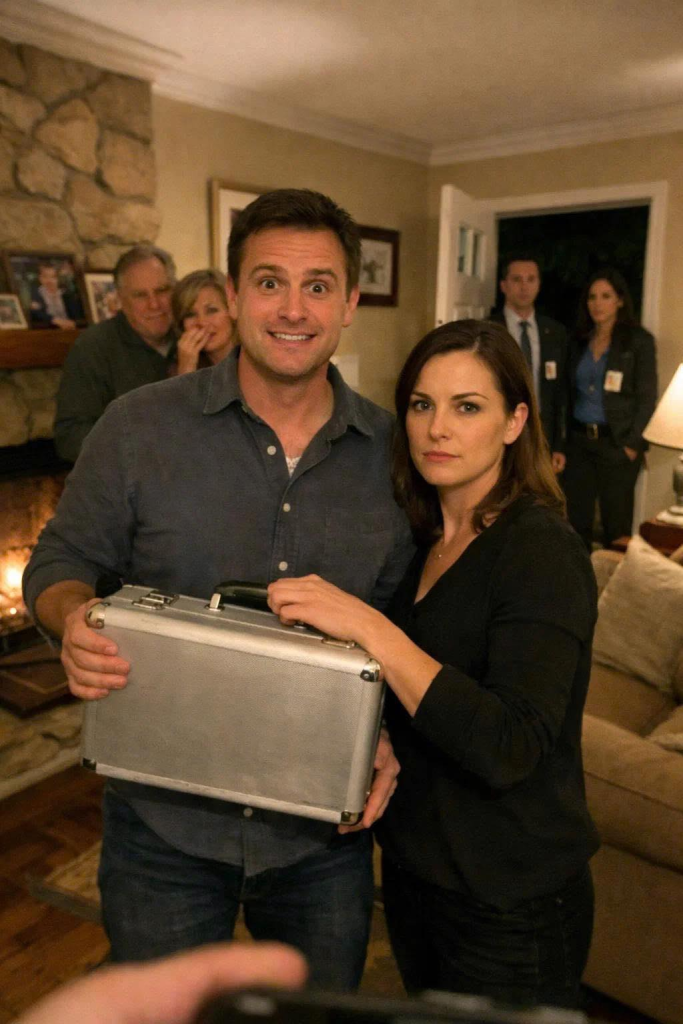
Inside, he stood near the fireplace holding court, the steel case tucked under one arm like a trophy, his voice animated as he spun a narrative about luck and timing and doors opening at last, while our parents watched him with the same familiar pride that had always come with his confidence, even when the substance was lacking.
I waited until he noticed me, until his smile faltered just enough to reveal surprise rather than guilt, and when he raised his glass in my direction the room followed his lead, applause breaking out in a way that felt rehearsed even if it wasn’t.
“You should thank her,” Julian said lightly, nodding toward me, “turns out my little sister’s been sitting on something valuable all this time.”
I set my bag down slowly, meeting his gaze without raising my voice, because volume had never been my weapon, and said, “That depends on what you think value looks like.”
He laughed, a little too quickly, and held up the case. “This,” he replied, “looks like the kind of thing people hide when they don’t want to share.”
The room went quiet, not because anyone sensed danger but because tension has a way of making itself known even to those who don’t understand its source, and I reached out, resting my hand on the case without trying to pull it away.
“Julian,” I said, keeping my tone even, “you don’t know what you’ve taken.”
His smile tightened. “I know enough.”
“That’s the problem,” I replied, and then I turned to our parents, who were already shifting uncomfortably, caught between the version of him they preferred and the one standing plainly in front of them, “because knowing enough is often what convinces people they don’t need to ask permission.”
Our mother frowned, her voice sharp with impatience. “Can we not do this tonight?”
I nodded. “We can,” I said, “but it won’t change what’s already in motion.”
Julian scoffed, lifting the case again. “You’re being dramatic.”
“Maybe,” I said, finally meeting his eyes fully, “but drama tends to follow evidence when it’s mishandled.”
The color drained from his face just a fraction, not enough for anyone else to notice but enough for me to recognize the flicker of doubt, and before he could respond there was a knock at the door, firm and unhurried, the kind that carries authority without aggression.
The conversation stalled as our father went to answer it, confusion rippling through the room, and when he stepped aside to reveal two federal investigators standing calmly on the threshold, identification visible but voices measured, the shift was immediate.
“Julian Mercer?” one of them asked.
Julian’s mouth opened, then closed, his bravado evaporating in real time as he looked at me, searching for the familiar reassurance I had provided my entire life, the silent promise that I would clean up whatever mess he made, and for the first time I didn’t offer it.
“That case,” the investigator continued, nodding toward his arm, “was reported removed from a secured location earlier this evening.”
“I didn’t steal anything,” Julian said quickly, his voice cracking just enough to betray him, “it belongs to my sister.”
“And your sister,” the investigator replied, glancing briefly at me, “has already confirmed its contents and cooperated fully.”
Our parents stood frozen, realization dawning slowly and painfully as the narrative they had accepted for years began to fracture, and when the investigators escorted Julian out, his protests fading into stunned silence, I felt something in my chest loosen, not relief exactly but release.
Later, after the house had emptied and the quiet settled heavily around us, my mother finally spoke, her voice softer than I’d ever heard it, asking questions she should have asked decades earlier, about my work, about why I never said anything, about when things had gone so wrong between us.
“I didn’t hide my life from you,” I told her honestly, “I protected it, because every time I tried to explain, it was treated like something Julian could borrow if he wanted.”
My father nodded slowly, shame etched into his posture. “We didn’t listen,” he admitted.
“No,” I agreed gently, “but you can now.”
The weeks that followed were difficult in quiet ways rather than dramatic ones, filled with conversations that required patience and accountability, and while Julian faced consequences that couldn’t be negotiated away, they were measured, grounded in law rather than revenge, leaving room for him to confront who he had become without destroying what remained of him.
Months later, I received a letter from him, stripped of excuses, heavy with reflection, and while it didn’t undo the past it acknowledged it in a way he never had before, which mattered more than I expected.
We are not close now, not in the way people imagine when they think of reconciliation, but we are honest, and sometimes honesty is the kindest ending a story can have.
As for me, I no longer downplay my work or my boundaries, no longer confuse silence with peace, and when people ask what I do, I tell them just enough, because I’ve learned that the right people don’t need access to respect you, and the wrong ones will always reveal themselves eventually.
In the end, justice didn’t arrive with spectacle or satisfaction, but with clarity, and that clarity reshaped my family in ways that hurt before they healed, leaving us quieter, humbler, and finally, for the first time, grounded in something real.



Leave a Reply