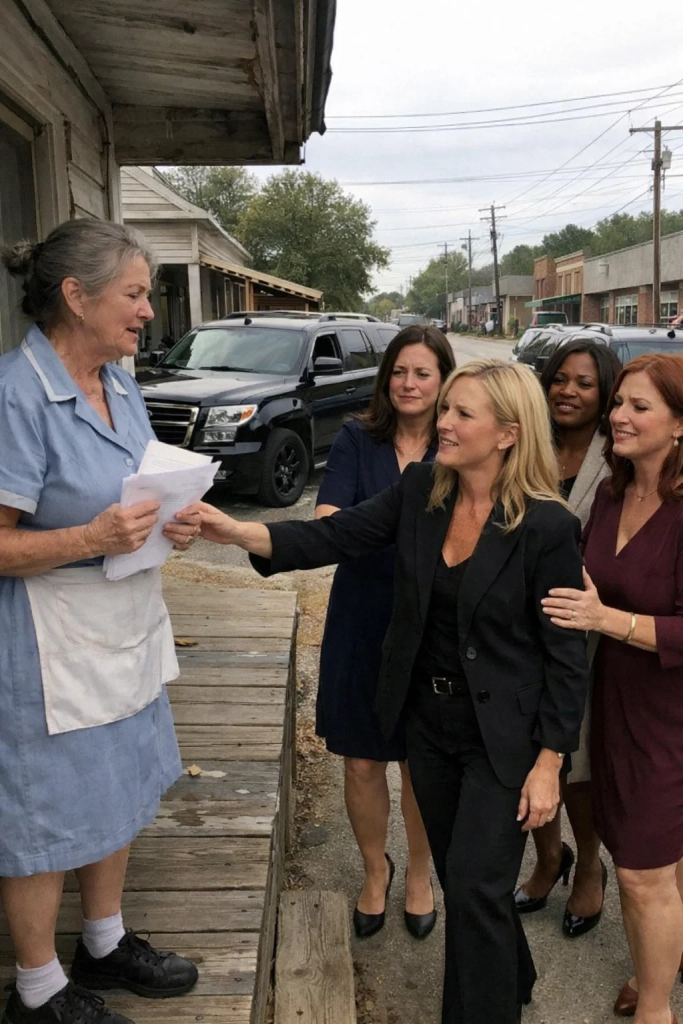
For nearly a decade, a quiet diner waitress in a forgotten town fed four orphaned girls in silence, never leaving her name. Twelve years later, three black SUVs stopped outside her crumbling house—and the women who stepped out knew exactly who she was.
For nearly ten years, most people in the small town of Maple Grove, Indiana, knew Helen Brooks as nothing more than the quiet waitress at Cornerstone Diner—the woman who refilled coffee before you asked, who remembered how you liked your eggs, who never complained even when customers snapped their fingers like she was part of the furniture. She was forty when the story truly began, though her face carried the tired softness of someone who had learned early how to put other people first.
Helen lived alone in a narrow two-bedroom rental at the edge of town, the kind of place with thin walls and a furnace that rattled all winter. Her life followed a simple rhythm: morning shifts at the diner, afternoons counting tips at the kitchen table, evenings balancing a checkbook that never quite stayed balanced. She didn’t travel. She didn’t shop much. She didn’t talk about dreams. People assumed she had none.
What no one knew—because Helen made sure of it—was that for almost a decade, she had quietly kept four orphaned sisters fed.
The girls’ last name was Reynolds: Paige, Lillian, Rowan, and June. They lost their parents in a winter highway accident when the youngest was barely six. After the funeral casseroles stopped coming, life narrowed quickly. An aunt took them in, not out of cruelty but necessity, already stretched thin by her own bills and health issues. The house they lived in leaned slightly to one side, the roof patched in places that never quite stopped leaking.
Helen noticed them on a stormy Tuesday night, long after the dinner rush had thinned. Four girls slipped into a corner booth, jackets still wet, hair plastered to their faces. They studied the menu with exaggerated seriousness, whispering to each other, finally ordering one grilled cheese and four waters.
Helen knew that look. She’d worn it herself once.
Without saying a word, she rang up four meals and delivered them in takeout boxes, sliding them across the table like it was the most natural thing in the world. “Kitchen made extra,” she said lightly. “Can’t let it go to waste.”
Paige, the oldest, hesitated. “We can’t pay—”
“It’s already covered,” Helen replied, meeting her eyes gently. “Eat while it’s hot.”

That night became a pattern. Extra meals. Bags of groceries tucked into their booth “by mistake.” Envelopes slipped into their mailbox with no return address. Helen adjusted her own life quietly—skipping new shoes, walking instead of driving, learning how far one dollar could stretch if you were careful enough.
She told no one.
Not her coworkers, who already thought she was strange for refusing promotions. Not her landlord. Not even the church down the road. Helen didn’t want recognition. She wanted the girls to grow up without the constant ache of hunger gnawing at their ribs.
Years passed. The girls grew taller. Their voices deepened with confidence. Eventually, they stopped coming to the diner. Life shifted, as it does. Helen assumed they’d moved, been absorbed into the wide, anonymous current of the world. She told herself that was how it was supposed to go.
She never expected anything back.
Twelve years later, on a quiet Sunday afternoon, Helen sat on her front porch sorting unpaid medical bills, squinting through reading glasses she should have replaced years ago. The neighborhood was still, cicadas buzzing lazily in the heat, when the low hum of an engine cut through the air.
Then another.
Then another.
Three black SUVs rolled to a stop in front of her small house, their polished surfaces wildly out of place on the cracked street. Helen stood slowly, heart pounding—not with excitement, but confusion edged with fear.
Four women stepped out.
They were composed, confident, dressed in clean lines and neutral tones that suggested money without screaming for attention. One of them looked straight at Helen and froze, her breath hitching like she’d been holding it for years.
“Are you Helen Brooks?” she asked.
Helen nodded, her mouth suddenly dry.
The woman’s eyes filled. “You fed us.”
Time seemed to tilt.
The women introduced themselves, voices trembling. Paige. Lillian. Rowan. June. The Reynolds sisters.
Helen searched their faces, and then she saw it—the same stubborn set of Paige’s jaw, Lillian’s thoughtful eyes, Rowan’s restless fingers, June’s unmistakable crooked smile. They had grown into themselves, but the echoes were unmistakable.
“You kept us alive,” Rowan said quietly. “When everyone else looked away.”
Helen shook her head, overwhelmed. “I just… I did what anyone should.”
Paige smiled, tears spilling freely. “No. You did what no one else did.”
They told her everything. About bouncing through foster placements after their aunt passed away. About working multiple jobs through college. About nights they nearly gave up. They had stayed together by force of will and a promise made over shared fries in a diner booth.
They built a logistics company first—small, then steady, then powerful. They reinvested carefully. They never forgot where hunger came from.
“We looked for you for years,” June said. “The diner closed. Records were thin. But we never stopped.”
Helen stepped back when they explained why they’d come. They had paid off her remaining debts. Purchased her home outright. Set up a trust that would ensure she never worried about rent or groceries again.
“I can’t take this,” Helen whispered.
Paige took her hands, firm and warm. “You already did. Long ago.”
Neighbors gathered, murmuring. Phones came out. For the first time in her life, Helen felt seen—and it terrified her.
That evening, they sat around her small kitchen table, laughing softly, crying openly, sharing stories that stitched the years together. The table felt fuller than it ever had.
Helen accepted their help under one condition: she wanted to work.
Together, they founded a network of community kitchens partnering with local diners—the same kind of place where kindness could slip quietly between plates and bills. Helen became the soul of it, traveling town to town, reminding people that dignity mattered as much as food.
The story spread, but it never became loud. It stayed human.
When asked why she had done it all those years ago, Helen answered simply, “Because they were hungry.”
Years later, standing outside a bustling community kitchen filled with laughter, Helen understood something she hadn’t before: her life had never been small. It had just been quiet.
And quiet kindness, it turned out, was powerful enough to change everything.



Leave a Reply