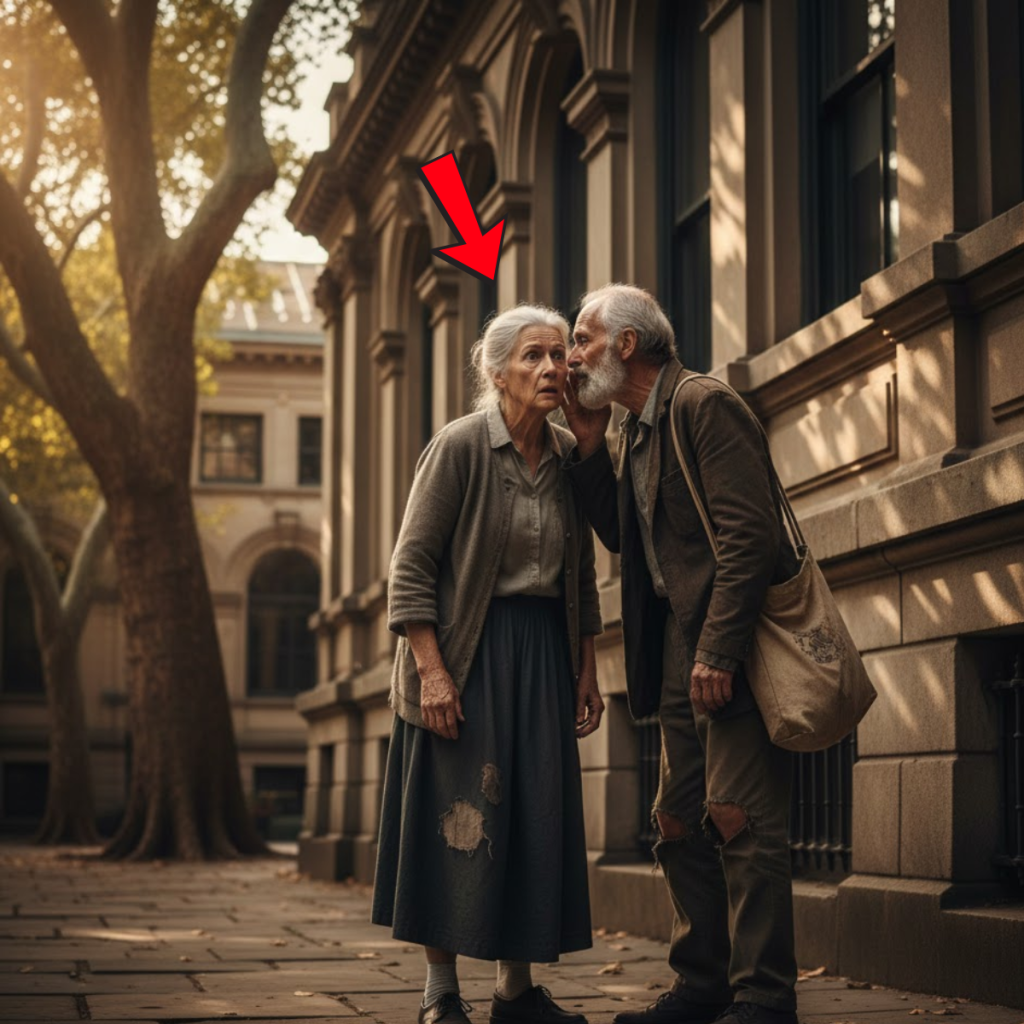
Every day, on my way to work, I left a coin for a homeless man. Always the same gesture, the same automatic routine I repeated without thinking too much about it—like someone dropping a crumb on the ground, convinced it means nothing, that it changes nothing. I never imagined that man, sitting silently in front of the library, his body slightly hunched and his eyes attentively following the flow of the world, would be the only one capable of clearly seeing the trap that was slowly closing around me, while I, trusting and unaware, kept walking straight toward it, convinced that I still had control over my life.
My husband, Ernesto Cruz, died nineteen months ago, and after his final breath there was no rest or relief—the kind everyone promises when suffering ends—but instead a silence so heavy it seemed to occupy physical space inside the apartment. A silence that slipped between the furniture, lingered in the air, slid beneath the table, and hid in the closet, reminding me at every moment that there would no longer be forgotten sandals beside the stove or the radio playing the same morning news at dawn. I was sixty-five years old, with a hip replacement that creaked with every step like a clock marking my limits, and suddenly I was a widow—tired and nearly ruined—facing a life I had never planned to live alone.
While sorting through Ernesto’s things, without any hurry because there was no longer a clear “tomorrow,” I found the truth he had hidden for years under the excuse of protecting me. Unpaid medical bills. Letters from law firms. Collection notices silently piling up, hidden behind old documents and useless memories. His illness had slowly devoured our savings like a patient animal, without my knowing it. The life insurance barely covered the funeral. Nothing more. No cushion. No safety net. I sold the house where we had raised our children, where we planted flowers and celebrated birthdays, where I learned how to grow old with someone beside me. I paid the debts one by one and, with what little remained, bought a small, gray apartment on the eastern outskirts of Mexico City—far from everything I had ever called home.
Our children were far away. One in Houston, the other in Los Angeles. They called when they could, asked questions, worried—but they were trapped in their own lives too, with their mortgages, their children, their routines. I didn’t want to be a burden. I never did. I found a part-time job as a receptionist at a community foundation linked to a parish, Helping Hands—poorly paid, but enough to give me a reason to get up every morning, put on decent clothes, and not disappear completely.
Every day I got off the bus two stops early to walk. Not for health or discipline, but to feel that I still had control over something, even if it was only the distance between one stop and the next. It was on that stretch that I saw him for the first time—always on the same bench in front of the José Vasconcelos Library. An older man, thin, wearing a worn green jacket that had known better winters, his hair completely white, his gaze calm, steady, dignified. He didn’t raise his voice. He didn’t extend his hand. He didn’t ask for anything. And because of that, he was invisible to everyone.
His name was Don Esteban Morales. He was seventy-six years old and had been a history teacher until a scam stole his pension and pushed him onto the streets. At first, I only smiled at him in passing, the way you smile at someone who feels like part of the scenery. Until one day I dropped a five-peso coin into his cup. Nothing heroic. Nothing generous. He looked up and told me God watch over you, in a warm, deep voice that touched me more than I expected.
From then on, we began to talk. First about small things—the weather, the noise of the city, the fatigue of age. Then about my widowhood, his loneliness, lives that break without warning. Don Esteban truly listened. He didn’t interrupt. He didn’t correct. He didn’t give advice. He was simply there. And in that quiet presence, he became my only friend—the only person who knew my entire story without judging it.
One cloudy Tuesday in late March, he wasn’t sitting on his bench. He was standing, restless, watching people with an urgency I had never seen in him before. When he saw me, he rushed over, grabbed my arm with a strength that surprised me, and almost pushing me against the cold wall of the library, spoke to me in a low voice. He told me something very serious was happening at the foundation. That I should distrust the red-haired accountant. That I should check the donation records. And above all, that I should not return home that night—that I should sleep anywhere else, wherever I could.
I felt my heart rise into my throat. I asked him how he knew. He stared at me with a seriousness that chilled my blood and said only that people speak in front of a homeless man as if he doesn’t exist—and that he hears everything.
At that moment, I didn’t know whether to believe him or not. But that very night, I would understand that some warnings arrive just before everything catches fire.
Part 2…
At the Helping Hands foundation, everything seemed normal. Too normal. The same rehearsed smiles, the same automatic greetings, the same smell of reheated coffee served in Styrofoam cups piling up on the reception table as if time never moved in that place. People came and went with papers in their hands, heavy stories on their shoulders, looking for help, for comfort, for someone to listen. And I was there, sitting behind the counter, doing my job as always, while inside me something tightened slowly, like a knot I didn’t know how to untie.
Don Esteban’s warning hammered in my head without rest. Every sound made me jump. Every laugh seemed too loud. Every look lasted a little too long. My body felt tense, as if I were waiting for a blow without knowing where it would come from.
Midmorning, the director called me into her office.
She closed the door with excessive care, almost ceremoniously, and motioned for me to sit across from her desk. She wore the same expression as always—that carefully practiced mix of professionalism and warmth that had so often reassured volunteers and donors. She spoke in a soft, measured voice, explaining that there was a serious discrepancy in the donation records. A significant sum. She said the police would investigate. She said it was only a procedure. That I shouldn’t worry.
But her eyes weren’t smiling.
They watched me closely, as if evaluating every gesture, every breath, looking for a crack to push through. I nodded, answered only what was necessary, guarded my words as if they were glass. I left the office with my legs trembling, with the uncomfortable certainty that something had already been set in motion—and that whether I wanted it or not, I was inside it.
That night, I didn’t go home.
With my last savings, I rented a cheap room in an old hotel near a noisy avenue. The yellowed walls were stained with damp, and the air smelled of cheap detergent and abandonment. I sat on the bed without taking off my shoes, clutching my purse like a lifeline. I didn’t turn on the television. I didn’t pray. I didn’t cry. I just sat there, listening to the sounds of the street, trying to understand when my life had twisted again.
At two in the morning, the phone rang.
The police.
My apartment had been set on fire.
The fire had started in the kitchen. There were clear traces of accelerant. The fire had been deliberate. There were no casualties because, fortunately, the place was empty.
I heard those words as if they weren’t meant for me, as if someone were reading a news story about someone else. I hung up and stared at the wall for a length of time I couldn’t measure. Slowly, the truth settled into my chest with unbearable weight: if I had gone home, I wouldn’t be alive.
The next day, exhausted and in shock, I walked to the library. Don Esteban was there, sitting on his usual bench. Calm. As if he knew I would need him. In his hands, he held an old notebook, worn by use and time. He handed it to me without a word.
Inside were dates, names, times, fragments of conversations written in firm handwriting. People talking about money, about movements, about “fixing problems.” There were also blurry photographs taken from a distance, where the director could clearly be seen meeting with men who did not belong to the foundation. Don Esteban looked at me with a seriousness I had never seen before.
“I couldn’t stay silent,” he said simply.
I went straight to the Public Prosecutor’s Office.
At first, they didn’t fully believe me. They made me repeat the story several times with mechanical patience. But then they saw the notebook. The photos. The records. The investigation moved quickly, as if someone had been waiting for the first piece so everything could fall into place. What seemed like an isolated problem turned out to be a network of corruption operating across several community foundations. There were raids. Arrests. Trials. The director was arrested in front of everyone. Others fell afterward. The sentences were severe.
Don Esteban testified.
And then he disappeared.
Days passed. Weeks. No one knew anything. I asked at shelters, public hospitals, the library. Until I finally found him in a white room, surrounded by machines beeping with cruel patience. Advanced kidney failure. Years without medical care. Years of being invisible.
This time, I stayed.
I filled out paperwork. Found lawyers. Knocked on doors. We recovered his stolen pension. I managed to have him transferred to a small but dignified retirement home. Today he lives in a simple apartment filled with donated books, with a window facing the street and a table where he makes coffee every morning. He teaches history classes at the library. People listen. They respect him.
I keep working. More alert. More aware. I no longer give my trust away easily.
Every morning, we have coffee together.
One coin a day.
A small gesture.
We saved each other.
Kindness matters.
Look at the invisible.
You never know who might save your life.



Leave a Reply