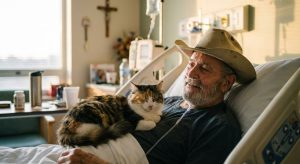
The doctors said he was in a deep vegetative state, with no real chance of waking up. The family had already begun discussing what to do with the company, the money, everything he had built during 50 years of hard work. It was then that the cat appeared through the half-open window of room 312, a thin, tabby animal with brown and white markings all over its body.
No one saw it come in. But when the nurse returned with the evening medication, there it was on the bed, touching the businessman’s face with its paw. “My God!” the woman cried, dropping the tray to the floor with a clatter that echoed down the hallway. The cat wasn’t startled. It stayed there, meowing softly, as if it were conversing with the unconscious man. It gently stroked his face, almost affectionately. The nurse rushed to take it off, but the animal gripped the sheet with its claws, refusing to budge.
“Get out of here! Come on, get out,” she insisted, trying to grab him before he scratched her. It was then that the doctor entered the room, drawn by the noise. Dr. Alejandro Gutiérrez was young, only 32 years old, but already considered one of the best neurologists at the hospital. He stopped in the doorway, observing the scene intently. “Wait,” he said, raising his hand to signal the nurse to stop. “Look at his face.” The woman looked and saw a tear running down Gerardo Mendoza’s face.
A single tear slowly sliding down his right cheek. “That’s impossible,” the doctor murmured, approaching the bed. “A person in a deep vegetative state doesn’t produce emotional tears.” He took the flashlight from his pocket and examined the patient’s pupils. Nothing. No reaction. But the tear was there, real, soaking the pillow. “I’m going to call the family,” the nurse said, still unable to believe what she was seeing. The cat kept meowing, now louder, as if it were calling someone.
Dr. Alejandro watched the animal with curiosity. It seemed to know the man, to have some kind of connection with him. “Let it stay for now,” the doctor ordered. “I want to see if anything else happens.” The call came to Daniela Mendoza’s cell phone at 11 p.m. She was at home trying to watch a movie to forget her troubles when the hospital number appeared on the screen. She thought about not answering, thought about turning off her phone and pretending to be asleep, but something made her accept the call.
“Mrs. Daniela,” it was the nurse’s voice, “you need to come to the hospital. Something has happened to your father.” Daniela’s heart raced, even with all the bitterness, even with all the resentment accumulated over the years. Those words hit her like a punch to the gut. “He left,” she asked, her voice trembling. “No, it’s not that, but you need to come. It’s urgent.” Daniela hung up without asking any more questions, grabbed her purse and car keys, and left without even properly closing the door.
The drive to the hospital seemed endless. Every red light felt like an eternity. She found herself thinking about when she had last visited her father. Three weeks, four. She’d lost count. When she arrived at the hospital, she hurried through the empty hallways to room 312. The door was ajar, and she could hear voices inside. She took a deep breath before pushing it open. What she saw stopped her in her tracks. A cat, a skinny tabby, was lying next to her father, purring loudly.
And Gerardo Mendoza, the man who hadn’t moved in three months, had his face turned toward the animal. “What’s going on here?” Daniela asked, entering the room. Dr. Alejandro turned to her. “Ms. Daniela, I know this is going to sound strange, but this cat triggered a reaction in your father. We saw him cry when the animal appeared.” Cry. Daniela looked at the doctor as if he’d gone mad. My father has been in a deep coma for months. He can’t cry.
“I saw it with my own eyes,” the doctor insisted. “And there’s more. Look at the position of his head. It was turned to the other side when I left earlier. Now it’s facing the cat.” Daniela approached the bed, still incredulous. The cat raised its head and looked at her with those attentive green eyes. There was something about that animal, something familiar that she couldn’t quite place. That’s when the memory returned, like an old movie playing in her mind.
That cat—she’d seen that cat before. “It can’t be,” she whispered. “Do you know this animal?” the doctor asked. Daniela nodded slowly, the memories returning in waves. “My father, he used to feed a cat in the company parking lot. This was a few years ago. I saw it a few times when I went to get papers from his office. I thought it was just some random stray cat that I fed now and then.” Dr. Alejandro wrote something on the clipboard.
That explains the reaction. There may be a deep emotional connection that…


Leave a Reply