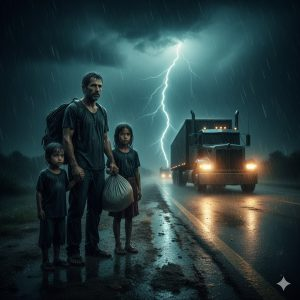
The storm wasn’t just rain: it was a raging wall of water that pounded against the windshield as if trying to shatter it. The Kenworth truck lumbered along a back road where even the state seemed to have forgotten it existed. The roar of the diesel engine and the hypnotic sway of the windshield wipers were the only constants in the middle of the night.
Rogelio was alone, as usual. At 58, he’d spent half his life on the road. His hands were calloused from the steering wheel and from work, and his gaze was dry, the kind that learns not to be surprised. He preferred driving at night: the darkness hid the familiar landscapes and, in a way, also hid what hurt inside.
He wasn’t in a hurry to get home. Since his wife died five years ago, “home” had ceased to be a place and had become a smell: stale coffee, tobacco, old leather. The cab was both his refuge and his prison. On the road, he could pretend to be busy; at home, the silence reminded him of everything that was gone.
That night he was hauling a load of lumber north, hoping to deliver it before dawn. But the rain forced him to drive slowly, and the glistening asphalt looked like a dangerous snake. Rogelio clenched his jaw, concentrating, until the headlights illuminated something that didn’t belong in the landscape.
About two hundred meters away, on the narrow, muddy shoulder, four figures were moving. It wasn’t a broken-down car or an animal crossing. They were people walking single file, hunched over, soaked, fighting against the wind that was trying to push them toward nowhere.
The instinct of a veteran trucker screamed at him: “Don’t stop. Trap.” He had heard enough stories: robberies on lonely roads, human decoys, people feigning need to steal the truck or the cargo. His right foot remained firm on the accelerator. “The world is full of misfortune,” he told himself. “And I’m no saint.”
But as the truck drew closer, the light revealed a detail that shattered his reasoning.
The youngest, a boy who couldn’t have been more than six, turned at the sound of the engine. He didn’t raise his arm or make any gestures. He didn’t call for help. He just stared at the lights as if they were a death sentence. His enormous eyes, pale face, and expression of pure terror… he clung to the leg of the man walking in front of him as if that leg were the only anchor in the world.
Rogelio felt a jolt run up his spine. He cursed aloud, slammed his palm on the steering wheel, and slammed on the air brakes. The sharp hiss mingled with the squeal of tires on the wet asphalt. The truck resisted, heavy, but began to slow down until it stopped about fifty meters ahead of the group.
His heart pounded. He could have committed the worst act of recklessness of his life… or the best decision of the night.
He rolled down the passenger window just a few inches. He left the engine running and kept his hand near the gearshift. If he saw a gun, he’d leave. If he sensed danger, he’d leave. He wasn’t going to die on impulse.
Through the rearview mirror, he saw the man from the group run toward the cab, leaving the woman and the two children behind. When he reached the window, Rogelio looked at him closely: a man in his thirties, his face etched with anguish and exhaustion, rain streaming down his face, mingled with tears he made no attempt to hide.
“Sir, please!” he cried, his voice cracking with sweat. “I don’t want money… I don’t want anything… my children just can’t walk anymore. The girl has a fever. Take us to the next town… to any place with a roof. I beg you.”
There was no threat in his voice. Only the desperation of a father who felt guilty for not being able to protect him weighed on him.
Rogelio took a deep breath. He felt that old weight in his chest, the same one he felt when he remembered his wife, when he remembered their empty house. With a sigh, he unlocked the door.
“Get in quickly,” he ordered.
The man gestured. The woman ran with the children toward the truck. Climbing into that tall cab was an ordeal: mud, slippery hands, weak piercings. When they finally got inside, the small space filled with dampness, old clothes, and fear. Rogelio’s sanctuary smelled different, as if life had burst in uninvited.
The woman’s name was Adela. She held a small girl in her lap, wrapped in a shawl as wet as her clothes. The man, Braulio, sat on the edge of the seat, trembling… not only from the cold, but from that mixture of relief and shame you feel when you need a stranger to survive.
Rogelio turned the heat up to the max and started the truck again. The black highway swallowed them up again.
For a few minutes, the silence was thick. Only the heating and the chattering teeth of the child, Tino, could be heard. Rogelio stared straight ahead, but he felt their eyes fixed on his profile, as if he were the last wall between that family and the abyss.
In many parts of the world, indifference is the norm. Would you have



Leave a Reply