She Whispered, “I Can’t Take the Pain Anymore,” Thinking No One Would Hear — But When Her Son Came Home Early and Overheard How His Wife Treated His Mother, Everything in That House Changed
Millionaire’s mother begs, “I can’t take it anymore, it hurts so much.” Son appears without warning and confronts his wife
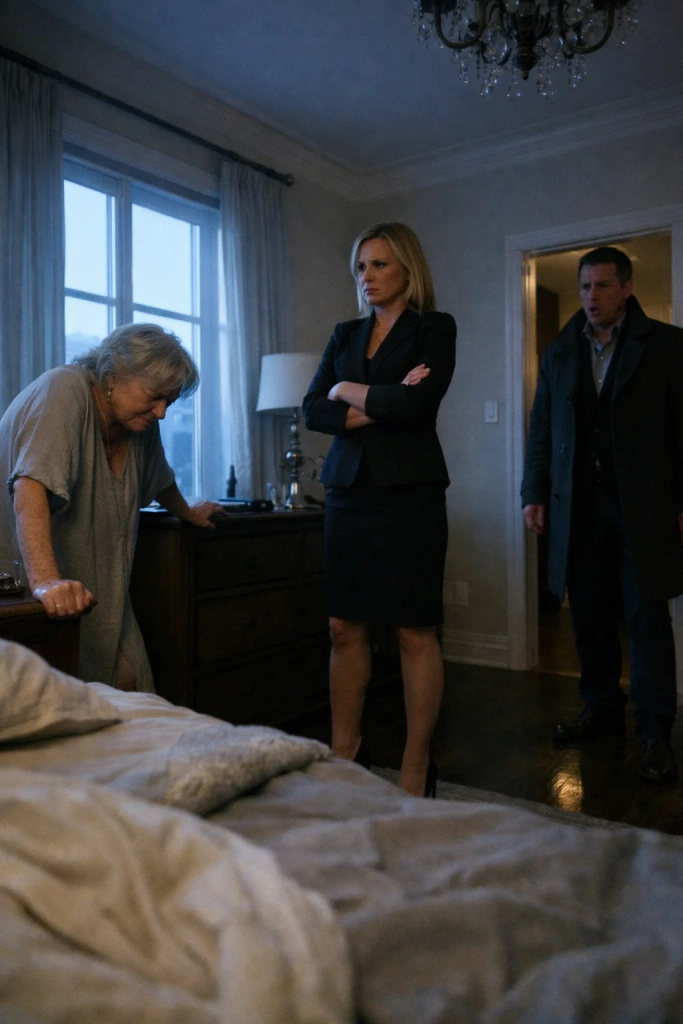
It was still dark outside when the bedroom door flew open with a force so sudden it felt as if the air itself had been split in two, and Margaret Lawson woke with a sharp gasp, her hand instinctively pressing against her lower back where pain had long since stopped asking permission before announcing itself. It wasn’t the kind of pain that screamed or demanded attention; it was quiet, steady, and patient, the sort that bent a person inward over time and reshaped their entire existence around avoidance.
Cold light spilled into the room as Sophia Lawson strode in without knocking, her heels striking the polished floor with deliberate precision, each step carrying authority that did not belong to her but had been worn so often it now seemed natural. She reached the curtains and pulled them apart in one sharp motion, letting the gray-blue dawn wash over the expensive furniture and settle unkindly on Margaret’s face.
“Get up,” Sophia said flatly.
“This isn’t a resort.”
Margaret blinked, her body stiff and uncooperative, every attempt to shift position answered immediately by a surge of pain that stole her breath. The previous night had been long, filled with sleepless hours and the dull ache that came from standing too long earlier that day. When she finally spoke, her voice was barely above a whisper.
“Sophia… please. I can’t take it anymore. It hurts so much.”
Sophia crossed her arms and tilted her head, studying her the way one might examine a stain that refused to come out of expensive fabric. A faint, fleeting smile appeared on her lips, sharp enough to wound.
“It’s barely morning,” she replied.
“And you’re already starting.”
Margaret tried to sit up, but the effort forced a low sound from her throat that she immediately swallowed, pressing her lips together so tightly they trembled. The bedroom was vast, perfectly styled, everything chosen for appearance rather than comfort, and yet she had never felt smaller in her life than she did standing barefoot on its cold floor.
“I have people coming this afternoon,” Sophia continued, already turning toward the door as though the matter had been settled.
“A charity luncheon. The house needs to be presentable, and I want everything done before ten.”

Margaret lowered her gaze. She had never learned to read people the way Sophia did, but she understood humiliation when it was delivered without haste.
“I just need a little time,” she said, the apology slipping out before she could stop it.
“No,” Sophia replied immediately, turning back and pulling the bedsheet away with a sharp tug.
“The staff handles their responsibilities, but you live here too. You can at least contribute.”
The word settled heavily in the room.
Contribute.
Margaret wasn’t a guest. She had never been a guest. She was the woman who had raised her son alone after his father died, who had worked two jobs, who had sewn until her fingers cramped and her back bent permanently forward, who had skipped meals so he could eat more, and who had believed, foolishly perhaps, that love would be enough to protect her in her old age.
“I really can’t,” she whispered.
Sophia stepped closer, lowering her voice as though secrecy made cruelty more effective.
“You’re always fine when Nathan is around,” she said.
“You stand straighter. You smile. But the moment he leaves, you suddenly become helpless.”
That was the truth Margaret hated most, because it was the part that hurt the deepest. When Nathan was home, Sophia became someone else entirely, offering tea, adjusting pillows, asking after her health with practiced gentleness. Margaret clung to that version of her daughter-in-law because it felt safer than admitting the reality that followed once the front door closed behind her son.
“Get up,” Sophia said again, impatience sharpening her tone.
“I don’t have time for this.”
Margaret lowered her feet to the floor, the cold seeping immediately into her bones, and steadied herself against the dresser, her hands shaking as she forced her body upright inch by inch, each movement careful and deliberate, the movement of someone whose pain had long gone unnoticed because it did not inconvenience the right people.
“Nathan wouldn’t want this,” she murmured.
Sophia laughed softly.
“Nathan believes whatever keeps his life uncomplicated,” she replied.
“Do you really think he has time for this?”
Margaret swallowed and remained silent. She had learned that tears, once seen by the wrong person, became a tool used against you later.
Then a voice cut through the room.
“Sophia.”
The single word changed everything.
Sophia froze mid-step. Margaret lifted her head in disbelief. Standing in the doorway was Nathan Lawson, his coat still on, his hair slightly out of place, his expression unreadable but taut with something that made the room feel suddenly smaller. Neither of them had heard him arrive.
The silence stretched, thick and suffocating, until Sophia finally turned, her face already rearranging itself into something warm and concerned, her tone softening as though on cue.
“Nathan, you’re home early,” she said lightly.
“I was just trying to help your mother. She insists on pushing herself, and I keep telling her to rest.”
Nathan didn’t respond. His eyes moved past her, taking in his mother’s bare feet, her rigid posture, the way her hands trembled as she held onto the furniture.
“I’ve been standing in the hallway for several minutes,” he said quietly.
“I heard everything.”
Sophia’s smile faltered.
“You’re misunderstanding—”
“The luncheon is canceled,” Nathan interrupted.
The words landed with finality.
Sophia stared at him.
“You’re overreacting.”
Nathan walked past her without another glance and knelt in front of his mother, ignoring the expensive suit as it brushed against the floor. He took her hands gently, as though afraid they might break.
“Why didn’t you tell me?” he asked softly.
Margaret looked at him then, really looked at him, and the tears she had been holding back finally escaped.
“You worked so hard,” she said.
“You built everything you dreamed of. I didn’t want to be the weight that pulled you back down.”
Guilt hit Nathan harder than any accusation ever could. He remembered the nights his mother came home exhausted, the lunches she pretended she wasn’t hungry for, the sacrifices she never listed because she didn’t believe love needed an audience.
He stood and faced his wife.
“The pain you called drama,” he said evenly,
“comes from decades of physical labor that paid for my education, my opportunities, and the life you now enjoy.”
Sophia opened her mouth, then closed it again.
“You told her she contributes nothing,” Nathan continued.
“Everything in this house exists because of her.”
“This is ridiculous,” Sophia snapped, losing her composure.
“You’re choosing her over me?”
“No,” Nathan replied calmly.
“I’m choosing decency.”
He pulled out his phone and made a brief call.
“Please bring the suitcases from storage,” he said.
“And contact my attorney.”
Sophia’s face drained of color.
“You can’t be serious.”
“I saw who you are when you thought no one was watching,” Nathan replied.
“And that ends today.”
Less than half an hour later, the grand hallway echoed with the sound of rolling luggage, and Sophia left the house she once ruled without ceremony or applause, escorted quietly by security she had never bothered to acknowledge.
The house felt different after she was gone, lighter, as though it could finally breathe.
Nathan returned to his mother’s room with a cup of tea and helped her settle back into bed, adjusting the pillows until she sighed softly in relief.
“I’m hiring a full-time nurse,” he said gently.
“And I’m working from home. You’re not doing this alone anymore.”
Margaret wrapped her fingers around the warm cup, her shoulders relaxing for the first time in months.
“You’ve always been a good son,” she said.
Nathan smiled faintly.
“I should’ve been a better one sooner.”
As the morning sun rose fully over the estate, Margaret lay back against clean sheets, no longer a burden, no longer a guest, but finally, unquestionably, home.



Leave a Reply