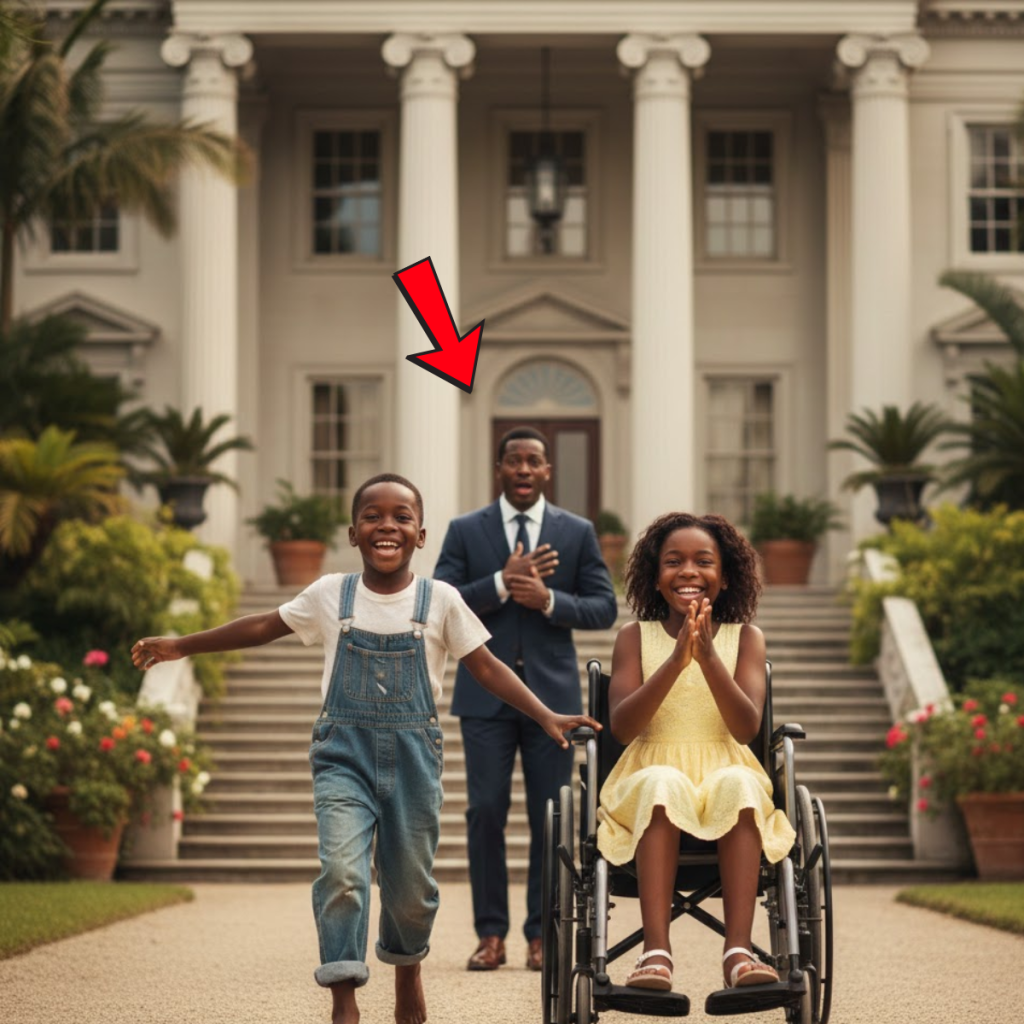
Richard Lawson had built an empire that people in the city called “the golden touch.” Oil. Real estate. Shipping. Every deal turned into profit, every investment into a headline. His mansion on Banana Island sat behind tall walls and manicured hedges—an entire world sealed off from noise, struggle, and surprise.
Yet inside that perfect world, Richard’s real problem couldn’t be bought, bullied, or negotiated.
It was silence.
His only daughter, Amanda, used to be the loudest thing in the house. At eight years old, she ran through the gardens chasing butterflies, laughing so freely it sounded like music. Then a car accident shattered everything. Richard’s wife, Elizabeth, died. Amanda survived—but was left paralyzed.
After that, the mansion became a museum of grief. Richard tried to fight it the only way he knew: with money and force. He flew Amanda to India for surgeries. Germany for therapy. The United States for advanced treatment. Doctors promised, specialists studied, machines whirred, and hope rose—only to crash again and again.
Amanda didn’t just lose movement. She lost her light.
Most days she stayed in her room. When she came out, her nanny rolled her into the garden, where Amanda stared past the flowers as if she were looking for a version of life that had already left. Richard watched her from a distance, proud in public, breaking in private. He missed his daughter’s laughter like a man missing oxygen.
Then, one hot afternoon, something impossible happened.
Amanda sat in her wheelchair near the garden gate, quiet as always. Her eyes rested on the ground. The air was thick and still—until she noticed movement near the hedge.
A boy slipped through a small gap like a shadow with bare feet.
He was thin, ragged, and hungry-looking. His shirt was torn at the shoulder. His shorts hung too large on his narrow waist. His knees were bruised and scarred—proof of streets that didn’t care how young you were. His hair was messy, his skin dusty.
But his eyes…
His eyes had mischief.
The boy looked at Amanda for a brief moment, like he could see the sadness sitting on her shoulders. Then, without asking permission, without speaking, without begging—
He started to dance.
Not professionally. Not gracefully. He danced like a kid who’d learned to survive by being ridiculous. Arms flailing like a cartoon clown. Overdramatic slips. Wild spins. Fake falls. Crossed eyes. He moved as if his body was telling a joke the world couldn’t interrupt.
At first Amanda only blinked, confused.
Then a small giggle escaped her.
The boy noticed—like he’d been waiting for that exact sound—and doubled down. He spun harder, hopped across the grass, rolled dramatically like he was performing in an imaginary arena.
Amanda clapped.
And then, like a miracle that didn’t ask permission, she laughed.
Not a polite laugh. Not a forced smile. A real laugh—bright and loud enough to travel across the compound. The sound Richard Lawson had not heard in months.
Inside the mansion, Richard froze mid-step.
That laughter hit him like electricity. He rushed to the balcony, heart pounding, expecting disappointment—expecting to see someone teasing her, or a cruel trick, or something fragile that would break.
Instead, he saw his daughter clapping like her hands had remembered joy.
And in the center of the garden, a barefoot homeless boy danced as if his life depended on it.
Richard’s first reaction was anger.
How had a street boy entered his compound? Where were the guards? What if the boy was dangerous? What if this was theft, a setup, a threat? Richard’s fists clenched. His pride stood up like a bodyguard.
He was about to shout.
Then he saw Amanda’s face.
Her cheeks were flushed. Her eyes were alive. Her posture—usually slumped in quiet defeat—was straighter. Her arms moved with an energy he hadn’t seen in months, clapping again and again, as if applause could keep the moment alive.
Richard didn’t shout.
He hid behind a marble pillar and watched.
And something unfamiliar crept into his chest—something he hadn’t allowed himself to feel because hope, for him, had become a dangerous thing.
Hope.
The boy danced until Amanda’s laughter shook her shoulders. He didn’t look toward the house. He didn’t ask for money. He didn’t glance at the doors like someone planning to steal.
He was only watching Amanda, reading her face like a performer who knows the crowd matters more than the stage.
When the laughter finally slowed, the boy grinned, bowed dramatically, and slipped back toward the hedge as quickly as he’d come.
Richard stood there, breathless, as if he had just seen a crack appear in the wall grief had built around his home.
The next afternoon, the boy came again.
Same entrance. Same barefoot silence. Same bright-eyed purpose.
He had slept behind a kiosk the night before, stomach rumbling, but he arrived with a smile anyway—because now he carried something bigger than hunger.
A mission: make the girl laugh.
Amanda was already waiting near the gate, hands ready to clap.
“Are you ready?” the boy asked, raising his arms like a circus announcer.
Amanda nodded eagerly.
Before he could begin, Richard stepped into the garden.
The boy froze.
He knew that adult look—the kind that usually came before a kick, a slap, or being chased away like garbage. His body tensed, ready to run.
Amanda’s voice sliced through the tension.
“Daddy, please don’t send him away. Please.”
Richard studied the boy up close for the first time. Torn clothes. Bare feet. Bruised knees. A body that looked like it had been in too many fights with life. Yet the boy’s eyes were steady—not arrogant, not broken. Just… steady.
“What’s your name?” Richard asked.
“Cola,” the boy replied.
“Why did you come in here?”
Cola swallowed. “I saw her. She looked sad. I thought if I danced, she would laugh. I didn’t come to take anything, sir. I only came to give something small. I can leave after.”
The words were simple, but they sank into Richard like rain on dry earth.
“Where do you stay?”
Cola shrugged. “Anywhere. Bus park. Sometimes under a bridge. Sometimes unfinished buildings.”
“And you dance for money?”
“Sometimes. Sometimes I just dance so hunger won’t win.”
Amanda’s eyes filled with tears. “He makes me happy, Daddy.”
Richard looked from the boy to his daughter—and noticed something that made his throat tighten.
Amanda’s toes shifted.
It was tiny. It could have been nothing.
But Richard knew her body. He knew how still she had been for months.
That small movement felt like the first crack in a locked door.
Richard exhaled slowly. “Okay. You can stay for today—where I can see you. No misbehavior. You understand?”
Cola nodded so fast it was almost painful.
He turned to Amanda with a grin. “Showtime?”
She clapped. And the garden became a stage again.
One day turned into three.
Three turned into a week.
Richard gave instructions to the guards: “Let him in at 4:00. He leaves at 6:00. He eats before he goes.”
Cola arrived daily with new routines. He danced like a spinning top. He acted out fights between bus drivers and conductors. He made sound effects, did dramatic fake falls, bowed like royalty, then crossed his eyes until Amanda laughed so hard she nearly couldn’t breathe.
But it wasn’t only laughter.
Something else began to happen.
Amanda’s hands grew stronger from constant clapping. She started lifting her arms to copy Cola’s moves. Her voice became louder, more confident, more present.
“Again!” she demanded one day. “No—do it like yesterday!”
She even tried spinning her wheelchair in small circles when Cola spun on the grass. Every tiny movement felt like a victory.
Richard watched quietly from a distance, noticing details he hadn’t expected.
Cola never asked for anything before dancing. He always checked Amanda’s face before trying a joke, like he was measuring her sadness and adjusting his joy to fit it. When food was offered, he ate gently—carefully—like a boy who knew meals weren’t guaranteed.
After Cola left each evening, Amanda talked more.
“Daddy, did you see the one where he pretended to be a police siren?”
“Daddy, today I felt something in my toes.”
“Daddy, can he come tomorrow?”
During a routine hospital visit, the doctor examined Amanda and raised an eyebrow.
“Her engagement is back,” he said. “This kind of motivation can spark recovery pathways. We can’t always explain it. Whatever you’re doing—keep doing it.”
That night, Richard stood alone in the garden where Cola danced and whispered into the warm air, “Thank you, boy.”
Then came the afternoon that changed everything.
Cola was doing a slow-motion dance—moving as if time had become thick and heavy—when Amanda suddenly lifted her hands from her blanket.
“Wait,” she said, breathless from laughing. “Let me try something.”
She placed both hands on the armrests of her wheelchair. Her face tightened with effort. For one long heartbeat, nothing happened.
Then her shoulders rose.
Her chest lifted.
Slowly, her hips rose an inch—then two.
Cola’s eyes widened.
Richard stepped forward without realizing he had moved.
Amanda trembled, holding herself up with a fierce concentration that looked like courage made visible.
“One,” Cola whispered.
“Two,” Richard breathed, voice shaking.
“Three,” Amanda exhaled—
—and sank back into the chair, panting, smiling, eyes wet.
Silence fell over the garden.
Not the old heavy silence that lived in the mansion after the accident.
A holy silence—the kind that comes when something impossible happens so quietly it feels like the universe is holding its breath.
Cola broke it first, shouting like he’d won a championship. “You did it! You did it!”
He spun three times and dropped to his knees beside her. “Champion!”
Richard knelt on the other side, hands trembling, and touched his daughter’s forehead like he was afraid she might disappear.
“You are brave,” he whispered. “I am so proud of you.”
Amanda reached for both of them—one hand for her father, one for her friend.
“I’m not scared anymore,” she said softly. “When he dances… I feel like I can move.”
They didn’t call the newspapers. They didn’t announce it to the world. They just kept going—more laughter, more practice, more tiny victories stacking into something bigger.
That night, Richard paced his mansion’s marble halls, fighting a war inside himself: pride versus love, image versus truth.
By dawn, he admitted what he had avoided for months:
Money hadn’t healed his daughter.
But kindness had reopened the door.
On Saturday, Richard called Cola to sit with him in the garden. For the first time, the boy wasn’t asked to dance—he was asked to talk.
“Tell me about yourself,” Richard said.
Cola hesitated. No one ever asked. People usually only saw dirty clothes and looked away.
“I don’t know where I was born,” he began. “My mother died when I was small. My father left. Some market women fed me when I was little, but when I got older, they stopped. So I stayed with other boys at the bus station. We sleep under bridges or in empty shops.”
Richard listened, chest tightening.
“Why do you dance?” he asked.
Cola’s smile was faint, but real. “When you’re hungry, your body feels heavy. If you sit, hunger wins. But if you move… it feels lighter. People laugh. Sometimes they give coins. Sometimes they don’t. But at least I don’t feel invisible.”
Richard, a man who had everything, realized he had never understood something so clearly.
He leaned forward. “From today, you are not invisible anymore.”
Cola blinked, unsure he heard right.
Then Amanda rolled closer, grabbed Cola’s hand, and smiled like the world was simple again.
The final turning point came that same week, after Amanda stood again for a few seconds and the mansion erupted—not with noise, but with life.
That night Richard found Cola sitting alone on the back steps, arms wrapped around his knees like a child afraid to claim comfort.
“You shouldn’t be out here alone,” Richard said gently.
Cola shrugged. “I’m used to it, sir.”
“Not anymore,” Richard replied, voice steady with the weight of a promise. “This is your home now. You’ll eat three meals a day. You’ll go to school. You’ll never again wonder where to sleep.”
Cola’s eyes widened. His voice trembled. “Thank you, sir.”
Richard turned fully to him. “Listen to me, Cola. You gave my daughter something no doctor, no medicine, no money could provide. Hope. And anyone who gives hope… is worth loving.”
For the first time in his life, Cola cried without shame.
And that night, he slept in a soft bed under a roof that didn’t threaten to vanish by morning.
The story spread across the city. Newspapers screamed headlines about the billionaire who “adopted a street boy.” Business partners warned Richard it would damage his image.
“What if he steals? What if he disgraces you?”
Richard didn’t flinch. “My daughter is standing again. Smiling again. That’s the only image I care about.”
Amanda made it even simpler for anyone who questioned her: “Cola is my friend. If you don’t like him, you don’t love me.”
The whispers faded.
And inside the mansion, life grew louder in the best way.
Mornings became Amanda calling Cola’s name. Afternoons became laughter and dancing. Evenings became shared meals where Amanda teased her father for smiling too often.
With Cola cheering beside her, Amanda began to take steps. Small ones, then longer ones. Sometimes she still used her wheelchair—but fear no longer ruled her.
And Richard changed too.
He wasn’t just a billionaire closing deals anymore.
He was a father learning to live again—guided by a boy who had once owned nothing but a dance.
One evening, as the sun painted the sky gold and crimson, Richard stood in the garden watching Amanda take careful steps while Cola held her hand.
Their laughter floated through the air like music.
And Richard finally understood what his fortune had never taught him:
True wealth isn’t a bank account.
It’s a child’s laughter returning to a home that had forgotten how to breathe.
It’s a boy refusing to be broken by the streets.
It’s love walking in—barefoot—through a gap in the hedge.

Leave a Reply