My grandfather Ismael repeated it so many times that his warning ended up clinging to my skin like the salty scent of the Gulf.
—Alma, promise me one thing —he would say, his hands rough from planting corn and his gaze serious with the weight of a secret—: never open the basement.
I always nodded. Because Ismael Barrientos was obeyed without questions. Because he was the only one who took me in when I was left alone, pregnant, with the shame of an entire town pressed into my back. Because he taught me never to bow my head to anyone… and yet he asked me to bow it before a trapdoor hidden beneath the worn-out rug in the living room.
Years passed. Ismael died on a mild February afternoon, and his wooden house on the outskirts of Nautla, Veracruz, was left to me and my daughters: Sofía, eight, and Camila, six. The house creaked with every change in temperature, but it was home. A roof. A piece of land. A place where the world didn’t look at us with pity.
Until October darkened.
The wind began as a whistle, then turned into a roar. On the battery-powered radio, through the static, an urgent voice confirmed what the sky was already screaming: hurricane en route, change of direction, direct impact. The rain battered the windows furiously, as if someone were throwing handfuls of stones.
Camila hugged our mixed-breed dog, Chispa, a skinny puppy we had found months earlier on the roadside.
—Mom… why did the sky turn ugly? —she whispered, trembling.
Sofía, the older one, didn’t cry. She just stared outside with eyes too large for her face.
—What if the house falls down? —she asked, without taking her eyes off the mango tree that was already bending as if it were made of paper.
I swallowed hard. The house was a matchbox. I could feel it in the vibration of the tin roof, in the old nails groaning.
In that moment, I remembered the basement.
I felt my grandfather’s promise like a hand tightening around my throat. Never open the basement. But the wind tore a sheet of metal from the roof with a crash that made the three of us scream, and an icy gust filled the living room with dust.
It wasn’t about disobeying a dead man. It was about choosing between a promise and my daughters.
—Come with me —I ordered, with a calm I did not feel—. Now.
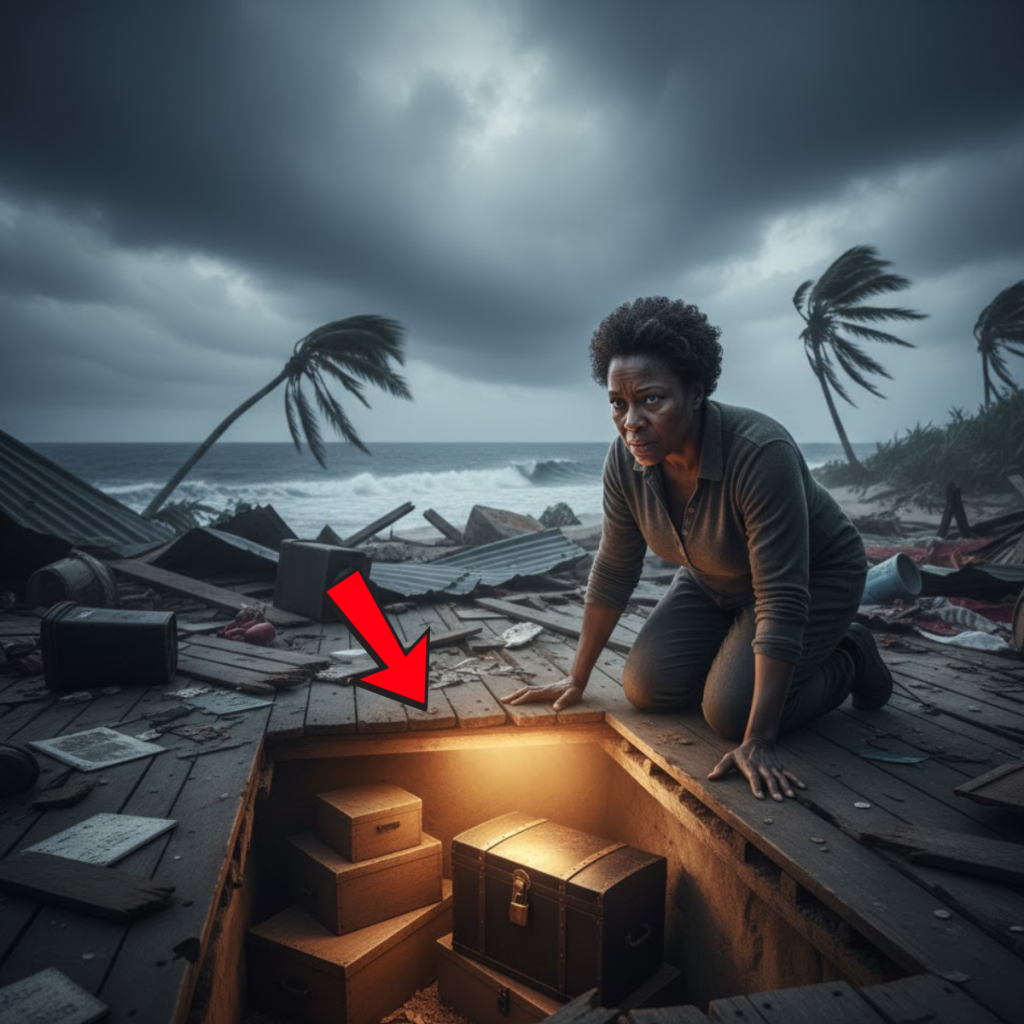
I pushed the rug aside with my foot. There was the wooden trapdoor, dark, almost invisible. It had an old padlock with no key. I grabbed the kitchen hammer, struck it twice sharply, and the metal gave way as if it, too, had been waiting for this moment.
The trapdoor opened with a deep groan. A damp breath rose from below, smelling of old earth and secrets.
—Mom… —Sofía grabbed my arm—. What’s down there?
—A safe place —I lied gently. Or maybe it wasn’t entirely a lie.
We went down. The flashlight cut through a space with dirt walls reinforced by wooden planks. The low ceiling had thick beams. It wasn’t pretty, but it was solid. I closed the trapdoor from the inside and hugged my daughters while the world broke apart above us.
The hurricane didn’t sound like wind. It sounded like a huge, furious animal tearing everything in its path. We heard wood splinter, glass shatter, metal twist. Camila cried with her face buried in my neck; Sofía squeezed her sister’s hand with a strength that broke my heart.
—Close your eyes —I whispered to them—. Think about the beach… mango popsicles… beautiful things.
I, meanwhile, thought of my grandfather.
Forgive me, Ismael. Forgive me…
When the roar became a panting… and then silence, my body kept trembling as if the wind were still pushing through me.
I waited several minutes. I turned the flashlight on again and noticed something I hadn’t seen before: in one corner, beneath thick tarps, there were rectangular shapes. Boxes. Many of them.
My heart pounded.
—Stay here —I asked them, and my voice sounded strange, as if it belonged to another woman.
I lifted a tarp. A cloud of dust made me cough. Underneath were stacked wooden crates, sealed with rusted nails. And at the back, a metal trunk with a heavy lock.
Sofía stepped closer, curious.
—Is it… treasure? —she asked, as if the word embarrassed her.
I didn’t answer. Because above us, outside, I had to see if our world still existed.
I pushed the trapdoor. It resisted, as if the house were begging me not to look. I managed to open it, and a gray light spilled into the basement.
I stuck my head out.
There was no house.
Where our walls had once stood, there were twisted beams and pieces of metal roofing stuck in the mud. The sewing machine I used to earn a living was gone. The photos… the toys… the clothes… everything scattered like a life taken apart.
Camila came out behind me and stood frozen.
—Our house… —she said, her voice a thread.
I held her tightly.
—We’re going to be okay —I heard myself say, and this time it wasn’t a lie. Because the basement was still there, like a hidden hand holding us up from below.
That night we slept in the basement, on rescued blankets, with Chispa curled up between the girls. I didn’t sleep. I lay staring at the dirt ceiling, listening to my own breathing, until dawn slipped through the trapdoor like forgiveness.
On the third day, when the mud began to dry, I gathered my courage.
I went back to the boxes.


Leave a Reply