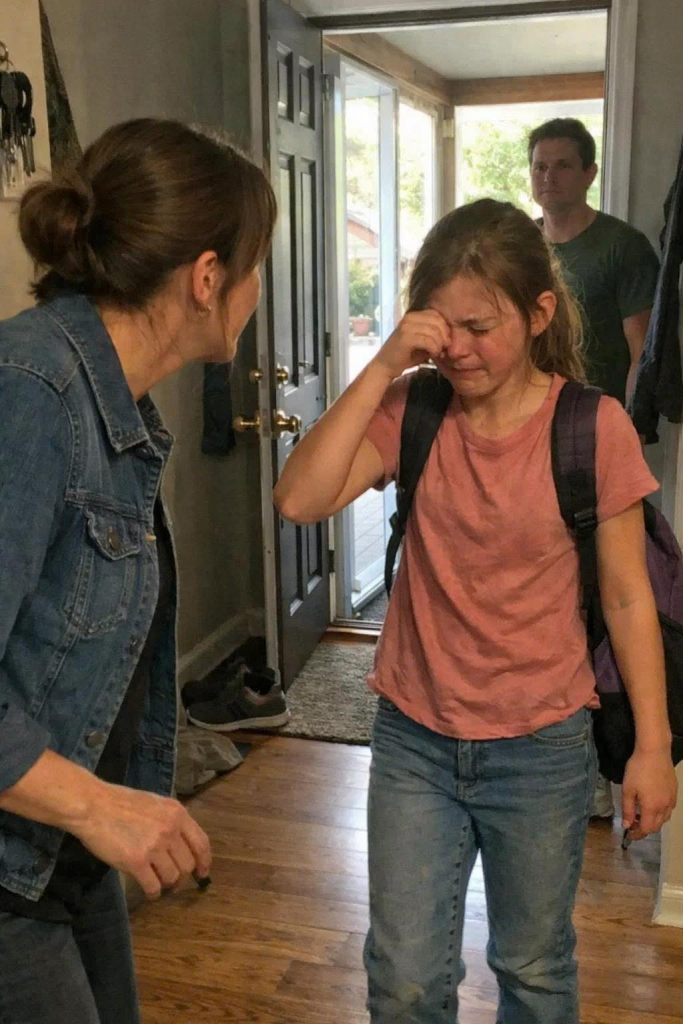
“Don’t Tell Your Mom. Just Go Home and Wash.” — I Thought My Daughter’s After-School Baths Were a Phase, Until I Pulled the Drain and Found the One Thing That Exposed a Secret the School Tried to Bury
For nearly half a year, my daughter followed the same ritual with a precision that should have unsettled me sooner. The front door would open at exactly 3:42 p.m., her backpack would slide off her shoulder and land by the shoe rack with a soft thud, and before I could finish asking how her day had been, she would already be halfway down the hall, calling out, “Bathroom,” like an announcement rather than a request. The door would close. The lock would turn. And the house would fall into a silence that felt heavier each day.
Her name is Ava Miller, and she is ten years old.
At first, I told myself it was nothing. Kids sweat. Kids play hard. Kids go through odd phases that adults don’t always understand, and as a single mother juggling work deadlines and dinner plans, it was easier to accept a simple explanation than to interrogate a routine that didn’t immediately scream danger. When I asked her casually why she always bathed the moment she got home, she smiled without hesitation and said, “I just like being clean,” and she said it with a brightness that seemed convincing enough to move on.
Except Ava had never been like that.
She had always been the kind of child who hated brushing her hair, who forgot to wash her hands unless reminded, who left fingerprints on every surface she touched. Cleanliness had never been her passion. So when her answer never changed, not once, not even in wording, it began to sound less like a preference and more like a line she had been taught to repeat.
The unease crept in quietly. It wasn’t dramatic. It didn’t arrive all at once. It showed up in the way she avoided eye contact while toweling off, in the way she flinched when I knocked to ask if she needed help, in the way she stopped talking about school altogether, offering only vague summaries that felt hollow and incomplete. Still, I told myself not to overreact, because parents are capable of inventing nightmares where none exist, and I didn’t want to become that person.
The afternoon everything changed was painfully ordinary.
The bathtub had been draining slowly for weeks, leaving behind a cloudy ring no amount of scrubbing seemed to fix. While Ava was still at school, I decided to finally deal with it. I pulled on gloves, removed the drain cover, and fed a plastic snake into the pipe, fully expecting the usual mess of hair and soap buildup.
What came out wasn’t usual.

It was heavier than I expected, a tangled, wet mass that clung stubbornly to the plastic. As I pulled it free, my stomach tightened. Mixed in with dark strands of hair were thin fibers that didn’t belong there. Fabric fibers. I rinsed it under the faucet, my heart beginning to pound as the water cleared the grime away.
The pattern emerged slowly, unmistakably.
Pale blue. Fine stitching. A familiar texture I had seen hundreds of times while ironing school clothes.
It was part of Ava’s uniform.
Uniform fabric doesn’t end up in a drain by accident. It doesn’t tear away during a normal bath. It ends up there when someone is scrubbing too hard, when they are desperate to erase something, when they don’t know how to explain what happened and believe water will make it disappear.
I turned the fabric over with shaking hands and saw the faint discoloration clinging to it, dulled by time and soap but still visible enough to make my vision blur. My legs felt weak. I had to sit down on the bathroom floor, clutching the edge of the tub as my thoughts raced in every direction at once.
Ava was still at school. The house was quiet. And suddenly, every locked bathroom door, every rushed bath, every too-perfect smile replayed itself in my mind like a warning I had ignored.
I didn’t wait to talk myself out of it.
I sealed the fabric in a plastic bag, grabbed my keys, and called the school as I walked to my car. When the front office answered, I asked if Ava had been injured recently, if there had been any incidents after dismissal, and my voice sounded strangely calm even as my hands trembled.
There was a pause.
Not long, but long enough.
Then the secretary said quietly, “Ms. Miller, could you come in right now?”
“Why?” I asked, already bracing myself.
Her reply landed like a weight on my chest. “Because you’re not the first parent to ask about something like this.”
The drive felt endless. Every red light felt cruel. The bag with the fabric sat on the passenger seat like proof of something I wasn’t ready to name. When I arrived, there was no small talk, no forced smiles. I was escorted directly to an office where the principal, Laura Henderson, and the school counselor, Ms. Sofia Ramirez, were waiting. Both looked exhausted in the way people do when they’ve been holding a secret too heavy to carry alone.
I placed the bag on the desk without being asked.
Ms. Ramirez nodded slowly. “We were hoping a parent would notice,” she said gently. “We just didn’t expect it to take this long.”
They explained that several children had been encouraged to “clean up immediately” after school by a staff member assigned to the pickup area, someone who presented it as part of a hygiene routine, something harmless, something not worth mentioning at home. Some children were told their clothes were dirty. Some were told not to worry their parents. All of them were told it was normal.
My hands curled into fists. “You’re saying an adult told my child to hide something from me.”
Laura didn’t deny it. “We’ve contacted the district,” she said. “And child services. But we needed confirmation. Evidence.”
The word evidence made my stomach turn.
That evening, Ava sat at the kitchen table, swinging her legs nervously as she picked at her dinner. I didn’t raise my voice. I didn’t rush her. I sat beside her and told her she wasn’t in trouble, that she hadn’t done anything wrong, and that nothing she said would ever make me love her less.
She stared at the table for a long time before whispering, “You found it, didn’t you?”
I nodded, fighting tears.
Her shoulders sagged with relief so deep it broke my heart. “He said I had to wash,” she said softly. “He said it was our secret.”
That was all she needed to say.
The investigation moved quickly after that. Other parents came forward. Other children told similar stories, their words careful and hesitant but consistent. The staff member, a man named Gregory Barnes, was suspended immediately and later arrested after evidence mounted far beyond what anyone could ignore.
The school district issued apologies. Policies changed. New safeguards were implemented. But the real work happened at home, in quiet evenings spent rebuilding trust, in therapy appointments where Ava learned that silence was never her responsibility.
Months passed. The drain was fixed. The bathroom door stopped locking.
One afternoon, Ava came home, dropped her backpack, and walked into the kitchen instead of the hallway.
“Can we bake cookies?” she asked.
I smiled, tears in my eyes. “Of course.”
Justice didn’t erase what happened, but it ensured it would never happen again. The person responsible faced consequences. The children were protected. And my daughter learned something far more important than cleanliness.
She learned she was safe.
And this time, that was the truth.



Leave a Reply