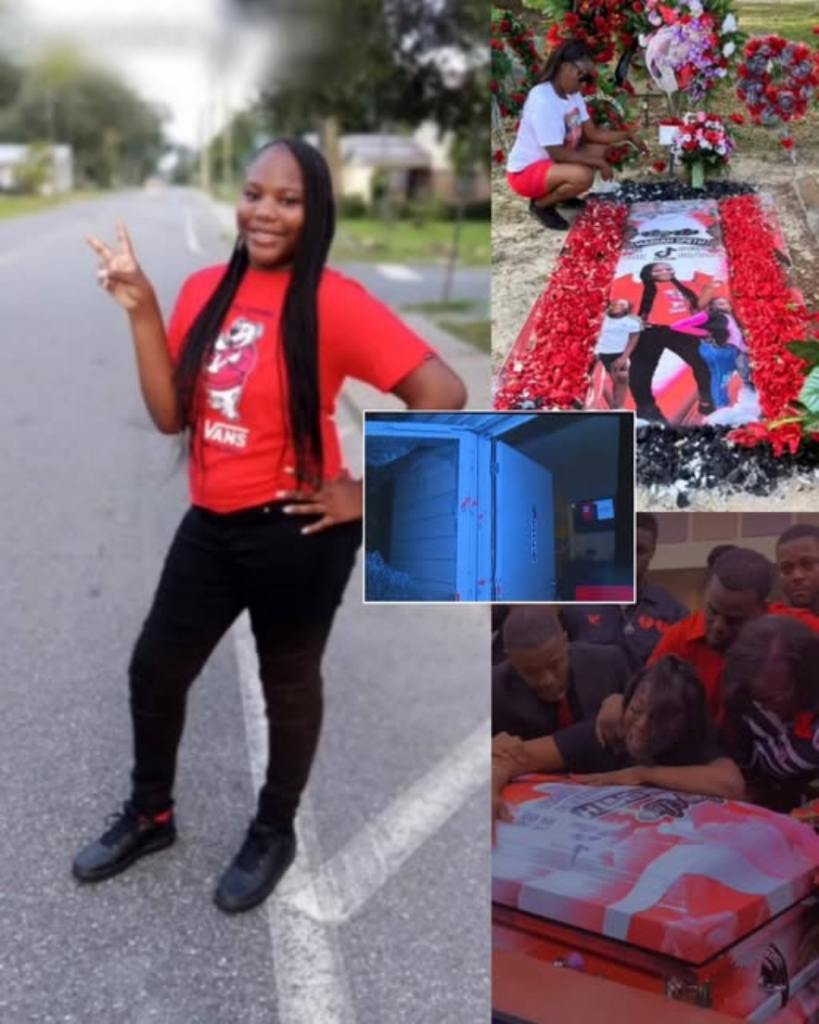
He had seen tragedy before, but nothing ever prepared him for the sound of a child’s final breath.
For Lake City, a town where children rode bicycles down cracked sidewalks and neighbors waved from porches at sunset, August 2023 was supposed to be just another warm, slow-moving Florida month.
But that illusion shattered the night bullets tore through a modest home on Northwest Long Street and stole the life of a 12-year-old girl named Mariah Reginae Smith.

Mariah was the kind of child who filled every room with light.
She loved braiding her grandmother’s hair, singing softly to herself while she worked her fingers through silver strands.
She laughed loudly, loudly enough to pull her older brother Todrion out of his darkest days.
She wrote little poems in the margins of her school notebooks.
She dreamed about becoming a nurse “to help people heal.”
No one could have imagined that, on a quiet summer night, she would become the center of a story that would tear her family apart and leave a permanent scar on a community that already knew too much pain.

The courtroom was full when the trial began.
Two families sat on opposite sides, their emotions simmering beneath the still air of the Tuesday morning session.
Prosecutors prepared to paint a picture of deliberate retaliation.
The defense prepared to argue a desperate plea: that the state could not prove what it claimed.
And somewhere in between, Mariah’s memory sat like a fragile ghost, hovering over every word spoken.
Jayden Burch, just 17 years old, sat hunched in a suit too large for him.
His eyes didn’t rise from the table.
He looked like a boy trying to disappear inside himself.

But the prosecutors said he was something else entirely—someone who fired into a home more than a dozen times, someone who admitted his role in a message on Instagram and then placed a smiling emoji beside it.
“Todrion’s sister,” he supposedly wrote.
“She dead.”
And when someone asked how he knew, they said Jayden replied:
“I know, I did it.”
Across the courtroom, Mariah’s older brother Todrion swallowed hard, gripping the edge of the witness stand when his name was called.
He was only a teenager, but trauma had aged him.
He walked with shoulders heavy from a guilt he could not escape.
The day of the shooting had begun like any other day for him.

A fight at school.
A scuffle he said he never meant to escalate.
But it escalated anyway.
He was suspended.
Kicked off the football team.
Humiliated.
And someone, prosecutors argued, wanted revenge.
Bullets began tearing through the walls of their home before he even had time to understand what was happening.
“I dropped to the floor,” he testified.
“First thing I heard was glass.
Then I felt the wind from the bullet.”

He said he covered Mariah, shielding her with his own body, but the shots were too many and too fast.
“She didn’t get a chance,” he whispered, voice cracking.
“I tried.
I swear I tried.”
It was his grandmother, Deidre Filer—Nana—who brought the room to silence when she stepped up to the stand.
Her hands trembled as she held the railing.
Her voice was soft, hoarse, aged not only by time but by grief.
“I heard something,” she said slowly.
“Sounded like dropping.
I asked, ‘What you dropping in there?’”

She paused, eyes filling with tears.
“Then he said, ‘Nana, they shooting up the house.’
I told them, ‘Get on the floor.
Get on the floor.’”
Those were the last words she spoke before chaos swallowed her home.
The responding officer’s body-camera footage played next, filling the courtroom with a haunting reminder of the reality behind the headlines.
The officer’s voice shook as he recounted performing CPR on Mariah.
He had pressed his hands on her small chest, hoping somehow she’d breathe again.
But her pulse slipped away beneath his palms, disappearing like a final whisper.
The courtroom grew still as prosecutors revealed a key piece of evidence—a firearm accessory found near the scene, one they said held Jayden Burch’s DNA.
If true, it meant he had been there, close enough to drop it while fleeing.

But the defense pushed back.
“Presence is not proof,” the attorney told jurors.
“A piece of plastic with DNA is not the same thing as guilt beyond a reasonable doubt.”
She insisted Jayden had been home in the same neighborhood at the time.
She said no witness had seen him fire.
She said assumptions were not justice.
But assumptions were not what Mariah’s family felt.
All they felt was the hollow space where her laughter used to be.
All they saw was the empty chair at the dinner table.
All they clung to was the memory of her brown eyes, bright and curious, always asking for one more bedtime story.

At recess, people whispered.
Neighbors avoided eye contact.
Reporters lingered outside the courthouse steps, fighting for angles while a grandmother inside struggled to breathe through grief.
Because the truth was simple.
A child was dead.
A teenager was accused.
A family was broken.
And no verdict could ever bring back what had been lost.
Mariah’s mother did not testify.
She could not.
She sat silently, hands clasped tightly in her lap, her eyes red but dry—as if she had cried so much there were no more tears left to give.

When the trial paused for the day, she stood, walked outside, and stared at the street sign that now bore her daughter’s name.
Months earlier, Lake City council members had renamed the road where the shooting took place:
Mariah Reginae Smith Forever 12 Memorial Street.
The metal sign glimmered under the afternoon sun.
It was meant to honor her.
But to her mother, it was a reminder of everything that should never have happened.
She touched the pole gently, like touching the cheek of a child she could no longer hold.
Mariah would never braid Nana’s hair again.
She would never hear her brother tease her about her messy handwriting.
She would never blow out birthday candles or play hopscotch or wear the glittery pink dress she begged for the month before she died.

Her story, once filled with dreams, now existed only in court files, in memorials, in the silent ache of those who loved her.
The trial was expected to end the following afternoon.
Some hoped for closure.
Some expected justice.
Others simply wished the nightmare could end.
But the truth lingered in the hallway like a shadow—
There were no winners here.
Only survivors.

As the courtroom emptied for the day, Todrion stepped outside and lifted his eyes to the sky.
He whispered something no one else heard.
A prayer.
An apology.
A promise.
He had survived, but a part of him never would.
Because every night, when he closed his eyes, he saw the moment he dropped to the floor.

He felt the heat of the bullets.
He felt Mariah’s small body against his.
He heard her last breath.
And in the quiet corners of his heart, he wondered if there was something he could have done differently.
If he could have saved her.
If he deserved to be here when she wasn’t.
But he remembered one thing—one truth Mariah had told him once, months before the shooting, when she found him crying over a bad game at football practice.
“It’s okay to fall,” she whispered.
“You just have to stand back up.”

And so he tried.
Even when it hurt.
Even when the world felt heavier than he could carry.
Mariah’s story would live on.
Not just in a street sign.
Not just in a courtroom transcript.
Not just in the tragedy that took her life.
It would live on in the people who loved her.
In the community that gathered around her memory.
In the hope that one child’s stolen future could inspire a safer, kinder tomorrow.
She would remain Forever 12.
Forever innocent.
Forever loved.
And Lake City would never forget her.
Some Cries Are Meant for Comfort. Hers Ended in Silence.

The story of Shakara Dickens is one that still haunts everyone who followed it, not because it is complicated, but because it is unbearably simple.
A young mother, already overwhelmed by life, made a terrible, irreversible choice in a moment of emotional collapse.
And the victim was her nine-month-old daughter, Lauryn, a child who could not speak, could not defend herself, and whose cries were meant to call for comfort, not to trigger tragedy.
Shakara was twenty-two when it happened.
She had grown up like many young mothers—caught between wanting to give her child a better future and feeling crushed under the weight of responsibility.



Leave a Reply