PART 1 — When Neglect Becomes Proof
Laura Bennett believed the weekend trip would save her marriage.
At thirty-two, she and her husband Ryan Bennett weren’t rich, dramatic, or reckless. They were simply tired. The modest mountain lodge they had booked was supposed to be a pause, a peaceful reset after years of work, postponed dreams, and conversations that ended too soon.
By the second morning, everything changed.
Laura slipped on a wet stone path outside the lodge. The pain was instant, blinding, radiating through her spine and left leg. She screamed. Ryan froze. By the time the ambulance arrived, Laura could no longer stand.
At the hospital, she was admitted for observation, placed in a wheelchair, and had her movements restricted until they could complete the imaging. Ryan sat next to her, checking his phone, sighing loudly every time a nurse asked him questions.
“This is taking forever,” he muttered. “They’re exaggerating.”
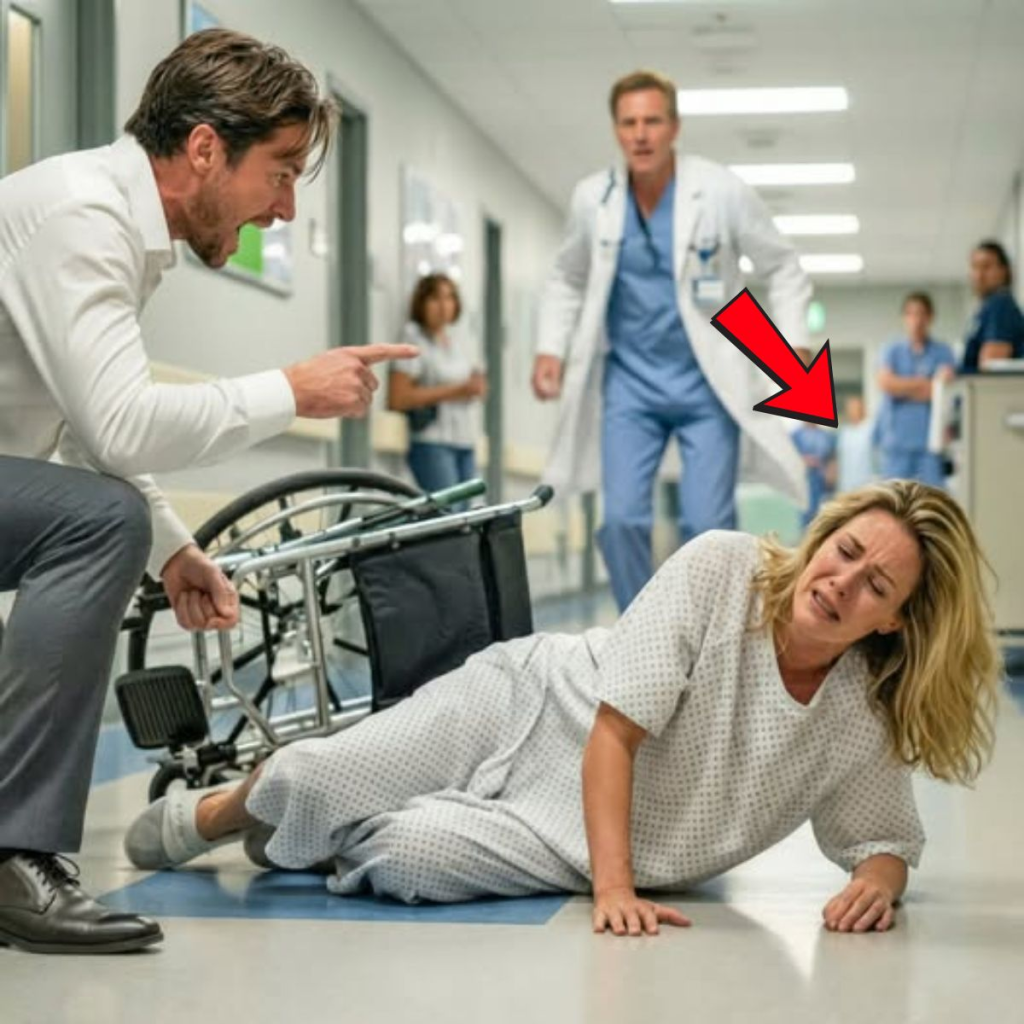
Hours later, alone in the hallway, Laura tried to get up to go to the bathroom. Her leg buckled. She fell hard, the sound echoing down the hall.
“Ryan!” she cried. “Please! I can’t get up.”
Ryan stayed three meters away.
“I told you not to move,” he snapped. “This is your fault.”
He turned and walked away.
Dr. Andrew Hale, the on-call doctor returning from his rounds, witnessed the scene. He rushed to Laura’s side, stabilized her, and personally escorted her to her room. He noticed the bruises, the fear, the lack of support.
Ryan was gone when Laura woke up.
The next day, Ryan returned briefly: irritated, distracted, distant. He complained about missed appointments. He refused to stay overnight. By morning, he stopped coming altogether.
Dr. Hale began documenting everything.
Missed visits. Refusal to help. Emotional distress.
Laura still didn’t understand why he was paying so much attention, or why his concern felt different.
Three days later, while Laura lay staring at the hospital ceiling, Dr. Hale sat beside her bed and spoke quietly:
“There are things you need to know. About your husband. And about me.”
Laura turned her head, confused.
And in that moment, she realized that her fall had not been the true crisis.
It was just the beginning.
What truth was Dr. Hale about to reveal, and why had Ryan left before part two?
PART 2 — When Neglect Becomes Evidence
Dr. Andrew Hale didn’t speak immediately.
He waited for the effect of Laura’s pain medication to kick in, for her breathing to calm, for her gaze to focus on him instead of the ceiling. Years of medical training had taught him when silence was more ethical than urgency.
“There are protocols,” he said carefully. “And then there are responsibilities.”
Laura nodded slightly.
“Your imaging shows nerve compression and ligament damage,” he continued. “Recovery will take time. What worries me most is what’s not shown in the images.”
She furrowed her brow. “What do you mean?”
Dr. Hale took a deep breath. “The absence of your husband. His refusal to help you. His reaction when you fell. This qualifies as medical neglect.”
The word hit harder than the pain.
Neglect.
“I didn’t want to cause problems,” Laura whispered. “He’s just… overwhelmed.”
“That doesn’t justify abandonment,” Dr. Hale responded gently. “Especially during a medical crisis.”
In the following days, Laura underwent further assessments. The physical therapy evaluations confirmed limited mobility. A social worker visited her. They asked questions, discreetly and professionally.
Ryan didn’t answer the calls.
When he finally returned, it was to argue with the billing staff.
“I didn’t sign up for this,” he shouted outside Laura’s room. “She was fine yesterday.”
Dr. Hale intervened.
“Mr. Bennett,” he said calmly, “your wife needs help. Refusing to participate can have legal consequences.”
Ryan scoffed. “You doctors love the drama.”
He left again.
That night, Laura cried silently, clutching the bed railing, realizing something devastating: she had confused tolerance with collaboration.
Two days later, Dr. Hale requested a private conversation.
“I should’ve told you sooner,” he said. “But hospital ethics require emotional stability before revealing personal information.”
Laura looked at him, puzzled.
“I’m not just Andrew Hale,” he continued. “I’m Andrew Hale-Bennett.”
She gasped.
“I’m your older brother.”
Memories flooded her: her mother’s second marriage, a brother she barely knew, letters that stopped arriving. The resemblance she had never questioned suddenly made sense.
“I found your name on the admission list,” he said softly. “I recused myself from making important decisions, but I stayed close. To protect you.”
Laura didn’t speak. She extended her hand, and he took it.
From that moment, things changed.
Formal reports were filed. The hospital administration began a review. Ryan was contacted by compliance officials. He responded with anger, accusations, and denial.
But the documentation didn’t lie.
Medical neglect was confirmed. Ryan was prohibited from making decisions.
When Laura was transferred to a rehabilitation unit, Ryan never showed up.
Instead, the divorce papers arrived.
Dr. Hale read them in silence and handed them to Laura.
“You didn’t fail,” he said. “He did.”
Laura began her rehabilitation slowly. With pain. But she was no longer alone.
And as she regained strength, she also regained clarity.
She started to understand that love without responsibility is not love at all.
PART 3 — Rising After Being Abandoned
Recovery is not cinematic.
There were no sudden breakthroughs, no miraculous steps. Laura Bennett learned to measure progress in centimeters, not miles. Some mornings, she could stand for thirty seconds. Other days, she couldn’t.
But she showed up.
Every day.
Dr. Andrew Hale coordinated her care, but never intruded. He respected her autonomy while protecting her interests. Their sibling bond didn’t stem from shared blood, but from shared truth.
Meanwhile, Ryan’s world shrank.
The hospital’s conclusions were sent to the relevant agencies. His employer requested explanations for the repeated absences and complaints from medical staff. His narrative—that Laura was “dramatic” and “difficult”—collapsed under the clinical documentation.
When the divorce process began, Ryan tried to control her.
He sought marital immunity. He argued that he had been excessively injured. He accused Laura of emotional manipulation.
The judge read the reports.
And then looked at Laura.
“How did you get out of bed?” the judge asked. “When your husband refused to help you?”
Laura simply replied, “I stopped waiting for him.”
The agreement was swift.
Ryan left with only debts and professional consequences. He quietly ceased to be relevant, as men do when evidence replaces excuses.
Laura continued therapy for months.
She learned to ask for help and reject mistreatment disguised as stress. She joined a patient advocacy group. Later, she spoke publicly, not about Ryan, but about responsibility.
“Neglect isn’t loud,” she said at a conference. “It’s what happens when someone watches you fall and decides not to move.”
Years later, Laura walked into a community center she helped fund. She had rebuilt her life carefully, intentionally. She didn’t rush to find love, but when it came, it was mutual.
Sometimes, she thought of the hallway where she fell.
Not with bitterness.
With clarity.
Because the moment Ryan walked away was the moment Laura began to turn toward herself.
And that changed everything.
If Laura’s story moved you, share it, talk about it, and reflect: your participation could help someone recognize abandonment before it becomes irreversible.

Leave a Reply