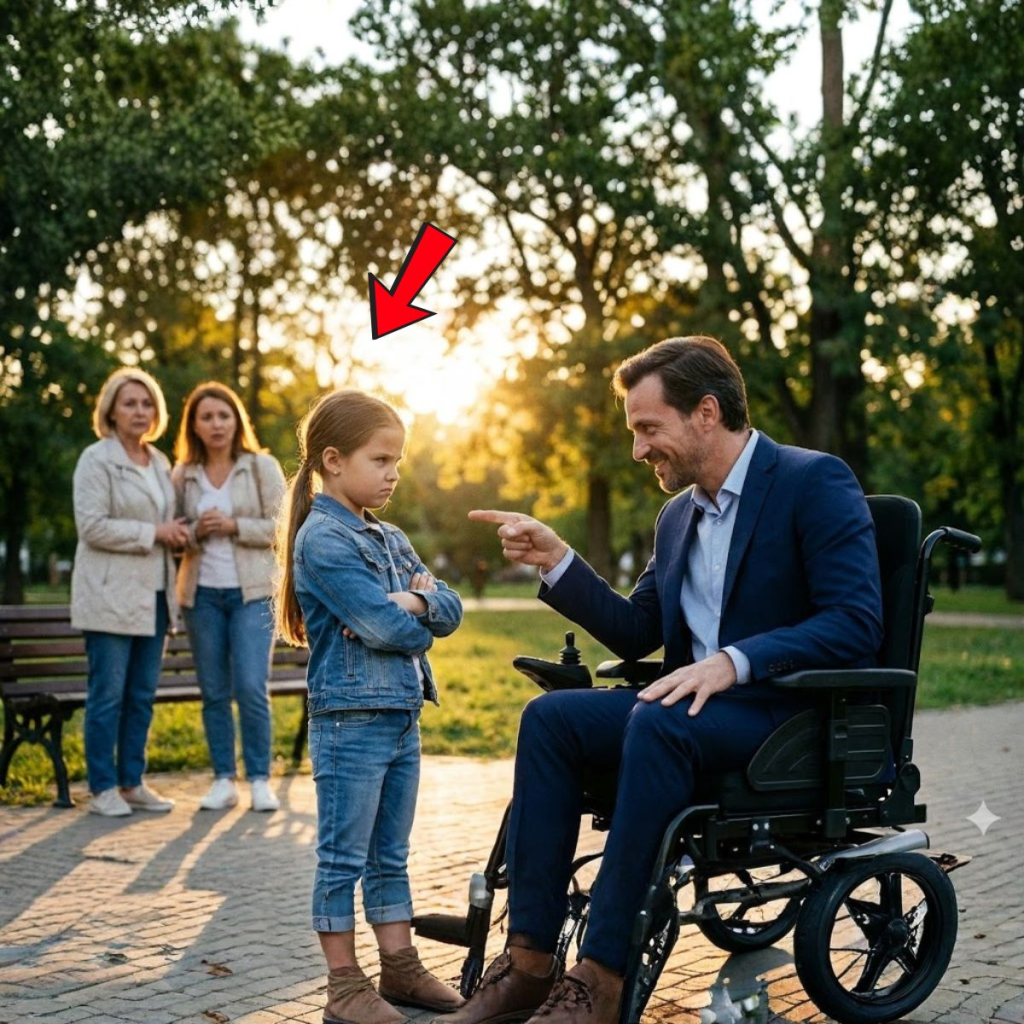
Laughter echoed through the courtyard long before the girl realized it was directed at her.
It spread across the polished stone tiles of the Franklin Bay Neurological Institute, sharp and theatrical, as if the men gathered there were not sharing amusement, but staging it, testing how high cruelty could express itself without consequences.
“Two million dollars,” said the man in the motorized wheelchair, clapping theatrically. “That’s what I’ll donate to this place if anyone here makes my legs move again.”
The men around him responded with approving laughter, their tailored jackets catching the morning sun as if the wealth sewn into their seams made them immune to discomfort or shame.
In front of them stood a girl. She couldn’t be more than ten, barefoot on a stone that still held the cold of the night, with knees stained with dirt that no scrubbing seemed to completely remove. Her T-shirt had once been white, and her hair was clumsily tied back with a frayed ribbon, suggesting it had been reused too many times to count.
Her name was Nina Álvarez.
Behind her was her mother, Lucía Álvarez, gripping the wooden handle of a mop so tightly that her knuckles had turned pale. That morning, she had made a decision she already regretted. She had brought her daughter with her because the neighbor who sometimes watched Nina had stopped answering the door, and there was no money for daycare, not when every dollar went toward rent, food, and the slow repayment of debts that never seemed to shrink.
Now, Lucía wished she could disappear. The man in the chair moved forward slightly, a fixed and rehearsed smile on his face, one of those that suggested confidence had long replaced empathy.
“Do you understand what that amount of money means?” he asked Nina, tilting his head as if relishing the game. “It’s more than your family would make in several lifetimes.”
Nina swallowed, her fingers closing into her palms, but she did not look away. She glanced back at her mother, saw the tears Lucía was desperately trying not to let fall, and nodded once.
“Yes,” Nina said quietly. “It’s more than we’ll ever have.”
That response prompted another round of laughter, louder this time, and one of the men was already raising his phone to capture what he clearly hoped would be a humiliation saved for entertainment. What none of them expected was that the girl would not beg.
Instead, Nina looked at the wheelchair. She noticed the impeccable design, the advanced controls, the shine that seemed more like a symbol than a necessity, and then she looked up at the man sitting in it.
“If you think it’s impossible,” she asked calmly, “why offer the money then?”
The courtyard fell silent so abruptly that even the fountain behind them seemed intrusive. The man’s smile faltered. Because the truth had slipped out before anyone could stop it. This was never generosity. It was mockery disguised as confidence. A public spectacle designed to remind everyone present that power belonged to those who could afford to laugh at the impossible.
Lucía stepped forward, panic finally breaking through her restraint.
“Please,” she whispered. “Let’s go. My daughter won’t touch anything. I’m sorry.”
The man didn’t look at her right away, and when he finally did, his eyes scanned her like she was a stain on the floor.
“I didn’t ask you to speak,” he replied calmly. “You’ve been cleaning these halls for years without interrupting my meetings. There’s no reason to start now.”
The words hit harder than any shout.
Lucía’s shoulders sank, and memories flooded her without permission. There had been a time when she had been at the front of classrooms, when students addressed her with respect, when she believed education would protect her from collapse. That belief dissolved the year her parents died within months of each other, followed by a cascade of medical bills and missed opportunities that pushed her to survive however she could.
Now she scrubbed floors and pretended not to hear laughter. Nina saw it all. She felt the humiliation settle in her chest like something heavy and cold, and in that moment, she understood something important.
Silence could be a shield, but it could also become a cage. She straightened her back.
“You’re not offering help,” Nina said quietly, with a firmness that even surprised her. “You’re offering proof that you don’t expect to lose.”
The man frowned, and a flash of irritation crossed his face.
“What did you say?”
“If you truly believed there was even a chance you could walk again,” Nina continued, “then that money would be a risk. But you’re sure you’ll never have to give it up.”
One of the men behind him let out an uncomfortable laugh, but it quickly died down when the man in the chair didn’t join in.
“And what makes you think you understand anything about me?” he asked.
Nina hesitated for just a moment.
“My grandmother used to help people,” she said. “She used to say that the body listens long before it obeys, and that pain often lives where no one looks.”
The man snorted, but something in his expression had shifted.
“Stories,” he said dismissively.
“I’m not here to impress you,” Nina responded. “I’m trying to understand why hurting others makes you feel safer.”
That touched something raw. The laughter didn’t return. For the first time, doubt crept into the man’s posture, not in his legs but in his chest, tightening his breath.
“And what if I wanted to try?” he asked quietly, surprising both himself and everyone else. “What if I no longer knew how?”
Nina’s gaze softened, not with triumph, but with recognition.
“Then stop laughing at the pain,” she said. “Start listening to it.”
Doctors were called in lazily, their skepticism barely hidden behind professional curiosity. Machines came in, sensors were placed, notes were taken with hands that barely trembled.
Nina set her jacket aside and moved closer.
“Stay still,” she said, not as an order, but as certainty.
The man obeyed. When Nina’s hands touched his knees, they were soft, deliberate, as if following an invisible map that no one else could see.
At first, nothing happened. Then his breath caught.
“I feel heat,” he whispered.
The monitors blinked. His fingers moved, tracing paths that made no sense to the graphs, but made perfect sense to intuition.
“I’m sorry,” he said again, louder. “Something’s moving.”
A murmur of gasps spread through the place. When his foot moved, deliberate and undeniable, disbelief shattered and chaos erupted. The doctors shouted. Papers flew. Someone screamed.
The man sobbed in front of everyone, with grief and relief colliding violently inside him.
“You didn’t fix me,” he said in a hoarse voice. “You reminded me how to forgive myself.”
The truth overflowed after that, the confession of guilt buried beneath arrogance, the accident he blamed himself for, the punishment he thought he deserved.
Nina listened without judging.
“You stopped yourself,” she said gently, placing a hand over his heart. “Not because you were broken, but because you thought you should be.”
When she whispered forgiveness aloud, something was freed, and the movement continued, hesitant but real. The world didn’t stop after that. A video leaked from the institute, spreading faster than any explanation, faster than any containment. The next morning, crowds gathered, with hope and desperation pressing against the gates.
Nina watched from a window, and fear finally caught up to her.
“I never wanted this,” she told her mother.
“I know,” Lucía replied, hugging her tightly. “You don’t owe your body to the world.”
When officials arrived with threats and ultimatums, it was the man who had once laughed who stood up first.
“No,” he said simply. “She is not yours to control.”
Nina stepped forward by his side.
“I’m not going to hide,” she said. “And I’m not going to lie.”
The center that followed was built in silence, not as a spectacle, but as a refuge, sustained by dignity and not by power. Nina never called herself a healer. She called herself a listener. And the world, slowly and imperfectly, learned to listen too.


Leave a Reply