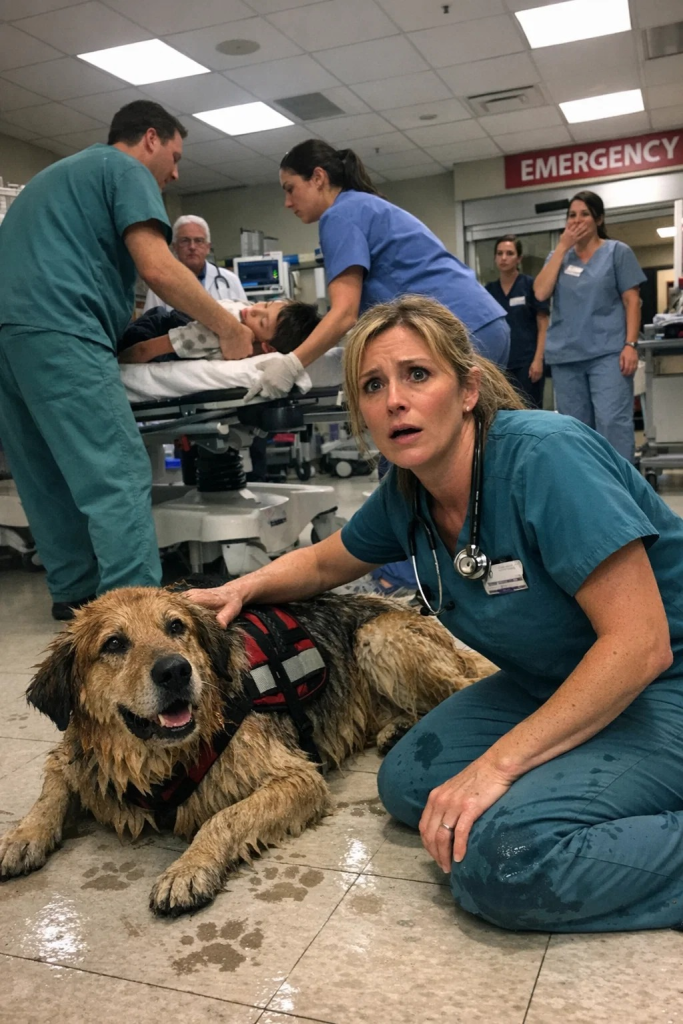
A Dog Dragged an Unconscious Child Into the ER — the Trauma Nurse Recognized Her Husband’s Search-and-Rescue Dog, the Same Mission Where He Was Declared Lost Years Ago.
The night shift at Crosshaven Medical rarely surprised anyone anymore, not because emergencies stopped happening after midnight, but because repetition dulls the edge of fear until even sirens feel routine, and at 1:58 a.m. I was restocking IV trays while counting the minutes between coffee refills, unaware that the quiet was about to fracture in a way that would rearrange my understanding of grief, loyalty, and the thin line between disappearance and death.
My name is Laura Benton, trauma nurse, twelve years in emergency medicine, and for nearly three years I had lived with the certainty that my husband, Mark, had died during a backcountry search-and-rescue operation when his radio went silent and the forest gave nothing back but broken branches and official condolences.
They never found his body.
They told me nature doesn’t return everything.
At 2:04 a.m., the automatic doors opened without warning.
Not slid—burst.
Rain slammed against the floor, carried in by wind sharp enough to sting the skin, and before security could react, a shape moved through the doorway with purpose that didn’t belong to panic or accident.
A dog.
Large, soaked, limping.
A Belgian Malinois, coat matted dark with rain and dirt, eyes bright with a focus that ignored every shouted command in the room, and across his back, secured by a child’s jacket twisted into a harness, was a small boy hanging unconscious, his cheek pressed against the animal’s spine like instinct had chosen the only steady place left.
For a moment, the ER forgot how to breathe.
The dog staggered forward, claws scraping tile, then stopped directly in front of the nurses’ station and lowered himself with controlled precision, careful not to jolt the weight he carried, releasing a sound that wasn’t a bark but a low, exhausted plea that vibrated through the room.
Something cold slid through my chest.
I knew that sound.
I had heard it every morning before dawn, every time Mark laced his boots, every time a training run ended in praise instead of discipline.
“No,” I said under my breath.
The dog lifted his head.
Our eyes met.
And recognition landed like a physical blow.
“Ranger,” I whispered.
The name crossed the room before logic could catch it.

His ears flicked.
His tail struck the floor once, weak but certain, and then his legs folded beneath him as if the last of his strength had been spent reaching me.
Everything moved at once.
Doctors rushed forward, the boy was lifted onto a gurney, wet fabric cut away, oxygen placed carefully, and someone called pediatric trauma while I dropped to the floor beside the dog without asking permission, my hands shaking as they found the scar along his shoulder, the one Mark used to joke about, saying it made Ranger look like he’d survived something worth remembering.
“You did it,” I whispered into his fur. “You found help.”
The boy’s wrist slipped free as they moved him, and something clinked softly against the rail.
A compass. Old. Scratched.
The same one Mark carried on every mission, the one engraved inside with a date that meant nothing to anyone else.
I felt my knees hit the floor again.
The boy survived the night.
Hypothermia, dehydration, exhaustion, but no internal damage, no fractures, and when he finally woke just before dawn, his eyes darted around the room with the alertness of someone who had learned too young that safety was temporary.
I was there when it happened.
Not because anyone told me to stay, but because something had rooted me to that room.
When his gaze landed on the compass in my hand, his breath hitched.
“Papa?” he asked, his voice small and raw.
The word cracked something open inside me.
I sat beside the bed slowly, keeping my voice low.
“My name is Laura,” I said. “You’re safe here. The dog is safe too.”
He swallowed hard.
“He said you’d know,” the boy whispered.
“Who?” I asked, though my pulse already knew the answer.
“My dad,” he said. “He said if Ranger found you, everything would change.”
The investigation didn’t like that.
Uniforms arrived with questions that felt rehearsed, explanations that avoided specifics, and a supervisor who watched me too closely when I asked where the search records were from the night Mark vanished.
They called it an unresolved loss.
They called the boy a coincidence.
They didn’t expect the map.
Hidden inside the boy’s shoe sole was a folded scrap of waterproof paper, marked with coordinates, supply notes, and a single sentence written in handwriting I would recognize even if I were blind.
If you’re reading this, they failed.
I didn’t go home.
I followed the coordinates with Ranger riding in the back of my car, bandaged but alert, the boy asleep beside him like the world had finally paused long enough to rest.
The cabin was buried deep beyond any marked trail, reinforced with scrap metal and camouflage, and inside it smelled like antiseptic, old coffee, and stubborn hope.
Mark was alive. Injured. Thin. But alive.
He’d uncovered something he wasn’t supposed to during his last operation, a supply chain masked as disaster relief, people who relied on the assumption that missing rescuers didn’t raise alarms, and when he realized the wrong people wore the right patches, he vanished instead of dying, knowing I would never stop looking if I knew too much too soon.
The boy was named Simon.
His mother had been one of the people Mark helped escape.
She didn’t survive the winter.
Mark had promised the child he would keep him safe, even if it meant becoming invisible.
The fallout was loud.
Internal investigations, quiet resignations, charges that never made the news but dismantled careers, and for the first time in years, I watched systems bend under the weight of proof instead of burying it.
Mark came home slowly. So did Ranger. Simon stayed.
Not because blood demanded it, but because choice did.
Our house isn’t quiet anymore.
It’s imperfect and loud and full of things healing at different speeds, but sometimes, late at night, when Ranger sleeps across the doorway and Simon’s laughter drifts down the hall, Mark squeezes my hand and says, “I knew he’d find you.”
And I understand now that love doesn’t always come back the way it left.
Sometimes it returns soaked, limping, carrying everything that matters through the storm, trusting that when the door finally opens, someone will still recognize it.
Leave a Reply