The engine of the black Mercedes roared beneath the merciless afternoon sun, devouring the asphalt that wound its way toward Hacienda Los Olivos. Behind the wheel, Álvaro Serrano felt that the air conditioning was not enough to cool the blood boiling in his veins. His hands—hands accustomed to signing multimillion-dollar contracts with steady precision—gripped the leather steering wheel until his knuckles turned white. He was going to do it. Today was the day. He was going to fire her.
Carla’s voice, his fiancée’s, still echoed in his head, drilling into his conscience with the persistence of a dripping faucet. “She’s a savage, Álvaro,” she had told him that morning, her eyes brimming with tears that, in his blindness as a guilty, lovestruck man, he believed were sincere. “That woman, Lucía… she doesn’t take care of the children. She leaves them dirty, ignores them, and worst of all… I think she hits them when you’re not around. Hugo and Mateo are terrified of her.”
The mere idea that someone might hurt his children—his four-year-old twin boys who had already endured the devastating loss of their mother—awakened something primitive in Álvaro, almost animalistic. Since Elena’s death two years earlier, the hacienda had become a mausoleum of silence. Buried in work to avoid confronting the emptiness of his bed, he had delegated parenting to a parade of nannies who never lasted. But Carla had promised this time would be different, that she would bring order. And order, according to Carla, required firing that young domestic worker who, she claimed, was the root of all the problems.
As he passed through the imposing wrought-iron gates of his property, Álvaro turned off the radio. He needed silence to rehearse the cold, harsh words with which he would throw the girl out. He didn’t care that she was young or that she needed the job; if she had laid a finger on his children, he would make sure she never worked in the region again.
He parked far from the main entrance, beneath the shade of an old oak tree, driven by a sudden desire for surprise. He wanted to catch her in the act. He wanted moral justification for his fury. He walked across the gravel with heavy yet silent steps, skirting the house toward the back garden—the place where Carla had assured him the “neglect” happened.
He prepared for the worst. He prepared to find his children crying, filthy, abandoned in some corner while the employee wasted time on her phone. He prepared to scream.
But what he found stopped him cold, as if he had run into an invisible wall.
The afternoon air carried no cries. It carried laughter.
Not the timid, stifled laughter his children rarely produced during formal dinners with Carla. These were pure, crystalline, explosive giggles—sounds Álvaro hadn’t heard in two years, sounds he thought had been buried with his wife.
He hid behind a thick column of volcanic stone, his heart pounding against his ribs. From his hiding place, the scene unfolding before him had the dreamlike quality of a Renaissance painting.
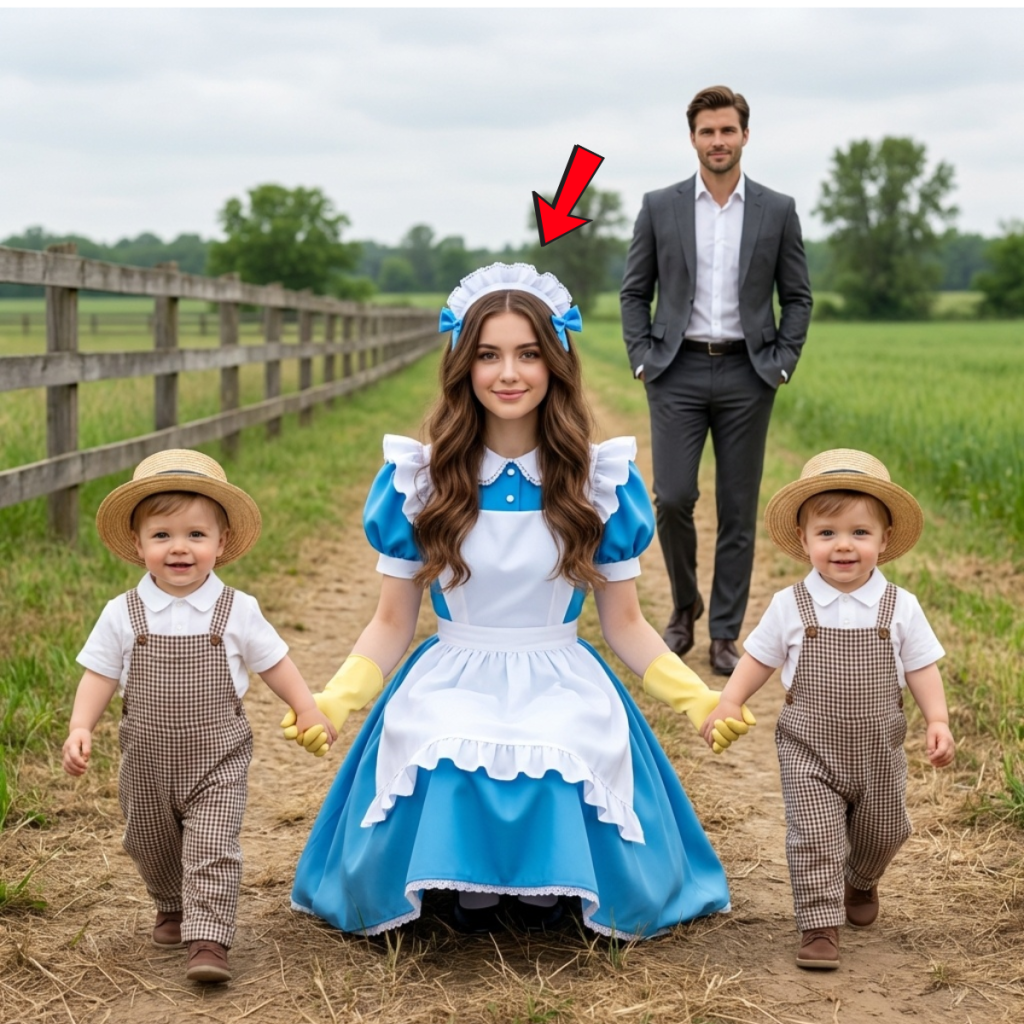
There was Lucía. She was not sitting idly, ignoring the children. She was kneeling on the grass, her blue uniform stained with dirt and mud, wearing ridiculous yellow rubber gloves. But she wasn’t cleaning. She was being a monster.
“Careful! Here comes the Tickling Monster!” she roared—but her voice held not a trace of menace, only vibrant, theatrical, loving warmth.
Hugo and Mateo—his sons, the same children Carla described as “introverted and problematic”—ran around her shrieking with delight, their faces flushed with sun and happiness. Hugo tripped and fell face-first. Álvaro’s instinct was to run, but before he could take a step, Lucía was already there. She didn’t scold him for getting dirty, as Carla usually did. She lifted him into the air with surprising strength for her small frame.
“Up we go!” she exclaimed, quickly inspecting his knees with practiced ease. “Any blood? No. Any broken bones? No. Then it’s tickle time!”
The boy, who had been on the verge of crying, burst into laughter as she attacked his stomach with the yellow gloves. Álvaro felt a knot tighten in his throat. That connection—that instant ability to turn fear into safety—couldn’t be bought with money. It was instinct. It was love.
Álvaro watched for ten minutes that felt like an eternity. He saw how Lucía wiped their faces with the edge of her apron, not with disgust but with tenderness. He saw how she looked at them—not as a job, but as the greatest treasure in the world. And he saw something else, something that chilled his blood: from time to time, Lucía glanced fearfully toward the balcony of the master bedroom, as if she were afraid of being discovered while being happy.
Suddenly, the unmistakable sound of heels striking marble shattered the enchantment.
“Lucía!”
The shout was sharp, shrill. Carla stormed out of the house like a summer tempest, impeccable in her silk dress, her face twisted with rage. She didn’t see Álvaro hidden in the shadows. Her eyes were fixed solely on the maid.
“I told you I don’t want them in the mud!” Carla screeched, charging down the steps. “Look at them! They look like pigs. If Álvaro saw this, he’d kick you out right now. You’re useless.”
The change in the children was instant and devastating. The laughter died. Their small bodies stiffened. And then came the moment that finally tore the blindfold from Álvaro’s eyes: instead of running toward Carla, their future “mother,” Hugo and Mateo ran to hide behind Lucía’s legs.
And Lucía—the young employee who was supposedly meant to fear the lady of the house—straightened up. She placed her protective hands on the children’s heads and, with a trembling but firm voice, replied:
“Miss Carla, the children need to play. The sun is good for them. I’ll wash the clothes later, don’t worry.”
“Don’t talk back to me, you nobody!” Carla raised her hand threateningly and stepped forward.
That was enough.
Álvaro stepped out from behind the column. His footsteps on the gravel sounded like death sentences.
“Carla.”
It was just one word, spoken low and deep, but it hit like a cannon blast. Carla turned, the color draining from her face. Her eyes widened when she saw her fiancé standing there, witnessing her cruelty.
“Álvaro… love…” she stammered, instantly replacing her rage with a fragile victim’s mask. “You’re home early! Thank God. Look at this—this woman has driven me crazy, the children are wild, I’m just trying to educate them…”
Álvaro didn’t look at her. He passed by as if she were invisible and knelt in front of Lucía and his sons. The boys stared at him in amazement.
“Hey, champs,” Álvaro said, his voice breaking.
“Daddy, Lulu is good,” Mateo whispered, clutching Lucía’s leg. “Don’t let the witch yell at her.”
Álvaro slowly stood and looked at Lucía. He saw the fear in her honey-colored eyes—the fear of losing her livelihood, the fear of authority.
“Take the children inside, Lucía,” he said gently. “Give them whatever snack they want. And please… don’t stop playing with them.”
Lucía nodded, confused but relieved, and hurried the boys toward the kitchen.
When they were alone in the garden, the silence weighed tons. Carla tried to step closer, placing a hand on his chest.
“Álvaro, darling, you have to understand, I was stressed…”
“Inside,” he cut her off. There was no warmth. No love. Only the coldness of a man who has just realized he has been sleeping with the enemy.
Álvaro went to his study—the sanctuary of wood and books where he usually hid from the world. But this time, he wasn’t hiding. He sat at his desk, took out his phone, and dialed a number he rarely used. It was the head of security at his tech company.
“Roberto, I need you at the hacienda. Now. Bring the full team.”
“Sir? Did something serious happen?”
“Yes,” Álvaro replied, staring out the window at the garden where the flattened grass still held the memory of his children’s games. “I’ve been blind, Roberto. I want cameras. Hidden cameras everywhere. The living room, the kitchen, the hallways. I want to see and hear everything that happens in this house when I’m not here. I think there’s a monster living under my roof—and it’s not who I thought.”
That night, the hunt began. And Álvaro Serrano rarely lost.
The installation was discreet and fast. By dinner, the house had more eyes and ears than a maximum-security prison—though no one knew it. Carla, believing her apologies and crocodile tears had worked, behaved with sickly sweetness at the table, though Álvaro noticed how she discreetly pinched Hugo’s arm when the boy made noise with his soup. Álvaro clenched his teeth but said nothing. He needed irrefutable proof. He needed the final blow to be definitive.
That night, locked in his study, Álvaro saw the truth.
The recordings from the past weeks—retrieved from the old security server he almost never checked—were a horror film. He saw Carla pushing the children, throwing food at them, locking them in dark closets while she laughed on the phone with her friends about how stupid they were. And he saw the contrast: Lucía arriving, comforting, hugging, singing, working herself to exhaustion to repair the emotional damage Carla caused. He saw Lucía pulling food from her own humble bag to feed the children because Carla had denied them dinner as punishment.
He cried. The ruthless businessman wept in front of the monitor, begging forgiveness from the memory of his dead wife for letting such evil into their children’s lives.
But Carla wasn’t going to surrender easily. The next day, sensing her control slipping, she played her final card—a dirty one.
Álvaro left early, pretending to go to the office, but stayed at the security control room, watching the monitors live. He saw Carla enter his study, open the safe—whose combination he had foolishly entrusted to her—and take out his grandmother’s emerald necklace. He saw her wrap it in a dirty cloth. He saw her go to the service room, where Lucía wasn’t, and hide the jewel at the bottom of the young woman’s humble backpack.
“I’ve got you,” Álvaro whispered, a mix of fury and satisfaction.
Half an hour later, chaos erupted. Carla feigned hysteria, screamed that she’d been robbed, and called the police before Álvaro “returned.” When the Civil Guard patrol arrived, Álvaro drove his Mercedes to the entrance, blocking the way just as officers were leading Lucía out in handcuffs.
The scene was heartbreaking. Lucía cried, swearing on her mother’s life that she wasn’t a thief, while the twins clung to the officers’ legs screaming, “Let her go!” Carla stood on the porch, perfectly playing the outraged victim.
Álvaro got out of the car. He didn’t run. He walked with the lethal calm of a predator.
“Release my employee,” he ordered, his voice cutting through the children’s cries.
“Mr. Serrano,” the sergeant said, “we found the jewelry in her bag. It’s an open-and-shut case.”
“What’s open and shut, Sergeant, is a setup.”
Álvaro pulled out his tablet and played the video from that morning in front of the officers—and in front of a Carla who was slowly starting to look like a ghost.
“There’s the real thief,” Álvaro said, showing Carla planting the jewels in Lucía’s bag. “And I have two hundred more videos of child abuse that I will deliver to family court if this woman doesn’t leave my property in the next five minutes.”
Carla tried to stammer, tried to blame nerves, but Álvaro’s gaze pierced her.
“Get out, Carla. And thank your luck I’m not having you arrested right now for the sake of my family’s reputation. But if you ever come near my children again, I will destroy you.”
Carla fled, humiliated, under the contemptuous gaze of the entire household staff.
Álvaro approached Lucía, who was still trembling as the handcuffs were removed. She looked pale, sick, far too fragile for all she had endured.
“I’m so sorry, Lucía,” he said, taking her hands. “Forgive me.”
She tried to smile, tried to say she was fine—but her eyes rolled back. Her legs gave out, and she collapsed into Álvaro’s arms.
The drive to the hospital was a blur of lights and sirens. Álvaro never left her side. When the doctor came out, his expression was grave.
“Mr. Serrano, your employee is stable, but her body has collapsed. She has severe anemia and signs of chronic malnutrition.”
“Malnutrition?” Álvaro couldn’t believe it. “There’s plenty of food in my house.”
“It’s not just that. We found recent needle marks on her arms. Multiple. Frequent.”
“Drugs?” Álvaro asked, a stab of disappointment piercing him.
“No, sir. Plasma. She’s selling her plasma. We found receipts in her pocket along with unpaid medical bills from this hospital’s oncology wing. Her mother has terminal cancer, Mr. Serrano. That girl is starving herself and selling her own blood to pay for her mother’s chemotherapy.”
Álvaro felt as if he’d been struck physically in the chest. He remembered every time he’d seen her tired and assumed it was laziness. Her worn clothes. The fact that she never asked for anything. She was an angel sacrificing herself in silence while he lived in his ivory tower.
That same afternoon, Álvaro paid all the hospital debts—anonymously—and hired the best specialists for Lucía’s mother.
When Lucía woke up hours later, she found Álvaro sitting beside her, holding her hand—not as a boss, but as a man who had found something precious he wasn’t willing to lose.
“Why didn’t you tell me?” he asked softly.
“Because you had your own problems… and I’m just the help,” she whispered through tears.
“Not anymore,” Álvaro said firmly. “Not anymore.”
The days that followed were filled with recovery and a growing closeness that frightened and thrilled them both. But peace is fragile. Carla’s family—and worse, the twins’ maternal grandmother, Bernarda, a vulture of a woman who had never cared about the children—saw their chance to attack.
A lawsuit arrived. Full custody. They claimed Álvaro was a negligent father who left his children in the hands of a “poor, uneducated delinquent” and maintained an immoral relationship with the maid.
The day before the hearing, Álvaro entered Lucía’s room. She was packing.
“What are you doing?” he asked.
“I’m leaving. If I go, they’ll leave you alone. I don’t want you to lose the children because of me. They say I’m a bad influence, that I’m poor…”
“You are the best example they’ve ever had,” Álvaro snapped, taking the suitcase from her hands and throwing it to the floor. “And you’re not leaving. I have a plan.”
“What plan? They have expensive lawyers, Álvaro.”
“We have the truth. And we’re going to have something else. Marry me.”
Lucía froze. “What?”
“Marry me. Tomorrow. Before the hearing. If you’re my wife, you’re no longer the employee. You’re the legal stepmother. You’re family. They can’t use the ‘maid’ argument.”
“Álvaro, that’s crazy… you can’t marry for strategy.”
Álvaro stepped closer, breaking her personal space, and cupped her face in his hands.
“It’s not just strategy, Lucía. Look at me. Do you think I’m doing this just for paperwork? My children adore you. And I… I can’t imagine waking up in that house without knowing you’re there. Marry me. Let’s save our family.”
And she, her heart racing, said yes.
The trial was a slaughter. Bernarda’s lawyer brought up Lucía’s “criminal record”: an assault when she was sixteen. The courtroom murmured. It seemed over.
“Is this true?” the judge asked, looking at Lucía sternly.
Lucía stood, trembling but dignified.
“Yes, Your Honor. I attacked a man. He was my stepfather. He was beating my mother against the floor. He was going to kill her. I hit him with a frying pan to make him stop. I would do it again. I would do anything to protect those I love.”
Silence fell like a tomb. Álvaro stood and presented the videos—the videos of Carla abusing the children, the videos of Lucía hugging them, teaching them, loving them. And finally, the marriage certificate, the ink still fresh.
“This woman, Your Honor,” Álvaro said powerfully, “is not a criminal. She is a heroine. She is my wife. And she is the only mother my children recognize.”
The judge—an old man tired of seeing families torn apart by hatred—watched the footage. Looked at Bernarda, dripping with jewels and venom. And looked at Lucía, in her simple dress, her hand entwined with Álvaro’s.
“Case dismissed,” the judge ruled, striking the gavel. “Custody remains with the father. And I suggest the plaintiff leave before I charge her with defamation.”
The exit from the courthouse was chaotic, but for Álvaro and Lucía, the world was calm. They returned to the hacienda at sunset. The children, who had been waiting with the cook, ran toward them.
“Daddy! Lulu!”
Álvaro took in the scene—his children clinging to the woman who had saved his home.
“Come,” he said to Lucía, guiding her into the garden, to the same spot where he had first seen her playing in yellow gloves weeks earlier.
“We won,” she said, still in disbelief.
“Yes, we won. But something’s missing.”
Álvaro knelt—not to comfort a child this time, but to honor a woman. He pulled a small box from his pocket.
“The civil marriage was paperwork, Lucía. Ink to win a war. But I don’t want a paper marriage. I want a real one.”
He opened the box. The ring wasn’t a cold, perfect diamond. It was a gemstone of intense yellow—warm, radiant, sunlike.
“Yellow,” she whispered through tears. “Like my gloves.”
“Like the light you brought into my life,” he corrected. “Lucía, I love you—not for what you do for my children, but for who you are. Will you be my wife, truly, forever?”
Lucía looked at the ring, at the house that was no longer silent but alive, and at the man who looked at her with absolute devotion.
“Yes,” she answered, her voice joining the cicadas and the gentle evening breeze. “Yes, forever.”
Álvaro slipped the ring onto her finger and kissed her. And in that kiss, there were no class differences, no painful pasts, no fears—only the certainty that sometimes angels don’t come with wings, but with rubber gloves and a heart willing to repair what others have broken.
From the window, Hugo and Mateo laughed, pressing their noses against the glass. Hacienda Los Olivos was no longer a big, empty house.
It was full.
It was alive.


Leave a Reply