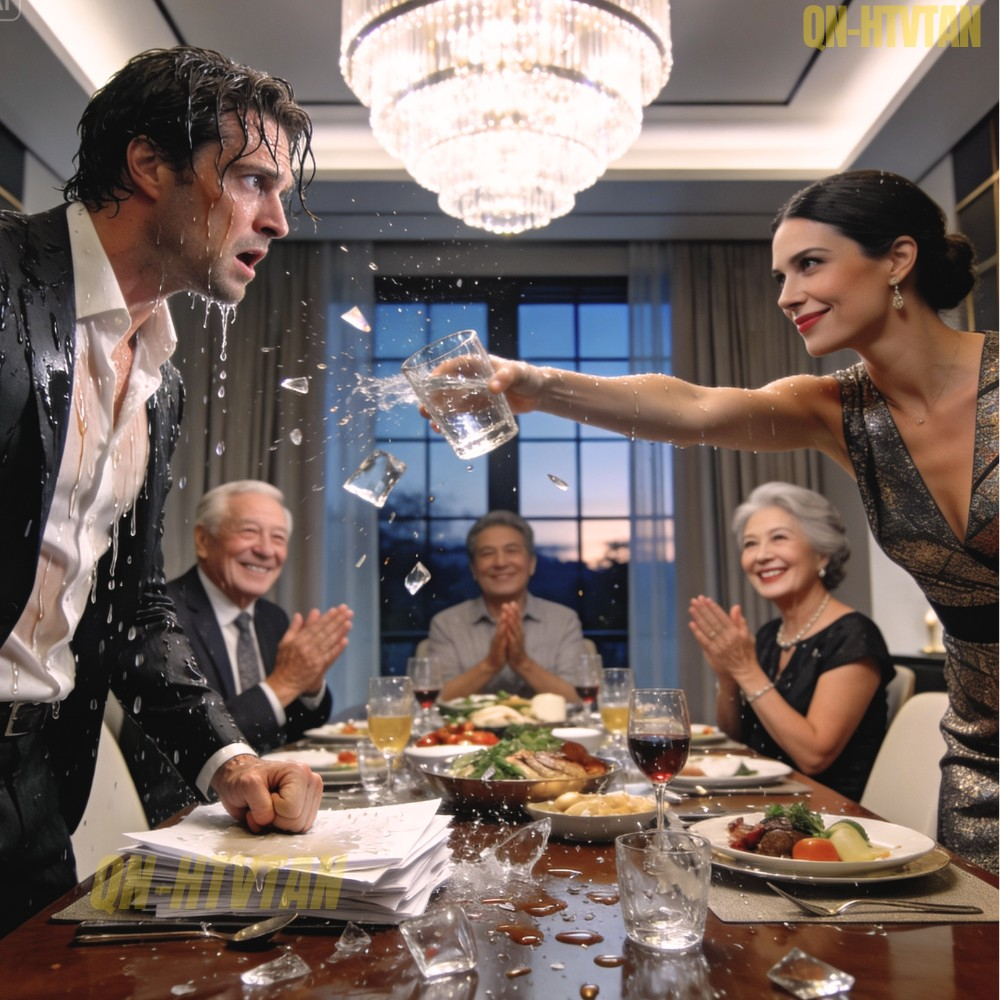
At Family Dinner My Sister Poured Water Over My Head And Sneered “You Have 5 Minutes To Leave My House” – My Parents Nodded Eagerly Clapping In Support… I Just
The invitation came through a group text, as if it were any other casual family gathering. “Dinner at my place this Saturday,” Madison wrote. “It’s been too long. Mom’s making her famous roast. Let’s all catch up.”
I knew what it really was—a performance. Every Reynolds family dinner was a stage play. A polished dining table, an expensive bottle of wine, and a script everyone followed. Smiles that didn’t reach the eyes. Jokes rehearsed, affection manufactured. My sister loved controlling the spotlight, and this dinner would be no different.
Except this time, I wasn’t coming as an extra in her show.
When Saturday came, the evening sky was already bruising dark by the time I parked outside her mansion—a modern glass-and-steel palace that screamed wealth and power. It sat high on the hill overlooking the city, the kind of home that made people believe the Reynolds name still meant prestige. But to me, it was a monument built on lies.
The door opened before I could knock. Madison stood there in a silk blouse and diamond earrings, the kind of effortless glamour she wielded like a weapon. “You’re late,” she said flatly, her eyes scanning me up and down.
“Traffic,” I replied.
She stepped aside, letting me in. The smell of rosemary and roasted beef filled the air. Everything was perfect—of course it was. The table was set for six, each place marked by engraved silver name cards. My parents sat at one end, already sipping wine. My father, Frank, in his usual navy suit even at home. My mother, Diane, in pearls and lipstick the color of blood.
“Gordon,” my father said without looking up from his glass. “Good of you to join us.”
Mom smiled faintly. “You look thin. Are you eating properly?”
The usual greetings. Cold concern disguised as conversation. I nodded, forcing a polite smile. “Nice to see you too.”
We ate in a silence that wasn’t really silence—just tension disguised as civility. Madison led most of the conversation, filling the air with updates about the company, upcoming projects, and charity galas. My father beamed with pride every time she spoke. I mostly pushed food around my plate, waiting for the right moment.
I wasn’t sure what I’d expected—that maybe they’d sense something different about me tonight, some quiet power behind my calm. But to them, I was still the disappointing son. The one who’d refused to join the family empire. The one who’d “wasted” his potential outside the Reynolds legacy.
When dessert came, Madison stood and clinked her glass. “Before we dig into Mom’s pie,” she said with that sharp smile that always meant she was about to humiliate someone, “I think it’s time we addressed the elephant in the room.”
I looked up, feigning confusion. “What elephant?”
“You’ve been asking around about the company,” she said, her tone light but her eyes narrowing. “Reaching out to old employees. Requesting financial records. Care to explain why you’re snooping around your own family’s business?”
I felt my chest tighten. So she knew.
“Just doing some research,” I said evenly. “I’ve been hearing things.”
“Research?” She laughed, but there was no humor in it. “That’s a cute word for betrayal.”
Mom’s fork clattered against her plate. “Gordon, please tell me you’re not entertaining those ridiculous rumors. People love tearing down successful families. You know that.”
My father leaned forward, his face darkening. “You’re out of line, son. We’ve worked too hard to build this company for you to come sniffing around like a tabloid reporter.”
I let their outrage wash over me, feeling strangely calm. “You’re right,” I said quietly. “You did work hard. And so did the inspectors you bribed, the shell companies you created, and the bookkeepers you fired when they wouldn’t alter numbers.”
The room froze.
Madison’s smile faltered, but only for a second. Then she picked up her wine glass, her hand trembling slightly. “You have no idea what you’re talking about.”
“Oh, I do,” I said. I reached into my jacket and placed a thick manila envelope on the table. “These are copies of invoices, tax records, and email correspondence linking Reynolds Properties to systematic fraud and falsified safety certifications. I’ve got the originals secured with my lawyer.”
My father’s knuckles went white around his wine glass. “You brought this… here?”
“Yes,” I said. “Because I wanted to give you one chance. One chance to make this right before it goes further.”
Madison laughed again, this time sharper. “Make it right? Gordon, you think you can walk into my house and accuse me—accuse us—of crimes based on whatever fantasy you’ve constructed in that paranoid head of yours?”
“Fantasy?” I pushed the envelope toward her. “Then you won’t mind proving me wrong.”
She stared at it, jaw tight. My mother reached out, her voice trembling with forced calm. “Honey, please. We don’t air family matters like this. Not here. Not ever.”
I turned to her. “A young couple and their baby died in a fire because of faulty wiring your company approved to save money. That’s not a family matter, Mom. That’s manslaughter.”
My father slammed his hand down on the table. “Enough!”
The sound echoed through the room. “You ungrateful little—after everything we’ve given you! You think you’re some kind of hero because you’ve been digging through numbers you don’t understand?”
I met his glare. “I understand them perfectly. And so will the IRS.”
For a moment, the only sound was the ticking of the grandfather clock in the corner. Madison’s face had gone still, her mask slipping. I could see the fury building behind her eyes.
Then she stood slowly, grabbed her glass of water, and—without a word—threw it across the table.
It hit me square in the face, cold and shocking. Water dripped from my hair, down my collar, onto the carpet. She smiled.
“You have five minutes to leave my house,” she said. Her voice was low, deliberate. “Before I have you dragged out.”
My father clapped his hands once, hard. “You heard her.”
Mom joined in, nodding, almost gleeful. “You’ve embarrassed this family enough.”
I stood there, soaked and silent, watching the three of them—my parents applauding their favorite child for humiliating me, Madison standing tall like a queen defending her throne. The perfect Reynolds tableau.
And then I smiled.
It wasn’t defiance exactly. It was something colder, deeper. The kind of smile that comes from knowing you’ve already won a battle the others don’t even realize has started.
I picked up the envelope and wiped a droplet of water from its edge. “You might want to watch the news next week,” I said softly. “There’s a story airing about Reynolds Properties. Should be… enlightening.”
Madison’s expression flickered—just for a second—but I saw it. Fear.
Continue below

My name is Gordon, 32 years old, and I never thought my own family would betray me like this. That fateful dinner at my sister Madison’s house changed everything. I can still feel the cold water dripping down my face as she sneered those words at me. What she didn’t know was that I came prepared for war, not reconciliation.
The look on their faces when I pulled out those documents still brings me satisfaction today. Before I begin my story, let me know where you’re watching from in the comments. Hit that like button and subscribe for more stories about standing up against family injustice. I was born into the Reynolds family, a name synonymous with real estate development in our city.
Our family business, Reynolds Properties, has been around for three generations, building everything from office complexes to luxury apartments. My father, Frank, started working for my grandfather when he was just 16, learning the ropes from the ground up before taking over the company in his 30s.
My mother Diane came from money too. Her family owned several successful restaurants across the state. They met at a charity gala, married within 6 months, and their union was as much a business merger as a marriage. Madison came first, the golden child born 7 years before me. From the moment I can remember, she was being groomed to take over Reynolds properties.
Our parents spared no expense on her education, sending her to private schools, prestigious summer camps, and eventually an Ivy League university where she double majored in business and real estate development. Her bedroom walls weren’t decorated with posters of musicians or actors like other kids, but with framed certificates, academic awards, and eventually her business school diploma.
By contrast, I was always the afterthought. Don’t get me wrong, I had all the material comforts a kid could want, but emotional support was scarce. My father barely made it to any of my school events. And when he did, he’d spend most of the time on his phone closing deals. My mother was physically present, but emotionally distant, more concerned with maintaining appearances than nurturing her son.
Gordon, stand up straight. Gordon, that’s not how a Reynolds behaves. Gordon, why can’t you be more like your sister? The constant comparisons to Madison were a soundtrack to my childhood. While Madison embraced the family legacy with open arms, I found myself pulling away. I developed different interests, gravitating toward finance and investment rather than property development.
I loved the analytical aspects, the market trends, the way money could work for you if you understood the systems. My father saw this as a rejection of his life’s work. Properties are tangible, he’d say dismissively. You can see them touch them. This investment stuff is all smoke and mirrors. By the time I graduated from college with my finance degree, the dye was cast.
Madison was already a vice president at Reynolds Properties with her own corner office and team of employees. I was expected to join the company too, despite my different educational path, but I refused. I wanted to build something of my own to prove my worth outside the family shadow. That decision created the first major rift between us.
My parents couldn’t understand why I’d turned down a guaranteed position in a successful company. Madison took it personally, as if my choice was a direct criticism of hers. The day I told them I’d accepted a position at a small investment firm instead, my father didn’t speak to me for 3 months.
The next few years were tough. While Madison’s career soared at Reynolds Properties, eventually taking over as CEO when our father semi-retired, I struggled. The investment firm I joined went under during the financial crisis, and I bounced between jobs for a while, trying to find my footing. Each family gathering became an exercise in humiliation with subtle and not so subtle digs at my career choices.
“How’s the job hunt going, Gordon?” My mother would ask loudly enough for everyone to hear, even during periods when I was employed. Through it all, I kept working, learning, building my knowledge and connections. 5 years ago, I finally established my own financial consulting business.
It was small at first, just me working out of my apartment, but I gradually built a client base. I specialized in helping small business owners optimize their finances, establish retirement plans, and navigate tax regulations. It wasn’t glamorous or hugely profitable like Reynolds properties, but it was honest work that helped real people.
The real turning point came about 8 months ago. One of my clients, a contractor who had worked on several Reynolds properties developments, came to me with concerns about some financial irregularities he’d noticed while working with them. At first, I dismissed it as a misunderstanding or sour grapes from a disgruntled contractor, but he showed me copies of invoices and payment records that didn’t add up.
As a financial professional, the discrepancies were obvious to me once I saw the paperwork. That night, I couldn’t sleep. Part of me wanted to ignore what I’d seen to pretend the documentation had never crossed my desk. These were my family’s business dealings, after all. And despite our differences, I had no desire to cause them harm.
But another part of me, the professional who had built his reputation on integrity and attention to detail, knew I couldn’t just look away. The next morning, I made the decision that would eventually lead to that fateful dinner. I would investigate quietly, discreetly to determine if there really was something unethical happening at Reynolds properties.
If it turned out to be nothing no one would ever need to know, I’d looked into it. But if my suspicions were confirmed, I would have some difficult choices to make. I had no idea then that my investigation would uncover a decadesl long pattern of fraud that would ultimately tear my family apart. And I certainly never imagined that it would culminate in my sister pouring water over my head at her dining room table while my parents applauded her actions.
The investigation began innocuously enough. I started by reviewing public records of Reynolds properties developments, cross-referencing them with tax filings and building permits that were available through public databases. Nothing seemed a miss at first glance, but something felt off about the timing of certain projects and the reported costs.
I needed more information, but I had to be careful. If my family caught wind of what I was doing, they’d shut me out completely before I could determine if there was any actual wrongdoing. I decided to reach out to someone I trusted, someone with access to information I couldn’t easily obtain. Bradley Turner and I had been friends since college.
We’d lost touch for a few years, but reconnected at our 10-year reunion. He now worked for the Internal Revenue Service in a division that handled tax audits for businesses. One night over drinks, I casually mentioned some general concerns about a client who suspected financial irregularities at a company they were considering investing in.
“What kind of irregularities are we talking about?” Bradley asked, swirling his whiskey. I described some of the patterns I’d observed in Reynolds properties public filings, careful not to name the company. Bradley’s expression grew serious. That sounds like potential tax fraud, Gordon. If your client has evidence, they should report it.
But what if it’s a family business? What if reporting it means destroying relationships that can never be repaired? Bradley studied my face for a long moment before setting down his glass. This isn’t about a client, is it? This is about Reynolds properties. I couldn’t lie to him. I nodded slowly. Jesus Gordon, your family’s company.
He ran a hand through his hair. Look, I can’t officially help you investigate your family. That would be a massive conflict of interest and probably illegal, but I can tell you what to look for, what documents would provide conclusive evidence if there really is fraud happening. Over the next few weeks, Bradley educated me on common tax evasion schemes used in real estate development.
Armed with this knowledge, I began digging deeper. I contacted former employees of Reynolds properties under the guise of networking carefully steering conversations toward company practices. Most were hesitant to say anything negative, but a few dropped hints about questionable accounting methods. I spent countless nights hunched over my laptop, cross-referencing data, following paper trails, and documenting everything meticulously.
The more I uncovered, the more disturbed I became. Reynolds properties had been systematically under reporting income and inflating expenses for at least 15 years. They had created shell companies to hide assets and avoid taxes. They had bribed building inspectors to overlook code violations.
And Madison, my perfect older sister, wasn’t just complicit. She was an architect of much of the fraud. One particularly revealing discovery came from a former bookkeeper who had been fired 3 years earlier. She contacted me after hearing through mutual connections that I was asking questions about the company’s financial practices.
They fired me because I refused to falsify records. She told me over coffee, her hands shaking slightly as she slid a flash drive across the table. I kept copies of the real books and the altered ones. I always knew someday someone would need to see them. The evidence on that drive was damning. It showed millions of dollars in unreported income systematic tax evasion.
and what appeared to be money laundering through various shell corporations. My father’s name was all over the older documents, but in more recent years, Madison’s signature appeared with increasing frequency. As the evidence mounted, I found myself facing an impossible moral dilemma. Should I confront my family directly, giving them a chance to explain or make amends? Should I report what I’d found to authorities potentially sending my parents and sister to prison? or should I destroy the evidence and try to forget what I discovered? I barely slept during
this period. I lost weight. Friends commented on my distracted demeanor and the dark circles under my eyes. I kept replaying memories from my childhood, searching for some justification to protect my family despite their crimes. I remembered my 8th birthday when my parents missed my party because they were closing an important deal.
I remembered my high school graduation when my father spent the ceremony on his phone and left immediately afterward for a business dinner. I remembered the time I lost my job during the financial crisis and asked for a temporary loan to cover my rent only to have my father lecture me about fiscal responsibility and suggest I move back home and work for the family company instead.
I also thought about the small business owners I worked with everyday, honest people who struggled to make ends meet while paying their taxes in full. People who played by the rules and often barely scraped by while my family lived in luxury built on fraud and deception. The turning point came when I discovered something truly unforgivable.
Among the projects Reynolds properties had developed was an apartment complex where corners had been cut on safety measures to save money. 3 years after construction, a fire broke out due to faulty wiring that hadn’t been properly inspected. A young couple and their infant son died in that fire. The official investigation placed blame on the electrical subcontractor who was properly insured, saving Reynolds properties from liability.
But the documents I found showed that Madison and my father had known about the substandard materials and had pressured inspectors to overlook the violations. That night, I made my decision. I would confront my family with the evidence I had gathered. I would give them one chance to take responsibility for their actions to make amends to turn themselves in.
If they refused, I would report everything I had found to the proper authorities. I spent another week organizing the evidence, making copies, and securing the documents with my lawyer. I wrote a detailed account of everything I had discovered and sent it to myself in a sealed email scheduled to be sent to federal authorities if anything happened to me.
Then I called my sister and asked if we could have a family dinner at her house. I told her I had something important to discuss with everyone. Is everything okay, Gordon? She asked a note of genuine concern in her voice that made what I was about to do even harder. Everything’s fine, I lied.
I just have some news I want to share with everyone together. She suggested the following Saturday, and I agreed. As I hung up the phone, I felt a strange calm settle over me. After months of investigation and agonizing over my decision, I was finally going to act. Whatever happened at that dinner would forever change my relationship with my family.
But I knew I was doing the right thing. I had no idea just how ugly that confrontation would become. Saturday arrived with an unseasonable chill in the air. I dressed carefully in a charcoal suit, professional serious armor against what was to come. The leather briefcase containing the documents felt unusually heavy as I carried it to my car.
Inside were organized files detailing 15 years of fraud, tax evasion, bribery, and cover-ups. The weight of those papers represented more than just evidence. It was the burden of betrayal, both by my family and from their perspective by me. Madison lived in a sprawling colonial in the most exclusive neighborhood in town.
The house was a testament to Reynolds property’s success with its manicured lawn circular driveway and imposing columns flanking the entrance. As I pulled up, I noticed my parents’ Mercedes already parked in the driveway. They were always punctual, a business practice my father had turned into a family virtue.
I sat in my car for a few extra minutes rehearsing what I would say, how I would present the evidence, how I would respond to their inevitable anger and denials. My hands were shaking slightly as I picked up the briefcase and walked to the door. Madison answered my knock with a smile that seemed genuinely warm. She wore an elegant black dress hair, perfectly styled makeup, flawless as always.
The picture of success and sophistication. Gordon, come in. Come in. Mom and dad are already in the living room having drinks. She hugged me and I forced myself to return the embrace, feeling like the worst kind of Judas. For a fleeting moment, I considered turning around, getting back in my car, and driving away, destroying all the evidence and pretending I’d never discovered the truth.
But the memory of that young family who had died in the fire strengthened my resolve. Madison’s home was a showcase designed to impress with its soaring ceilings, marble floors, and tasteful artwork. Everything gleamed with polish and privilege. I followed her through the foyer into a spacious living room where my parents sat on a cream colored sectional sofa, drinks in hand.
My father stood as I entered his 6-ft frame, still imposing despite his 68 years. His handshake was firm business-like. Son, he said with a nod. Not good to see you, or how have you been? Just son, an acknowledgement of biological connection without warmth. My mother was more demonstrative, rising to kiss my cheek, her expensive perfume enveloping me momentarily.
Gordon, darling, you look thin. Are you eating properly? The question wasn’t really about my well-being. It was a subtle dig, implying I couldn’t properly care for myself, that my life choices had led to some kind of deprivation. I’m fine, mother. Just been busy with work. Oh, my father perked up at this business picking up finally.
Those small clients of yours actually paying decent fees now. The dismissive tone was familiar, but knowing what I now knew about how Reynolds Properties had built its wealth made it even more gling. I swallowed my irritation. My practice is doing well. Yes. What can I get you to drink? Madison interrupted, playing the perfect hostess. Just water, thanks.
I want to keep a clear head tonight. My father raised an eyebrow at this, but said nothing. My mother filled the silence with chatter about mutual acquaintances, charity events, and the country club renovations. I nodded at appropriate intervals. My mind elsewhere, the briefcase resting against my leg like a live thing.
After what seemed like an eternity of small talk, Madison announced dinner was ready. We moved into the formal dining room where a table that could comfortably seat 12 was set for our small family of four. Crystal glasses, fine china, and sterling silver utensils gleamed under a chandelier that probably cost more than my annual income.
The first course was served a delicate butternut squash soup that I barely tasted. The conversation continued to drift around superficial topics, everyone carefully avoiding anything substantive. This was typical of our family gatherings. Maintain appearances, keep things pleasant on the surface, never dig too deep into feelings or concerns.
So Gordon, my father said, as the main course was served, Madison mentioned you had some news to share, a new client, perhaps or have you finally met someone worth introducing to the family? The moment had come sooner than I expected. I placed my fork down carefully beside my barely touched filet minan. Actually, it’s about Reynolds properties.
The air in the room shifted immediately. My mother’s hand froze halfway to her wine glass. Madison’s eyes narrowed slightly. My father’s expression hardened. “What about the company, Madison?” asked her voice carefully controlled. “I’ve been doing some research.” I began choosing my words carefully, looking into the company’s financial practices, its tax filings, its building safety records.
Why would you be investigating our company? My father’s voice was dangerously quiet. I met his gaze steadily. It started with some discrepancies that were brought to my attention by a contractor who worked with Reynolds Properties. The more I looked into it, the more problems I found.
Madison laughed, but it sounded forced. Oh, Gordon, always the dramatic one. If you had concerns, why didn’t you just ask me or Dad? Why go sneaking around behind our backs? Would you have told me the truth about the tax evasion? The bribes to building inspectors, the shell companies used to hide assets? With each question, I watched their faces. My mother palded.
My father’s jaw tightened. Madison’s smile became fixed unnatural. I don’t know what you think you found, my father said. But you’re clearly confused. Reynolds properties is run with the highest ethical standards. Is that so? I reached for the briefcase by my feet because I have documentation that suggests otherwise.
15 years of evidence showing systematic fraud. Madison stood abruptly, her chair scraping loudly against the hardwood floor. I think you should leave, Gordon. This is beyond inappropriate. I’m not leaving until we discuss this. I insisted keeping my voice level. I’m giving you a chance to explain to make this right.
Make what right? Some imagined crimes you’ve invented because you’re jealous of our success. Madison’s voice rose. You’ve always resented me. Resented dad because you couldn’t measure up. This isn’t about jealousy, Madison. It’s about criminal behavior that has hurt people. Real people. I turned to my father. Like the Carson family who died in the fire at the West View Apartments because you cut corners on electrical work. My mother gasped.
My father’s face went from red to white in an instant. “You have no idea what you’re talking about,” he whispered. “I have copies of the original inspection reports before they were altered. I have emails between you and Madison discussing how to pressure the inspector to overlook the violations.” “I have everything, Dad.
” Madison walked around the table toward me, her movement stiff with rage. “Who do you think you are? You contribute nothing to this family, yet you sit in judgment of us. We built something magnificent while you floundered from one mediocre job to another. I stayed seated, forcing myself to remain calm despite my racing heart. I built something honest.
Can you say the same? That’s when it happened. Madison picked up a crystal picture of ice water from the table and poured it directly over my head. The cold was shocking water streaming down my face, soaking my suit dripping onto the polished floor. “You have 5 minutes to leave my house,” she hissed, her face inches from mine, distorted with fury.
To my astonishment, my parents began to applaud. My father actually smiled, nodding in approval at Madison’s action. My mother joined in, clapping delicately as if at a theater performance. “Well done, Madison,” my father said. “It’s about time someone put him in his place.
” I sat there, water dripping from my hair, my expensive suit ruined, facing the united front of my so-called family. In that moment, any remaining doubts I had about what I needed to do vanished completely. The water was ice cold against my scalp, trickling down my spine and soaking through my shirt. Time seemed to slow as droplets fell from my chin onto the pristine tablecloth.
Each one a small punctuation mark in this unfolding family drama. I could feel their eyes on me, expecting me to storm out in humiliation or perhaps to explode in anger, giving them more ammunition to dismiss me as unstable and unreliable. I did neither. Instead, I calmly reached for a cloth napkin and methodically dried my face, maintaining eye contact with Madison the entire time.
The smug satisfaction in her eyes began to falter slightly at my composed reaction. This wasn’t the script she had written for this confrontation. “Is this how the mighty Reynolds family handles criticism?” I asked quietly, my voice steady, despite the adrenaline coursing through my veins with childish tantrums and physical aggression.
“How professional! You dare talk to us about professionalism when you’ve been sneaking around spying on your own family?” Madison’s voice rose an octave, the control she prided herself on starting to slip. My father stood now pointing a finger at me. Your sister is right. You have no right to come into our homes, eat at our table, and then accuse us of crimes.
If you have such disdain for how Reynolds properties operates, you should have just stayed away entirely. That’s rich coming from you, Dad. You’re the one who taught me about the importance of integrity. Remember all those lectures about how a man’s word is his bond, how reputation is everything in business? I shook my head, water droplets flying from my still soaked hair.
Was it all just talk, or did those principles only apply to everyone else, not to the Almighty Reynolds family? My mother, who had remained largely silent until now, suddenly spoke up. Gordon, darling, I think you’re working too hard. Perhaps you’re having some sort of breakdown. We can get you help the best doctors. I don’t need doctors, mother, I interrupted.
What I need is for my family to take responsibility for their actions. Madison laughed a harsh, brittle sound. Responsibility? That’s rich coming from you. When have you ever taken responsibility for your failures? Always blaming us because you couldn’t hack it in the real business world. Madison’s right. My father chimed in.
We offered you everything. Education, opportunities, connections, and you threw it all away because your ego couldn’t handle working under your sister. and now you come here with these ridiculous accusations. This is nothing but petty revenge. I looked at each of them in turn, these people who shared my blood but were suddenly strangers to me.
The realization was both painful and freeing. They would never acknowledge what they had done. They would never change. They would continue to justify their actions to believe themselves above the law, above common decency. 5 minutes. Gordon Madison reminded me, glancing ostentatiously at her watch. The clock is ticking.
That’s when I reached for my briefcase. The leather was cool and smooth under my fingers as I placed it on the table and clicked open the locks. The sound was crisp definitive in the tense silence of the dining room. Actually, I said, pulling out a thick stack of neatly organized documents. You’re the ones running out of time.
The atmosphere in the room shifted immediately. My mother’s smug smile faltered. My father’s face flushed with anger just moments before began to pale. Madison took an involuntary step back. “What is this?” she demanded, but I could hear the first note of uncertainty in her voice. I spread the documents on the table, careful to avoid the water puddles from Madison’s little display.
This is 15 years of evidence documenting tax fraud, bribery, money laundering, and criminal negligence. every transaction, every false report, every bribed official, all meticulously documented and cross-referenced. I turned to a specific page and pointed, “Here’s where you created a shell company to hide assets from the IRS. I flipped to another section.
Here are the real versus the reported expenses for the Riverside development, showing over $3 million in unreported income.” Another page. And here’s the smoking gun emails between you and dad discussing how to falsify inspection reports for the West View Apartments, the building where the Carson family died. Those are confidential company documents.
My father spluttered. You had no right. I had every right as a citizen to report criminal activity. I cut him off. And as your son, I had every moral obligation to give you a chance to come clean before I turned these over to the authorities. Madison lunged for the papers, but I was quicker sliding them back into the briefcase and snapping it shut.
I have copies, of course, multiple copies stored in various secure locations. My lawyer has a complete set with instructions to release them to the FBI, the IRS, and the district attorney’s office if anything happens to me. You’re bluffing, Madison said. But the tremor in her voice betrayed her uncertainty. I smiled for the first time that evening, a cold, humorless smile that felt foreign on my face.
Am I? You really want to test that theory? Because copies of these documents are scheduled to be delivered to the authorities tomorrow morning unless I personally cancel that delivery. So, yes, Madison, you’re right about one thing. Time is running out, but not for me. I stood briefcase in handwater still dripping from my ruined suit.
You’ve only got about 5 minutes left to pray that I might change my mind. But given the welcome I’ve received here tonight, I wouldn’t count on divine intervention. The color had drained completely from my mother’s face. My father, the man who had loomed so large throughout my childhood, suddenly looked small, diminished by the weight of his exposed crimes.
You wouldn’t do this to your own family, he said. But it sounded more like a plea than a statement. You stopped being my family long before tonight,” I replied, surprised by how little emotion I felt saying those words. “A real family supports each other, respects each other, holds each other to a higher standard. What we have is a biological connection and a shared last name, nothing more.
” “Gordon, please.” My mother finally spoke her voice barely above a whisper. “Think about what this will do to us to the Reynolds name. I have thought about it, mother, for months. I’ve thought about nothing else, and I’ve decided that the truth matters more than protecting people who have shown me nothing but contempt, who have built their fortune on lies and the suffering of others.
Madison, always quick to recover, switched tactics. Her face softened, and she took a step toward me, hand outstretched. Gordon, let’s talk about this reasonably. I’m sure we can come to some arrangement that satisfies everyone. There’s no need to do anything rash. I recognized the expression. It was the same one she used when negotiating with contractors.
A calculated blend of charm and implied threat. It might have worked on someone who hadn’t grown up watching her perfect this technique. An arrangement I repeated. You mean a bribe? That’s your solution to everything, isn’t it? Throw money at problems until they go away. But I’m not for sale, Madison. Not everyone can be bought. Name your price.
My father interjected businessman to the end. Everyone has one. I looked at him with something approaching pity. That’s where you’re wrong, Dad. Some things aren’t negotiable. Integrity, justice, the truth. You taught me that once before. I realized they were just words to you, not principles you actually lived by.
I checked my watch, deliberately mirroring Madison’s earlier gesture. Your 5 minutes are almost up. I’ll be going now. I suggest you spend what little time you have left getting your affairs in order and contacting your lawyers. You’re going to need them.” And with that, I turned and walked toward the door, half expecting someone to try to stop me physically, but no one moved.
The silence behind me was absolute broken, only by the soft sound of my mother beginning to cry. As I reached the foyer, Madison finally found her voice again. “You’ll regret this.” She called after me a desperate edge to her words. When this is all over, you’ll have nothing and no one. You’re dead to us. Do you hear me? Dead. I paused at the front door and looked back at them one last time.
My father standing rigid with shock and fury. My mother collapsed in a chair with tears streaming down her face. Madison trembling with rage. I’ve been dead to you for years, I said quietly. The difference is now I know it. Then I walked out into the cool night air, climbed into my car, and drove away from the house, the family, and the lies that had defined my life for too long.
I felt neither triumph nor sadness, just a profound exhaustion, and the certainty that I had crossed a point of no return. Tomorrow, everything would change for the Reynolds family, and for the first time in my life, I would be charting my own course, unbburdened by their expectations and untainted by their corruption.
The next 24 hours passed in a blur. True to my word, I didn’t cancel the delivery of documents to the authorities. By 9:00 the following morning, copies of everything I had collected were in the hands of the FBI, the IRS Criminal Investigation Division, and the District Attorney’s Office. I had spent the night in a hotel. My phone turned off, isolating myself from the inevitable backlash.
When I finally turned my phone back on around noon, it exploded with notifications. 27 missed calls from Madison, 15 from my father, 12 from my mother, dozens of text messages ranging from threats to desperate pleas for a meeting. I deleted them all without reading beyond the previews. There was also a voicemail from Bradley at the IRS.
Gordon, what the hell have you done? The office is buzzing about a major case just opened against Reynolds properties. Call me as soon as you can. I didn’t call him back. Not yet. I needed time to process what was happening to prepare myself for the storm that was about to break over my life.
I checked out of the hotel and drove to a small coffee shop on the other side of town, someplace my family would never think to look for me. I had just ordered when my phone rang with an unknown number. Against my better judgment, I answered, “Mr. Reynolds, this is special agent Carla Martinez with the FBI. We’ve received your documentation regarding Reynolds properties and would like to meet with you as soon as possible.
” The meeting was set for 3:00 that afternoon. I arrived at the federal building 15 minutes early, clutching a briefcase containing the original documents. Security was tight, and I felt strangely exposed as I was escorted to a conference room on the fourth floor. Three people waited for me. Special Agent Martinez from the FBI, a stern-faced man who introduced himself as Richard Thornton from the IRS Criminal Investigation Division, and Assistant District Attorney James Wilson.
They asked me to walk them through everything I had discovered, interrupting occasionally with clarifying questions. I spoke for nearly 2 hours, my throat going dry, as I laid out the extent of my family’s crimes. You understand that this will likely result in criminal charges against your father, your sister, and possibly your mother as well? Ada, Wilson asked when I had finished.
Yes, I said simply, and you’re prepared to testify against them if necessary. I hesitated only briefly before nodding. Yes, Agent Martinez studied me with a mixture of respect and suspicion. May I ask why you’ve chosen to come forward now, Mr. Reynolds? These activities have been going on for 15 years by your own account. I only discovered the extent of it recently, I explained.
Once I knew I couldn’t be complicit by remaining silent. “Even though it’s your own family,” Thornon asked. “Especially because it’s my family,” I replied. “They taught me about responsibility and integrity, then failed to live up to those values themselves. Someone had to hold them accountable.” They nodded, seemingly satisfied with my answer.
As the meeting concluded, Martinez handed me her card. “There will be significant blowback from this, Mr. Reynolds. If you receive any threats or feel unsafe in any way, call me immediately. I hadn’t even reached my car when my phone rang again. This time it was my lawyer, Michael Prescott. Gordon, I just got a call from Lawrence Deming.
Deming was my father’s attorney, a shark in an expensive suit who had represented Reynolds properties for decades. They want to arrange a meeting tonight if possible. What for? They claim they want to discuss a resolution that would benefit all parties. I strongly advised against meeting without me present. I considered this for a moment.
Set it up, but I choose the location and you’ll be there. We agreed on Michael’s office at 8:00 that evening. I spent the intervening hours in a state of hypervigilance, jumping at every sound, checking my rear view mirror constantly as I drove around the city with no particular destination in mind. I wasn’t sure if I was more afraid of confronting my family again or of being alone with my thoughts.
8:00 arrived with brutal swiftness. I arrived at Michael’s downtown office to find my father’s black Mercedes and Madison’s Range Rover already parked outside. Michael met me in the lobby, his expression grave. They brought the heavy artillery. He warned me. Lawrence Deming and Patricia Schultz.
Schultz was one of the top criminal defense attorneys in the state, known for representing white-collar criminals. “They’ve been here for 15 minutes, already trying to intimidate me with legal jargon and thinly veiled threats.” “Let them try,” I said with more confidence than I felt. The conference room was tense with unspoken hostility when we entered.
My father sat at the far end of the table, looking older than I had ever seen him. Madison sat to his right, her face a mask of controlled fury. Their attorneys flanked them like bodyguards. Gordon, my father, acknowledged me with a curt nod. I took a seat opposite them, Michael beside me. Let’s skip the pleasantries, I said.
Why did you want this meeting? Lawrence Deming cleared his throat. My clients believe there’s been a serious misunderstanding. The documents you’ve provided to authorities have been taken out of context or misinterpreted. I laughed without humor. Is that the defense you’re going with? Good luck explaining the shell companies and falsified inspection reports as a misunderstanding.
Gordon Madison leaned forward, her voice honeyed with fake sincerity. We’re your family. Why are you doing this to us? I think the water you poured over my head last night answered that question pretty definitively, don’t you? Her smile faltered. I was upset. You blindsided us with those accusations which you knew were true. Mr.
Reynolds Patricia Schultz interjected smoothly. What exactly do you hope to accomplish with these allegations? Surely destroying your family’s company and reputation isn’t your goal. My goal is justice, I replied simply. For the people who died in that fire. For the taxpayers who picked up the slack while Reynolds properties evaded millions in taxes.
for everyone who played by the rules while my family decided they were above them. My father slammed his hand on the table. Enough of this sanctimonious garbage. You want money? Fine. Name your price. 10 million 20. We can make it happen tonight. Wire the funds to any account you specify. Just call off the dogs and hand over all copies of those documents.
Michael started to speak, but I raised a hand to stop him. I stared at my father, this man who had loomed so large in my imagination for my entire life and felt nothing but pity. You still don’t get it, do you? This isn’t about money. It was never about money. Then what Madison demanded? Revenge because we didn’t praise you enough because the company went to me instead of you.
It’s about doing the right thing, I said quietly. Something that seems to be a foreign concept in this family. The right thing, my father scoffed. Do you have any idea what you’ve done? The company will be destroyed. Hundreds of employees will lose their jobs. Our family name will be ruined forever.
Is that your idea of right? You did this, not me, I countered. Every time you bribed an inspector, every time you falsified a tax return, every time you chose profit over safety, you’re the architects of this disaster, not me. The meeting devolved quickly after that. Threats were made legal and otherwise. Madison called me every name she could think of.
My father alternated between rage and attempted manipulation. Their attorneys tried repeatedly to steer the conversation towards some kind of settlement. Through it all, I remained calm, refusing to engage with their emotions or to consider any deal that would involve withdrawing the evidence. After an hour of getting nowhere, they finally gave up.
As they gathered their things to leave, my father paused beside my chair. “You’re no longer my son,” he said, his voice low and trembling with rage. “If I pass you on the street, I won’t acknowledge you. If you’re dying in a hospital, I won’t visit. You are dead to this family from this moment forward.” I looked up at him, this stranger who had given me life, but little else.
“I can live with that,” I said. They filed out of the room. Madison pausing at the door to deliver a parting shot. You think you’ve won, but you’ve lost everything, Gordon. When this is all over, you’ll have nothing and no one. After they left, Michael poured us each a generous whiskey from the bottle he kept in his credenza. “You okay?” he asked, concern evident in his voice.
I considered the question carefully before answering. “No,” I admitted. But I will be. That night alone in my apartment, I finally allowed myself to feel the full weight of what I had done. The grief hit me in waves, not for the relationships I had lost, which had been broken long before this confrontation, but for the family I had never really had.
For the father who had never seen my worth, the mother who had never truly known me, the sister who had viewed me as competition rather than kin. I cried until there were no tears left, then fell into an exhausted sleep, still wearing my clothes. When I woke the next morning, something had shifted inside me.
The grief was still there, but alongside it was a strange, fragile sense of freedom. For the first time in my life, I was completely untethered from the Reynolds legacy, from their expectations and judgments. I was alone, yes, but I was also finally free. The aftermath unfolded with the inexurable logic of a mathematical proof.
Actions had consequences, and my family’s actions had finally caught up with them. 3 days after I provided the evidence to authorities, the FBI and IRS conducted simultaneous raids on the Reynolds property’s headquarters and three other locations, including my parents’ home and Madison’s house. The local news carried footage of agents carrying out boxes of documents and computers, while reporters speculated about the nature of the investigation.
By the end of the week, formal charges had been filed against my father, Madison, and two other executives at the company. The list was extensive tax fraud, money laundering, wire fraud, bribery of public officials, and criminal negligence resulting in death. My mother was named as a person of interest, but not immediately charged.
The story dominated local media and even made national business news. Reynolds properties empire crumbles amid fraud allegations, read one headline. Family whistleblower exposes years of corporate corruption, proclaimed another. I stopped reading after the first few days. The satisfaction I had anticipated feeling never materialized, replaced instead by a hollow ache and the constant nagging question, had I done the right thing? The personal fallout was immediate and severe.
My phone became a weapon deployed against me, delivering venomous messages from extended family members who blamed me for destroying the family legacy. Cousins I had grown up with blocked me on social media. My mother’s sister called me in tears, asking how I could do this to my own blood. I had no answer that would satisfy her or anyone else who saw my actions as betrayal rather than justice.
Even more difficult were the calls from Reynolds Properties employees, people whose livelihoods were now in jeopardy. Some were understanding, acknowledging that the company’s leadership had brought this on themselves. Others were furious, seeing me as the villain who had endangered their jobs out of spite or jealousy. One call in particular haunted me.
Lisa Parker had been my father’s assistant for 20 years. I had known her my entire life. She had sent me birthday cards every year, even during periods when my father and I weren’t speaking. I always thought you were different, Gordon, she said, her voice tight with emotion. I defended you when your father complained about your choices, and now I find out you’ve been working against us all this time. Not against you, Lisa.
I tried to explain against the illegal activities, the fraud, the lies. Save it. She cut me off. I’m 58 years old. Do you know how hard it is to find a new job at my age? The company is in chaos. They’re talking about layoffs. Where am I supposed to go? I had no answer for her. The truth was, I hadn’t fully considered the collateral damage my revelations would cause.
In my righteous determination to expose my family’s crimes, I had overlooked the innocent people who would be caught in the crossfire. The isolation grew more profound with each passing day. Friends who had been close suddenly became unavailable. Business associates found reasons to cancel meetings or referred me to colleagues.
Even my small client base began to dwindle as news of my involvement in the Reynolds scandal spread. I began to wonder if Madison had been right. Perhaps I had won the battle but lost everything else that mattered. The victory felt increasingly pirick as the weeks passed and the legal proceedings against my family ground forward at an agonizingly slow pace.
The lowest point came about 6 weeks after that fateful dinner. I was grocery shopping late one night trying to avoid running into anyone I knew when I rounded an aisle and came face to face with my mother. She looked terrible. her normally perfect appearance disheveled dark circles under her eyes. She froze when she saw me, her hand tightening on her shopping cart.
For a moment, I thought she might speak to me, might offer some word of reconciliation, or at least acknowledgement. Instead, she turned her cart around and walked away without a word, as if I were a stranger, or worse, completely invisible. I abandoned my half-filled cart and drove home in a days. That night, for the first time since I was a teenager, I seriously considered drinking myself into oblivion.
The bottle of scotch on my kitchen counter beckoned with promises of temporary escape from the crushing weight of isolation and doubt. Instead, I called the one person who had reached out to me since the scandal broke Elizabeth Camela, a former classmate who now worked as an ethics professor at the local university.
She had emailed me a week after the news broke simply saying, “What you did took immense courage. If you ever need to talk, I’m here.” Elizabeth answered on the third ring despite the late hour. “Gordon, is everything okay?” “No,” I admitted. “I’m not okay. I’m starting to think I made a terrible mistake. Why don’t you come over?” she suggested.
“I’ll put on some coffee.” Elizabeth’s small apartment was warm and cluttered with books, a stark contrast to the sterile perfection of my family’s homes. She listened without interruption as I poured out my doubts, my guilt about the employees who might lose their jobs, my increasing isolation, and the crushing weight of being cast out from my family.
When I finally ran out of words, she was quiet for a long moment. Gordon, did you know that whistleblowers almost always go through what you’re experiencing? the isolation, the doubt, the questioning of their own actions. There’s even research on it. They call it whistleblowers. Remorse. So, I’m just another statistic.
She smiled gently. No, you’re a human being grappling with an incredibly difficult ethical choice. Look, I can’t tell you if what you did was right or wrong in some absolute sense. Ethics rarely deals in absolutes. But I can tell you this. You acted according to your principles at great personal cost.
There’s moral courage in that regardless of the outcome. What about the people who might lose their jobs? The ones who did nothing wrong. That’s a legitimate concern, she acknowledged. But consider this. Those jobs were built on fraud. The company’s success, its very existence in its current form, was based on criminal activity.
If Reynolds properties had played by the rules all along, who knows how many of those jobs would actually exist. It wasn’t a perfect answer, but it helped. Over the following weeks, I found myself at Elizabeth’s apartment, frequently, sometimes talking for hours, sometimes just sitting in companionable silence as we both worked on our laptops.
She became my anchor in a world that had suddenly become unrecognizable. 3 months after the scandal broke, my father and Madison were formally indicted on multiple federal charges. Their trial was set for the following year. The local paper ran a front page story featuring sidebyside photos of them leaving the courthouse after their arraignment, their faces grim, flanked by their attorneys.
That same day, I received a letter from a woman named Terresa Carson. The name was immediately familiar. Carson was the surname of the family who had died in the apartment fire. Teresa was the mother of Robert Carson, who had perished alongside his wife, Jennifer, and their six-month-old son, Michael.
The letter was handwritten on simple stationary. Dear Mr. Reynolds, it began. I wanted to thank you personally for your courage in coming forward with the truth about my son’s death. For 3 years, I’ve lived with the official explanation that blamed the electrical contractor. I never fully believed it, but I had no way to prove otherwise.
Thanks to you, the truth is finally coming to light. While nothing can bring back Robert, Jennifer, and little Michael, knowing that those responsible will face justice brings me some measure of peace. Your actions cost you your family, but please know that they have provided closure for mine. With deepest gratitude, Terresa Carson, I read the letter three times, tears blurring my vision.
I had not expected this, this validation, this confirmation that despite all the personal cost, my actions had mattered to someone who truly deserved justice. I folded the letter carefully and placed it in my desk drawer. That night, I slept soundly for the first time in months. The healing wasn’t immediate or linear. There were still days when the doubt and loneliness threatened to overwhelm me.
But slowly, incrementally, I began to rebuild my life. I found a new apartment in a different part of town. I focused on rebuilding my financial consulting business, starting with small clients who either didn’t know or didn’t care about my connection to the Reynolds scandal. Elizabeth remained a steadfast friend and eventually became more than that.
Her perspective as an ethics professor helped me process what had happened and find meaning in the painful choices I had made. She never tried to minimize the loss of my family, but helped me see that relationships built on lies and manipulation weren’t true connections to begin with. 6 months after the indictments, an unexpected call came from Bradley, my friend at the IRS, who had helped me understand what to look for in the Reynolds properties records.
Gordon, I wasn’t sure if you’d take my call, he began awkwardly. Why wouldn’t I? Well, I haven’t exactly been in touch since everything went down. I should have reached out sooner. You were in a difficult position professionally, I acknowledged. I understand. That’s generous of you. Listen, I’m calling because there’s something you should know. The Carson case.
The family that died in the fire. The prosecutor is considering bringing manslaughter charges against your father and sister based on the evidence you provided. The news hit me like a physical blow. Fraud and tax evasion were one thing. Manslaughter was something else entirely. Despite everything, the thought of my father and Madison potentially going to prison for years, possibly decades, was difficult to process.
“Are you okay?” Bradley asked after my prolonged silence. I don’t know, I answered honestly. I wanted justice, but but they’re still your family. He finished for me. It’s okay to have complicated feelings about this, Gordon. It would be weird if you didn’t. After that call, I made a decision that surprised even me. I contacted the district attorney’s office and requested a meeting with Madison at the courthouse before her next hearing.
I wasn’t sure she would agree to see me, but 3 days later I found myself in a small conference room waiting for her to arrive. When she entered, escorted by a court officer, I barely recognized her. The perfectly polished Madison was gone, replaced by someone who looked both older and somehow diminished. She wore no makeup, and her designer clothes had been replaced by a simple blouse and slacks that looked like they’d been chosen for a jury rather than for style.
You wanted to see me, she said flatly, taking the seat across from me. Why? I had rehearsed what I wanted to say, but facing her now, the words evaporated. I heard they might bring manslaughter charges. I finally managed, and you came to gloat. Her voice was bitter, but lacked the cutting edge I remembered.
No, I came to ask if there’s anything I can do. She stared at me in disbelief. You’re the reason I’m facing these charges in the first place, and now you want to help. That’s rich even for you, Gordon. I didn’t want this, I said quietly. I wanted the truth to come out. I wanted accountability, but I never wanted. Save it, she interrupted.
You knew exactly what would happen when you handed over those documents. Don’t pretend otherwise. Perhaps she was right. Perhaps on some level, I had known where this would lead, even if I hadn’t fully admitted it to myself. How’s mom? I asked, changing the subject. Something flickered across Madison’s face. Pain perhaps or worry.
Not good. She’s drinking too much. Barely leaves the house. Dad’s lawyer thinks the prosecutors might offer her immunity to testify against Dad, but she refuses to even discuss it. And Dad Madison’s expression hardened like you care. He’s a shadow of himself if you must know. His health is failing. the stress of all this.
She trailed off, then fixed me with an accusing stare. Are you satisfied now? Is this the justice you wanted? I met her gaze steadily. No, this isn’t what I wanted. But it’s what your actions, all of your actions, made inevitable. She looked away, and for a brief moment, I thought I saw the first glimmer of recognition of acceptance that she bore responsibility for where she now found herself.
But it passed quickly, replaced by the defensive anger I knew so well. Times up. The court officer announced from the doorway. Madison stood. Don’t come back, Gordon. There’s nothing left to say between us. As she turned to leave, I spoke one last time. Madison, despite everything, I hope someday you can understand why I did what I did.
She paused at the door, but didn’t turn around. Someday maybe, but not today. And with that, she was gone, leaving me alone with the echoing silence and the complicated grief of a family irrevocably broken. Two years have passed since that fateful dinner at Madison’s house, when a picture of cold water became the catalyst for a complete transformation of my life.
The legal proceedings against my family finally concluded 6 months ago. My father, at 70 years old, was sentenced to 8 years in federal prison for fraud, tax evasion, and negligent homicide. Madison received 5 years a lighter sentence reflecting her cooperation with prosecutors in the later stages of the investigation.
My mother avoided jail time through a plea agreement but was placed under house arrest for 2 years and ordered to pay substantial restitution. Reynolds properties no longer exists. The company was dissolved, its assets sold to pay fines, legal fees, and restitution to victims, including the families of those who died in the apartment fire.
Many employees lost their jobs, though some were hired by the companies that purchased various Reynolds properties and development projects. As for me, I’ve built a new life from the ashes of the old one. My financial consulting business has slowly rebounded with a new focus on helping small businesses maintain ethical practices while navigating complex regulations.
I’ve even hired a few former Reynolds Properties employees who had nothing to do with the fraudulent activities, including Lisa Parker, my father’s former assistant, who now manages my office with characteristic efficiency. Elizabeth and I married last spring in a small ceremony attended by a handful of friends who stood by me during the darkest days. Bradley was my best man.
We bought a modest house in a quiet neighborhood. Nothing like the ostentatious mansions my family once occupied, but it’s filled with warmth and genuine connection, something I never truly experienced growing up. The journey to this point hasn’t been easy or straightforward. There were months of depression following the trial periods when I questioned everything about my decision to expose my family’s crimes.
The isolation was at times nearly unbearable. Former friends and business associates who abandoned me during the scandal occasionally reappear now, usually with awkward explanations about giving me space or not knowing what to say. I accept their overtures politely, but keep them at arms length. The crisis revealed who was truly in my corner, and those are the relationships I now cherish.
The most unexpected development came 6 months ago when I received a letter from Madison. She had been in prison for a year and a half by then, and we hadn’t communicated since our courthouse meeting. The letter was tentative, almost hesitant, so unlike the confident, brash sister I had known. “I’ve had a lot of time to think in here,” she wrote.
“About the company, about our family, about what led us to this point. I was angry at you for so long, Gordon, furious that you had destroyed everything we built. But lately, I’ve been asking myself if what we built was worth preserving. The more I reflect on it, the more I realize that dad created a culture where cutting corners and breaking rules was normalized expected even.
And I followed his example without question. That doesn’t excuse what I did what we all did. But I think I’m finally beginning to understand why you couldn’t be part of it. After several exchanges of letters, I decided to visit her at the minimum security facility where she was serving her sentence. It was a strange emotional reunion.
The prison setting stripped away all the trappings of wealth and status that had defined our relationship for so long. Sitting across from each other in the visitors area, we were just two people trying to make sense of a shared past and very different presence. I never thought I’d say this, Madison told me during that visit, but in some ways you did me a favor. Not the prison part, obviously.
She gave a rise smile. But being forced to step off the hamster wheel to re-evaluate everything I thought was important, I don’t think I would have done that voluntarily. And what have you concluded? I asked. She looked down at her hands, the manicured nails of her former life now plain and short. That success without integrity is just an elaborate lie.
That I was so focused on winning dad’s approval. That I lost sight of who I actually wanted to be. that maybe when I get out of here, I can build something new that I can be genuinely proud of. We’re not close, Madison and I, and may never be. Too much has happened. Too many harsh words exchanged, too much damage done on both sides.
But there’s a fragile bridge being built between us now, brick by careful brick. It’s not forgiveness exactly, not yet. But perhaps a mutual recognition that we were both products of a dysfunctional family system that valued appearance over substance achievement over ethics. My father is a different story. He has refused all my attempts at communication, returning my letters unopened.
According to Madison, he remains convinced that I betrayed the family out of jealousy and spite unable or unwilling to acknowledge the real reasons behind my actions. His health has deteriorated in prison, and Madison believes he may not serve his full sentence. Part of me hopes for a reconciliation before it’s too late, but I’ve accepted that it may never come.
My mother calls occasionally, usually when she’s had too much to drink. Our conversations are stilted, superficial. She flits between blaming me for destroying the family, and imploring me to visit, seemingly unable to decide if I’m villain or victim in her narrative. I maintained contact out of a sense of duty rather than connection.
Aware that she too is grappling with the collapse of everything she believed in. The most profound lesson I’ve learned through all of this is about the nature of family itself. For most of my life, I defined family narrowly as the people who shared my DNA and my last name. I measured my worth by their approval and acceptance, even as their actions demonstrated values contrary to my own.
The crisis forced me to reimagine what family truly means. Family, I’ve come to believe, is not an accident of birth, but a community of choice. It’s built on mutual respect, shared values, and genuine care for one another’s well-being. Elizabeth Bradley and the handful of friends who stood by me during the darkest days have become my real family.
The bonds we’ve formed aren’t based on obligation or shared history, but on authentic connection and chosen loyalty. I’ve also learned about the heavy price of integrity and the complex nature of justice. Doing the right thing rarely feels triumphant in the moment. More often, it’s painful, messy, and full of unexpected consequences.
The black and white certainty I felt when I first uncovered my family’s crimes has given way to a more nuanced understanding of human fallibility, including my own. There are still nights when I lie awake questioning whether I could have found another way, whether the collateral damage could have been minimized. But then I remember Teresa Carson’s letter thanking me for bringing closure to her family’s tragedy.
I think of the small business owners who were forced to compete against Reynolds property’s fraudulent advantages. I recall the employees who were unwittingly made complicit in illegal activities. And I know that despite all it cost me personally shining a light on the truth was the only choice I could have made and still lived with myself.
Last month I launched a nonprofit foundation aimed at supporting whistleblowers who expose corporate malfeasants using a portion of the reward I received from the IRS whistleblower program. Something I never anticipated when I first came forward. The foundation provides legal assistance, counseling, and financial support to those who risk everything to stand up for what’s right.
It’s my way of creating meaning from the pain of ensuring that something constructive emerges from the ashes of my family’s downfall. Sometimes I think back to that moment at Madison’s dining table, water dripping from my hair, faced with the united contempt of my family. I remember the cold fury I felt as I pulled out those documents and said those words, “You’ve only got 5 minutes left to pray.
” In that moment, I was motivated partly by righteousness, but also by hurt and anger at years of dismissal and emotional neglect. The journey since then has taught me that justice without compassion can become another form of violence. That standing firm for truth doesn’t require hardening your heart. that even in the midst of holding people accountable for their actions, there must be room for redemption and healing.
I don’t know what the future holds for my biological family. Madison will be released in 3 years, facing the daunting task of rebuilding a life with a felony record and a notorious last name. My father may never leave prison. My mother continues her solitary existence in what remains of our family home, a shadow of her former self.
The Reynolds legacy built over three generations has crumbled to dust. Yet from that dust, new possibilities have emerged. Not just for me, but perhaps even for Madison, who seems genuinely committed to charting a different course when she returns to society. The truth painful as it was created space for authentic growth and connection that would never have been possible within the elaborate lie that was our family business.
If there’s one thing I want you to take from my story, it’s this. True integrity often comes at a high price. But the cost of compromising your values is ultimately far greater. The hardest choices, the ones that pit your principles against your personal connections, your ethical code against your comfort, are the ones that define who you really are.
And sometimes losing everything you thought mattered is the only way to discover what truly does.



Leave a Reply