The Mexico City International Airport vibrated with that chaotic, electrifying energy that only places where thousands of destinies cross can possess. It was a gray, rainy Saturday morning—one of those mornings that invites melancholy. Among the hurried travelers, families saying goodbye through tears, and executives glued to their phones, walked Víctor Agustín.
At thirty-eight years old, Víctor projected an undeniable image of success: a custom-tailored Italian suit, a designer leather briefcase, and that upright posture of someone used to giving orders and being obeyed. Yet beneath that façade of triumph, his blue eyes revealed an ancient weariness, a loneliness that money and status could not cure.
Víctor was heading toward the boarding gate for his flight to Madrid. Normally, he would travel in the silent opulence of first class, sipping champagne before takeoff and isolating himself from the world with noise-canceling headphones. But fate—that capricious screenwriter who sometimes plays tricks on us to teach us lessons—had decided to intervene. A system error, massive overbooking, and an unavoidable business urgency had forced him to accept the last available seat on the plane: 23C, aisle, deep in economy class.
Víctor sighed, adjusting the watch on his wrist. “It’s just a flight,” he told himself, trying to convince himself that he could survive twelve hours surrounded by strangers, without the legroom he was used to. When he reached his row, he stopped short. The scene before him was a living portrait of human desperation.
In the window seat, 23A, sat Paola. She looked younger than she probably was—perhaps around twenty-five—but life had already marked her face with lines of premature worry. She wore a simple sweatshirt, her hair pulled back into a messy ponytail, and in her arms she held a baby no more than eight months old. The child, small and rosy, was crying with impressive lung power—a sharp, constant wail that seemed to drill into the ears of nearby passengers.
The woman in the middle seat, 23B, huffed loudly, shooting venomous looks at the young mother. Paola, her eyes filled with restrained tears, rocked the baby frantically, whispering words of comfort that were lost in the commotion.
“Please, Santiago, my love, calm down… please,” she begged, her voice breaking under the stress.
Víctor felt a pang in his chest. He could have been indifferent. He could have asked a flight attendant to find him another seat. But something in that girl’s fragility reminded him of his own mother, of past struggles he thought he had forgotten. He took a deep breath and, with a gentleness that contrasted with his imposing appearance, stepped forward.
“Excuse me,” Víctor said, catching the attention of both women. He looked at the middle-seat passenger, who clearly had little patience. “Ma’am, I see the noise is really bothering you.”
“It’s unbearable,” the woman replied aggressively. “They’ve been like this for half an hour and we haven’t even taken off. Traveling with children should be forbidden if they can’t control them.”
Paola lowered her head in shame, hugging her son tighter as if to shield him from the stranger’s sharp words.
“I understand,” Víctor said calmly. “Look, I have the aisle seat. But if you’d like, we can switch. You might be more comfortable on the aisle, or maybe you could see if there’s another free seat once the doors close. But I’d ask you, please, for a little empathy.”
The woman, surprised by the elegant man’s intervention and perhaps slightly ashamed at being so politely corrected, muttered something unintelligible, grabbed her purse, and moved to the aisle seat, leaving the middle seat empty. Víctor seized the moment. He didn’t sit in the aisle. He slid into the middle seat, right next to Paola.
“Hi,” he said, offering her a warm smile. “Don’t worry about her. Some people forget that they were once children too—and that they cried as well.”
Paola looked up. Her eyes were large, deep brown, and filled with gratitude and fear.
“Thank you so much, sir. I’m really sorry. Santiago is very tired. We’ve been at the airport since four in the morning and… I think he feels my nervousness.”
“I’m Víctor,” he introduced himself, extending his hand. “And you have nothing to apologize for. Babies cry. It’s their only superpower to tell us something’s wrong. May I?”
Víctor gestured toward the baby. Paola hesitated for a second, her protective instinct on full alert, but the kindness in the stranger’s face disarmed her. Víctor began making a soft sound—a rhythmic clicking with his tongue—and moved his hand in front of little Santiago’s eyes. The baby, surprised by the new stimulus, stopped crying. His huge dark eyes fixed on Víctor, and a chubby little hand reached out to grab the businessman’s silk tie.
“Look at that!” Víctor laughed. “I think he likes me. Or at least he likes my tie.”
Paola let out a nervous laugh—the first she’d had in days.
“I think he has good taste,” she said, wiping away a rebellious tear. “I’m Paola. And this is Santiago. We’re going to Madrid… to start over.”
During the following hours, as the plane climbed and crossed the vast Atlantic Ocean, an improbable connection formed. Víctor—the man who closed million-dollar deals with cold precision—found himself playing peekaboo with a napkin. He listened to Paola’s story. It wasn’t unique, but it was heartbreaking. Santiago’s father had left when he learned about the pregnancy. Her family had turned their backs on her because of the “shame.” Paola had sold everything she owned—absolutely everything—to buy those tickets.
“I have a job waiting for me,” she told him, hope shining in her eyes as she pulled a folded, worn piece of paper from her pocket. “A woman, Mrs. García. I contacted her online. She needs a live-in caregiver for her elderly mother. She offers housing, food, and a salary in euros that will let me give Santiago everything he needs. It’s my only chance, Víctor. If this doesn’t work… I don’t know what I’ll do.”
Víctor looked at the paper. An address in central Madrid and a phone number. Something in his business instinct—the sixth sense that had made him rich—sent up a warning signal. It seemed too good, too easy for a girl without proper work papers. But seeing the hope on Paola’s face, he didn’t have the heart to sow doubt.
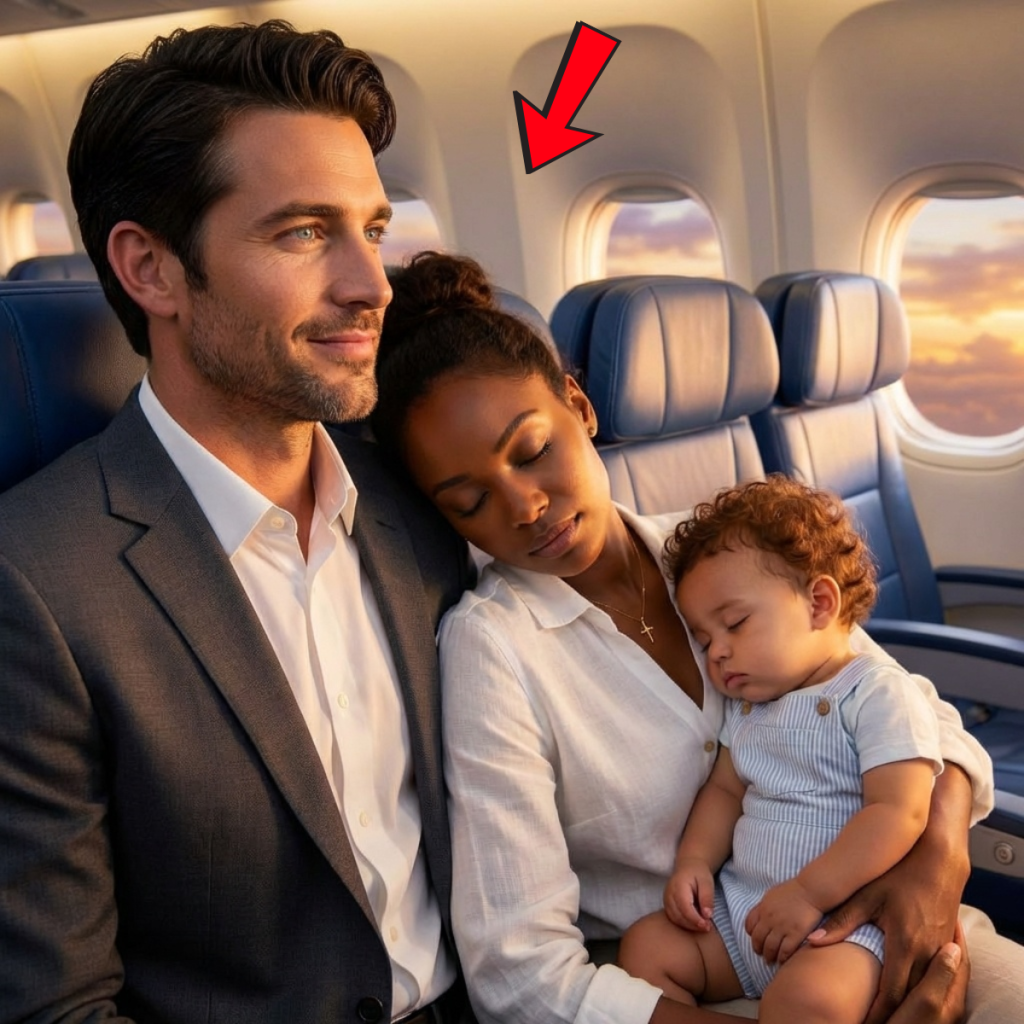
Night fell over the ocean. The cabin lights dimmed. Paola’s accumulated exhaustion was evident; her eyelids weighed a ton. Santiago had finally fallen asleep in her lap. Víctor noticed her nodding off uncomfortably and did something he never imagined he would. He lifted the armrest between them.
“Rest, Paola,” he whispered. “Lean on me. It doesn’t bother me. Sleep a little—you’ll need your strength when we arrive.”
Defeated by exhaustion, Paola rested her head on Víctor’s shoulder. He stayed perfectly still, breathing softly so as not to wake her. He felt the weight of that brave mother and her child, and in that stillness at thirty thousand feet, he felt a peace he hadn’t known in years. He felt useful. He felt human.
However, as the plane began its descent toward Barajas Airport and the first Spanish sunrise painted the clouds orange, Víctor couldn’t shake a sense of unease. He looked at the paper with the address Paola held like a sacred treasure, and a dark premonition tightened his stomach. The city below looked beautiful and promising, but Víctor knew that great cities also have sharp teeth, ready to devour the innocent.
When they landed, Víctor helped Paola with the diaper bag and carry-on luggage. He noticed her trembling slightly as they walked down the jet bridge toward immigration.
“Is someone coming to pick you up?” he asked, though he already knew the answer.
“No. Mrs. García said to take a taxi straight to this address,” she replied, trying to sound confident. “She said she’d be waiting for me with breakfast.”
They exited into the arrivals terminal. The bustle of Madrid welcomed them. Víctor had a company car waiting, but he couldn’t leave her like that.
“Paola, listen,” he said, stopping. “My driver is here. Let me take you. I know the city—it’s on the way to my house. It costs me nothing, and I’ll feel better knowing you arrive safely at the door.”
Paola tried to refuse out of courtesy, but the reality of being in a foreign country with a baby and two heavy suitcases made her accept gratefully. They got into the elegant black car. During the ride, Paola gazed out the window in fascination, pointing out buildings and parks to Santiago, dreaming about the life she was about to begin.
The car wound through the city center, turning onto increasingly narrow streets until it stopped in front of the number written on the paper. It wasn’t a luxury residential area, but it didn’t look dangerous either. It was an old building with an ochre façade.
“This is it,” Paola said, her heart pounding.
Víctor got out with her and asked the driver to wait. They walked to the entrance. Paola searched for the name “García” on the intercoms. It wasn’t there. There was a “González,” a “Pérez,” a dental clinic… but no García.
“That’s strange…” she murmured, feeling the first cold wave of panic. “Maybe the buzzer doesn’t have names. I’ll call her.”
She pulled out her phone, her fingers trembling as she dialed the number she knew by heart, putting it on speaker.
“The number you have dialed does not exist or is temporarily out of service. Please check…”
Paola hung up and dialed again. The same message. Once, twice, three times. The cold, mechanical voice was the only answer. Víctor watched as the color drained from Paola’s face.
“Maybe it’s the wrong number,” she whispered. “I’ll ask the concierge.”
Just then, a neighbor exited the building. Paola rushed toward her.
“Excuse me! Ma’am, I’m looking for Mrs. García, from 3B. I’m coming to work for her.”
The neighbor looked at her with confusion, then pity.
“Dear, a German student has lived in 3B for two years. There’s no Mrs. García here. And you’re not the first girl to come asking for her this week.”
The words hit Paola like a death sentence. The world stopped. The street noise faded, replaced by a deafening buzz in her ears. She looked at Víctor, then at her baby sleeping innocently in the stroller, and finally at the building that was supposed to be her home. Everything had been a lie—the job, the house, the promise. She was alone, on the other side of the world, without money and without shelter.
Paola felt her legs give way and collapsed to her knees on the cold sidewalk, covering her face with her hands as a heartbreaking sob tore from her chest—a sound of pure anguish that froze Víctor’s blood. What she didn’t know in that moment of absolute darkness was that this instant—the worst of her life—was about to become the foundation of something wonderful. Because sometimes you have to lose everything to find what truly matters.
Paola’s crying on that Madrid sidewalk was not just sadness; it was the sound of hope shattering into a thousand pieces. Víctor stood frozen for a second, watching this strong woman—who had crossed an ocean for her son—collapse under the cruelty of a vile scam. People passed by, some curious, others indifferent, but no one stopped.
Víctor felt a burning rage rise in his chest—rage at whoever had deceived her, rage at the injustice of the world. He knelt beside her, not caring that his thousand-euro suit was touching the dirty pavement.
“Paola, look at me,” he said firmly, placing a hand on her shoulder. “Paola!”
She lifted her tear-soaked face, her eyes red and swollen.
“I have nowhere to go, Víctor,” she sobbed. “I spent everything I had. I can’t afford a hotel. I can’t afford a ticket back. My son… what am I going to feed my son? I’m stupid, naïve…”
“You are not stupid,” he cut in. “You’re a mother who trusted because she needed to believe. And listen to me carefully: you are not alone. I will not leave you on this street. Not while I’m breathing.”
Víctor stood up and held out his hand.
“Get up. We’re going to fix this.”
“I can’t ask you for anything more—you’ve already done too much,” she sobbed, trying to preserve a shred of dignity.
“I’m not asking you, Paola. I’m telling you what we’re going to do.”
Víctor picked up the suitcases with fierce determination, signaled to the driver, and helped Paola back into the car.
“To the Hotel Palace,” he ordered.
“No, Víctor! That’s too expensive—I can’t pay for that,” she protested from the back seat, hugging Santiago, who had woken up and was starting to fuss.
“Please, be quiet,” he said gently. “Consider it a very long-term loan if that makes you feel better. Right now, you need a hot shower, a bed, and food for your child. Tomorrow, we’ll think about the rest.”
That night, Paola slept in a room larger than the entire house she had lived in back in Mexico. She couldn’t enjoy the luxury—fear still lingered. But knowing that Víctor was in a nearby room, that he had promised to help her, gave her the only relief possible.
The next day, Víctor didn’t go to his office. He canceled his meetings. He showed up at Paola’s door with a full breakfast and a planner in hand.
“Action plan,” he said, entering with renewed energy. “First, you can’t stay in a hotel forever—it’s not practical. I have a friend who owns a small apartment building in a quiet area. There’s one vacant. It’s yours for as long as you need it. I’ll cover the rent for the first few months.”
“Víctor, I… I don’t know how I’ll ever repay you. I’ll look for work—anything—cleaning floors, washing dishes…”
“I know you will. I know you’re hardworking. That’s why step two is this.”
Víctor took out his phone and dialed a number.
“Elena, it’s me. Yes, I need a favor. I have someone I trust completely—honest, hardworking, excellent with children. She needs a job now. Yes, today. Perfect.”
He hung up and smiled at Paola.
“You have an interview at three this afternoon. It’s a high-end domestic placement agency. My recommendation carries a lot of weight there. If you’re as good as I think you are, you’ll have a job before the week is over.”
And that’s exactly what happened.
Paola’s life took a 180-degree turn—not by magic, but through the radical solidarity of a man who chose to act. She got the job. She moved into the small apartment Víctor found for her. She worked from dawn to dusk, saving every cent, determined to repay every euro he had spent on her.
But the story didn’t end when the debt was paid.
Víctor started finding excuses to visit. At first, it was to “check that the apartment was okay.” Then to bring a toy he “happened to see and thought of Santiago.” Later, simply because it was Sunday and the idea of spending the day alone in his cold mansion was unbearable compared to the warmth of Paola’s small home.
Months passed and turned into a sweet routine. Víctor—the serious businessman—learned how to change diapers. He learned that Santiago liked mashed banana and hated peas. He learned to sit on the floor and build block towers just to watch the child knock them down in fits of laughter.
Paola, in turn, began to see Víctor not as her savior, but as the man he truly was. She saw how his face lit up when Santiago smiled at him. She saw the tenderness with which he looked at her when he thought she wasn’t noticing. She began to feel things she thought were long dead inside her—fear, yes, but also an undeniable attraction to his pure kindness.
The turning point came a year after her arrival. It was Santiago’s second birthday. Paola had organized a small party in Retiro Park. There were balloons, a homemade cake, and spring sunshine. Víctor was there, of course, camera in hand, capturing every moment like a proud father.
Santiago was running across the grass, chasing a ball. Suddenly, he tripped and fell face-first. The crying was immediate. Paola ran toward him, but from the ground, Santiago stretched out his arms in another direction.
“Daddy!” the child cried between sobs, looking straight at Víctor. “Daddy, ouchie!”
Time seemed to stop in the park. The birds fell silent. Paola froze mid-step. Víctor dropped the camera, which hung from his neck, and ran to the child. He lifted him into his arms, hugged him tightly, and kissed his bumped head.
“It’s okay, champ. It’s over. Daddy’s here,” Víctor whispered—and in saying those words, he realized they were true. They weren’t a biological title; they were a truth of the soul.
When Santiago calmed down and returned to playing, Víctor approached Paola. She looked at him with tear-filled eyes, biting her lip.
“I’m sorry, Víctor,” she said. “He hears the other kids at daycare and… he doesn’t know what he’s saying.”
Víctor shook his head and took Paola’s hands in his. His large, well-kept hands enveloped hers—small and rough from work.
“He knows exactly what he’s saying, Paola. And so do I.”
There was a silence charged with electricity, with feelings that had been growing like roots beneath the earth for an entire year.
“All my life I chased success,” Víctor continued, his voice hoarse. “I have houses, cars, bank accounts. But before meeting you and Santiago, I was the poorest man in the world. You gave me a wealth I didn’t know existed. You gave me a home.”
“Víctor… I’m a complicated woman. I come with baggage, with fears…” she began, fear surfacing one last time.
“You are the bravest woman I’ve ever known. And I love your baggage. I love that child as if he were my own. And I love you, Paola. I’ve loved you since you fell asleep on my shoulder on that plane—even if it took me a while to admit it. I don’t want to be just your friend. I don’t want to be just Santiago’s godfather. I want to be his father. I want to be your partner.”
Paola released the breath she’d been holding. All the walls she had built to protect herself collapsed before Víctor’s raw sincerity.
“I love you too,” she whispered. “I was so afraid you’d leave—that you’d get tired of playing family and go back to your real world.”
“You are my real world,” he replied.
And there, beneath Madrid’s ancient trees, they kissed. It wasn’t a movie kiss—it was better. It was a kiss of promise, of arrival, of two shipwrecked souls finally finding their harbor.
Life moved forward—fast and beautiful. They married six months later in an intimate ceremony. Víctor legally adopted Santiago, giving him his last name and, more importantly, his unconditional presence. Víctor’s real estate company continued to grow, but now he came home at six every evening without fail, to bathe the child and have dinner with his wife.
Three years after that fateful flight, the Agustín family returned to Barajas Airport—but the image was very different.
Víctor walked confidently, holding the hand of a five-year-old Santiago who wouldn’t stop talking about dinosaurs. Paola pushed a new stroller. Inside slept Valentina, the daughter they had together just a few months earlier. They were flying to Mexico on vacation so Paola’s mother could meet her grandchildren and see that her daughter had not only survived—but thrived.
While waiting to board, they passed by a gate where a flight had just arrived. People were exiting—tired, disoriented. Paola paused, watching a young woman with a backpack staring at a map, clearly lost.
Without saying anything, Paola approached her.
“Do you need help?” she asked with a smile.
“Yes, please. I’m a bit lost—I’m looking for the bus to the city center,” the girl replied.
Paola explained patiently, gave her a few tips, and before leaving, took out a pen and wrote a number on the girl’s map.
“If you have any trouble—any trouble at all—call this number. My husband and I know the city well. Have a good trip.”
She returned to Víctor’s side. He looked at her with pride and infinite love.
“Saving the world again?” he joked, kissing her forehead.
“Just paying a little of the favor back,” she replied, gazing toward the runway where planes lifted into the infinite sky. “Víctor, do you realize? If I hadn’t been scammed that day—if I hadn’t hit rock bottom—you would never have rescued me. We never would have fallen in love.”
Víctor looked at his children and then at his wife.
“Sometimes, Paola, God takes the ground from beneath our feet so we learn to use our wings. The scam was the abyss—but you already had wings. I only helped you open them.”
They boarded the plane. This time, they were traveling first class—together. But Víctor knew that even if they had to sit in the very last row, cramped and uncomfortable, he would still be the happiest man in the world—as long as they were by his side.
The story of Víctor and Paola reminds us that life is an unpredictable journey. That in airports, it’s not only suitcases that cross paths, but destinies. It teaches us that kindness is an investment that always returns multiplied, and that sometimes, when we think we’ve lost our way, we’re actually being redirected toward our true destination.
No matter how dark the night or how cold the ground where we fall—there is always, always a hand willing to lift us, if we have the courage to trust again. Because true love isn’t the one that finds you at the peak of success, but the one that reaches for you in the abyss and climbs with you, step by step, until you touch the sky.


Leave a Reply