A Little Girl Walked Six Police Dogs Through the Same Quiet Neighborhood Every Morning — Everyone Thought It Was Adorable Until Someone Followed Them and Discovered Where She Took the K9s and Why the Entire Operation Had Been Hidden
In Willowbend, a quiet Midwestern city tucked between a river and a stretch of old industrial land, mornings followed a rhythm people trusted. Porch lights clicked off. Coffee steamed through open kitchen windows. School buses coughed awake at the curb. Nothing ever really surprised anyone there—until the little girl appeared.
Every morning at exactly 7:12 a.m., just after the church bell rang once and before it rang again, she stepped onto Birch Lane.
She couldn’t have been more than five.
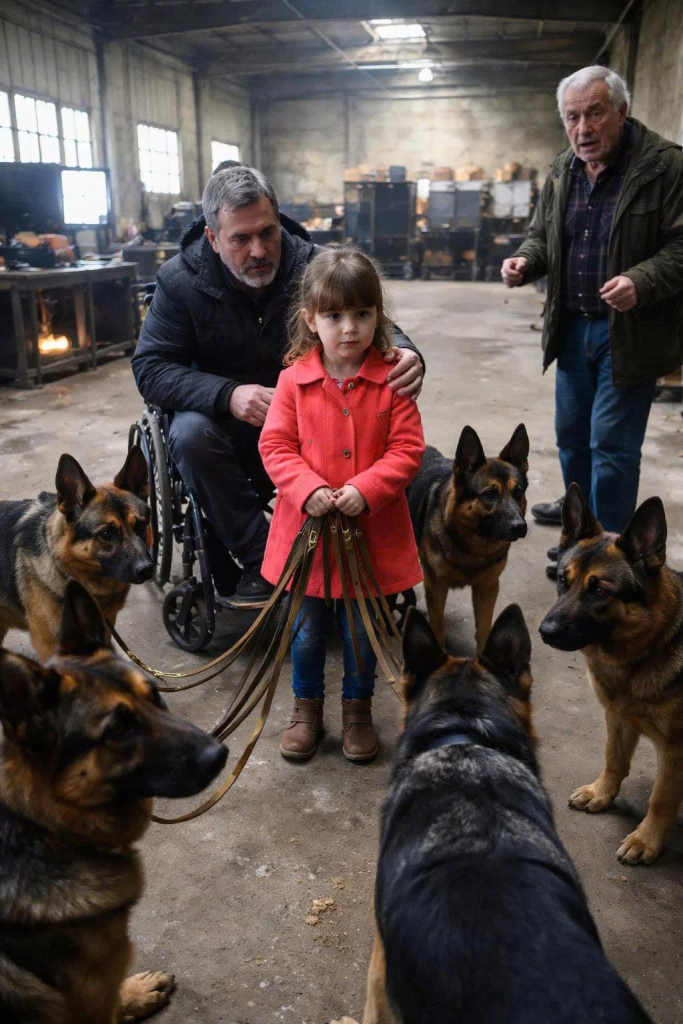
She wore the same bright coral coat every day, a little too big for her frame, the sleeves rolled once at the wrists. Her dark curls were always gathered into a loose ponytail that never quite stayed neat. And in her hands—hands barely large enough to hold a juice box—she gripped six thick leather leashes.
At the other ends of those leashes walked six full-grown German Shepherds.
Not pets.
Police dogs.
Anyone who had ever seen a K9 unit knew immediately. The way they moved—heads level, shoulders loose but ready, eyes scanning with quiet intent. Their pace matched one another perfectly, each step measured. They didn’t pull. They didn’t wander. They formed a curved perimeter around the girl like a living shield.
Cars slowed. Joggers stopped pretending not to stare. A barista once dropped an entire tray of cups.
At first, people smiled.
“Best babysitters in the world,” someone joked.
Then people whispered.
Those dogs didn’t act like retired K9s. They acted like they were still on duty.
If someone approached too fast, one of the dogs would drift subtly into their path. Not barking. Not growling. Just standing there, broad chest forward, eyes unblinking. It was enough.
The girl herself never spoke.
She nodded politely when waved at. She never smiled fully. She never cried. She never showed fear. Occasionally, she murmured something under her breath—soft, almost musical—and six elite-trained animals responded instantly.
People tried to guess her story.

“Her parent must be high-ranking law enforcement.”
“No way, those dogs are too sharp. Something’s off.”
“What kind of parent lets a kid do that alone?”
Videos appeared online. Millions of views. Comments flooded in.
That kid is safer than a bank vault.
Those dogs would walk through fire for her.
Why does she look like she’s protecting them, not the other way around?
But no one knew her name.
No one knew where the dogs came from.
And no one noticed where they went after the walk ended.
Until Arthur Bell noticed the patterns.
Arthur was sixty-eight, a widower, former federal auditor who’d spent his life finding things people tried very hard to hide. He lived near the edge of Willowbend, where neighborhoods gave way to shuttered factories and rusted gates. He didn’t follow gossip. He followed habits.
He noticed the dogs didn’t walk randomly.
They checked sightlines.
They paused at intersections exactly long enough for one dog to scan ahead before moving again.
They adjusted formation near certain houses and never near others.
And most telling of all, they always ended the walk at the same place: the abandoned Northline Warehouse.
On a bitter January morning, Arthur followed.
He stayed back far enough not to trigger the dogs’ defenses, using parked trucks and snowbanks as cover. The girl turned onto an access road no one used anymore and stopped at a heavy steel gate.
She reached into her coat and pulled out a key.
Arthur’s breath caught.
The gate opened.
The dogs slipped inside silently, not barking once.
Arthur waited, then followed.
Inside the warehouse, the air was warmer than it should have been. Portable heaters hummed. Solar batteries lined one wall. Monitors glowed softly, displaying street feeds, traffic cameras, timestamps.
And in the center of it all sat a man in a reinforced wheelchair.
Arthur recognized him instantly.
Micah Rowan.
Former K9 operations coordinator for the state. Declared lost during a river sting operation eight months earlier. Memorial held. Flag folded. Case closed.
Except here he was.
Alive.
His hair was thinner. His face older. His legs motionless beneath a blanket. But his eyes were sharp, focused, burning with unfinished business.
The little girl walked to him without hesitation.
“Morning, Dad,” she said quietly.
Her name was Rosie.
Arthur stepped forward before he could stop himself. The dogs reacted instantly, forming a wall between him and Rosie. Micah raised a hand.
“It’s alright,” Micah said. “He followed us, didn’t he?”
Arthur swallowed. “You were set up.”
Micah nodded once. “And I didn’t have anyone left to trust.”
Rosie climbed onto her father’s lap with practiced care. She handed him a small notebook filled with drawings and symbols—markers only she could have placed during the walks.
“She remembers everything,” Micah said softly. “Routes. Faces. Cars. Times.”
Arthur looked at the dogs again. Six of the best K9s the state had ever trained. All officially reassigned after Micah’s ‘death.’
“Why her?” Arthur asked.
Micah’s voice tightened. “Because they tried to finish the job. She was there. She heard things no child should have to hear. And after that… the dogs wouldn’t listen to anyone else.”
Rosie looked up. “They listen to me because I never lie to them.”
Arthur stayed.
And once he understood the full scope of what Micah and Rosie were doing, he helped.
The walks weren’t walks.
They were reconnaissance.
The dogs’ collars held cameras and data chips. They recorded conversations, movements, exchanges that didn’t belong in daylight. Rosie marked locations with chalk symbols only she and Micah understood. Every morning, evidence was collected in plain sight while the city smiled and filmed.
The people being mapped lived comfortably in Willowbend.
They assumed no one was watching.
They were wrong.
When the arrests came, they came fast.
Federal agents, not local.
Warrants airtight.
Evidence undeniable.
Micah Rowan was exonerated publicly. The officials who framed him faced sentencing quietly. The city watched in stunned silence as the truth unfolded—how a child had done what an entire system failed to do.
Rosie no longer walks alone.
Micah walks beside her now, braces supporting him, determination doing the rest.
The dogs still form a circle, but it’s relaxed now. Protective, not defensive.
People still stop and stare.
But now, when Rosie nods at them, she smiles too.
And Willowbend finally understands something it missed the first time.
Sometimes the smallest guardian is the strongest one in the pack.
Leave a Reply